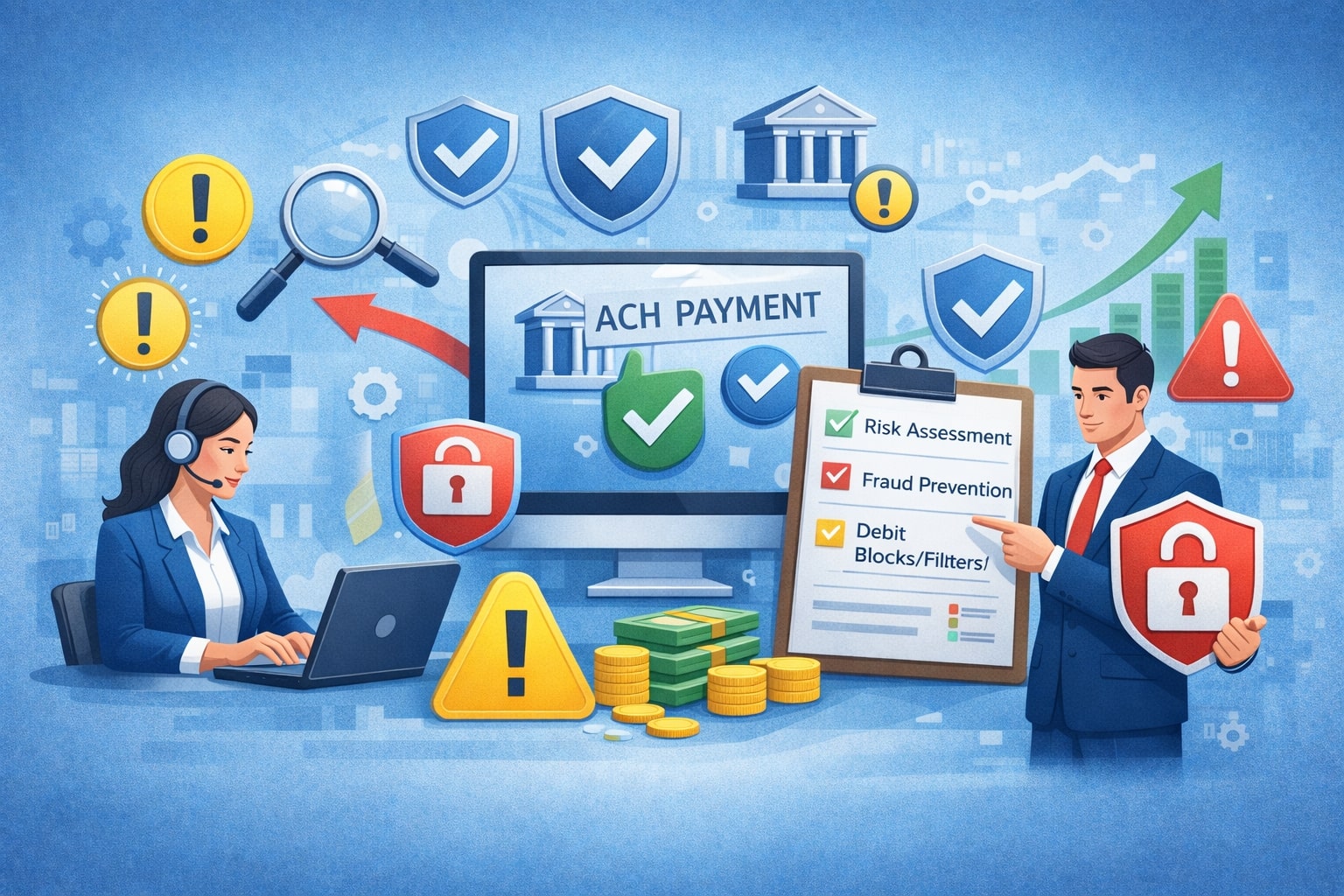
ACH is one of the most cost-effective ways to move money for payroll, vendor payments, subscriptions, loan collections, marketplaces, and account-to-account transfers. It’s also one of the easiest payment rails to underestimate—because when ACH works, it feels invisible.
But ACH risk is real, and it’s different from card risk. Disputes and returns operate on different timelines, fraud patterns often involve account data compromise or social engineering, and your exposure can spike fast when you scale volumes, expand to new customer segments, or automate onboarding.
This guide is a practical, business-first blueprint for ACH risk mitigation. You’ll learn how ACH risk actually shows up, which rules and thresholds matter most, what controls reduce returns and fraud, and how to build an ACH risk mitigation program that keeps you compliant while protecting margin and customer experience.
You’ll also get forward-looking predictions so your ACH risk mitigation stays durable as network rules and fraud tactics evolve.
Throughout this guide, “ACH risk mitigation” means reducing fraud, errors, returns, compliance issues, and operational failures—without making payments slower or frustrating for legitimate customers.
Understanding ACH: Where Risk Starts and How It Spreads
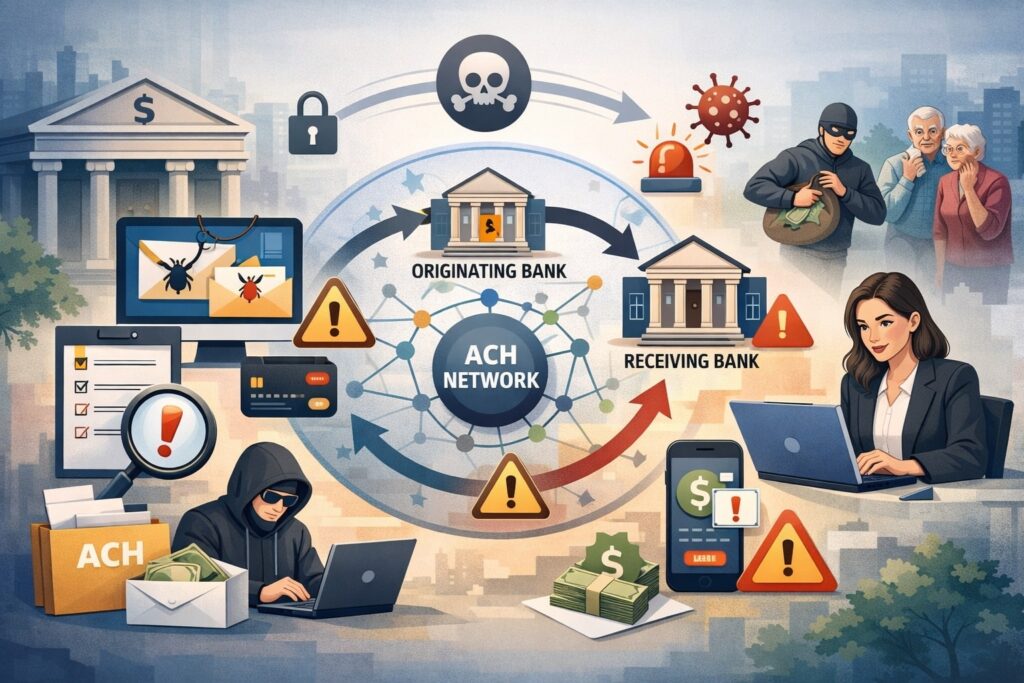
ACH risk mitigation begins with understanding how ACH flows through your business. ACH transactions are built from batches of entries (credits or debits) that move through a chain of parties—your business (the originator), your bank (ODFI), the network operators, the receiving bank (RDFI), and the receiving account holder.
Unlike card payments, where authorization happens instantly at the point of purchase, ACH often involves delayed settlement and different reversal mechanics.
This is why ACH risk mitigation is less about “approval” and more about preventing bad entries from being created in the first place.
Once a bad entry is released—wrong account number, wrong amount, unauthorized debit, or a payment sent because of a business email compromise—it may settle before you can react. Then your problem becomes: returns, chargebacks-like disputes, reputational harm, and sometimes account closure risk with your bank.
ACH risk mitigation also depends on whether you originate credits (push payments like payroll and vendor disbursements) or debits (pull payments like subscription billing and collections).
Credits are heavily targeted by social engineering (invoice fraud, vendor impersonation). Debits are heavily targeted by stolen account data, identity mismatch, and “friendly fraud” disputes. A serious program treats these as different risk domains with shared governance.
Parties in the ACH chain and what each one expects
From a risk standpoint, you’re not operating alone. Your bank and any platform partners are evaluating your ACH risk mitigation maturity continuously—sometimes through explicit monitoring, sometimes through subtle “risk friction” like increased reserves, payout delays, or onboarding freezes.
Your bank typically expects you to have clear authorization language (for debits), a consistent onboarding and verification flow, and strong return management. Nacha’s Operating Rules set the foundation for responsibilities across participants, and new rulemaking trends are pushing more fraud monitoring expectations toward originators and third parties.
For businesses, the lesson is simple: if you don’t define your own ACH risk mitigation controls, someone else will define them for you—often in ways that are costly or disruptive.
Settlement timing, return windows, and why “it cleared” doesn’t mean “it’s safe”
A common ACH misconception is that once a payment “posts,” the risk is gone. ACH risk mitigation must account for returns and disputes that can appear after settlement.
Returns can occur for administrative reasons (wrong account, closed account), authorization reasons (customer claims unauthorized), or other categories. These returns create operational load, fees, and customer support escalations.
That’s why effective ACH risk mitigation has two layers:
- Pre-origination controls (identity, account validation, authorization capture, limits).
- Post-origination controls (monitoring, return analytics, rapid response workflows).
When you treat ACH like “set it and forget it,” you tend to discover risk only when thresholds are breached, bank relationships are strained, or customers complain. A disciplined ACH risk mitigation approach spots the early warning signals—like return-rate drift, sudden changes in transaction size, or anomalies in onboarding conversion.
The Rules and Standards That Shape ACH Risk Mitigation

ACH risk mitigation isn’t just best practice—it’s heavily influenced by network rules, bank expectations, and data protection requirements. The most important foundation is the Nacha Operating Rules, which govern how ACH participants send entries, validate information, manage exceptions, and enforce risk standards.
Nacha also publishes rule updates by effective date, and these changes matter because they often shift operational expectations even when liability frameworks stay stable.
For businesses, “compliance” in ACH risk mitigation is practical: it determines whether your bank and partners let you scale, and it impacts how quickly issues escalate when something goes wrong.
Return-rate thresholds, enforcement pressure, and why metrics are compliance
One of the most important compliance dimensions in ACH risk mitigation is return-rate performance. Nacha has long used return-rate thresholds as an enforcement tool, and unauthorized debit thresholds have been reduced over time (commonly referenced at 0.5% for unauthorized debits, with separate administrative and overall thresholds).
Even if you are not directly audited, your bank is watching these metrics because they signal origination quality and potential fraud. A mature ACH risk mitigation program treats return rates like product KPIs:
- You track them daily/weekly, not monthly.
- You segment by customer cohort, use case, channel, and partner.
- You tie them back to root causes (bad data, weak authorization, fraud cluster).
This transforms ACH risk mitigation from a reactive function into a growth enabler—because fewer returns means lower cost, better bank confidence, and fewer customer disputes.
Account validation and data protection expectations for WEB and beyond
Modern ACH risk mitigation increasingly includes account validation and stronger data protection—especially for internet-initiated (WEB) activity.
Nacha has published guidance and resource centers highlighting account validation as a best practice for all organizations sending payments, reflecting the broader shift toward reducing misdirected payments and preventing account-data misuse.
In parallel, industry communications and bank guidance show a continued emphasis on protecting deposit account information, especially where account numbers are stored or transmitted for web-based debits.
While implementations vary (micro-entries, third-party validation tools, bank APIs, risk-based validation), the direction is consistent: ACH risk mitigation is moving “left,” closer to onboarding and data handling, not just transaction monitoring.
For businesses, the action is straightforward: if you originate WEB debits at scale, treat account validation and secure storage as core—not optional.
The ACH Risk Landscape: Fraud, Errors, Returns, and Operational Failure Modes

ACH risk mitigation works best when you classify risks clearly. Many businesses treat “returns” as the problem, but returns are a symptom. The real root causes usually fall into a small set of categories.
First, there’s fraud risk: stolen account credentials, identity mismatch, mule accounts, and social engineering that convinces staff to send credits to a fraudster. Second, data quality risk: incorrect routing/account numbers, mismatched account types, stale customer data, and onboarding typos.
Third, authorization and consent risk: unclear debit authorization, weak proof of authorization, and disputes that are difficult to defend. Fourth, operational risk: file errors, duplicate batches, cutoff-time misses, and breakdowns in change management.
And finally, third-party and compliance risk: vendors, payment processors, and upstream partners whose controls determine your outcome.
In a strong ACH risk mitigation program, each category has an owner, playbooks, and measurable controls.
Debit vs. credit risk: why the playbooks should be different
Debit-focused ACH risk mitigation emphasizes authorization integrity, account validation, and return prevention. Common problems include unauthorized claims, closed accounts, NSF patterns, and “test” behavior where bad actors probe amounts.
Credit-focused ACH risk mitigation emphasizes change control and fraud prevention against impersonation. The highest-impact losses often occur when a fraudster convinces your team to update bank details for a vendor or employee—classic invoice redirection and business email compromise.
Nacha has explicitly pointed to frauds like BEC that use credit-push payments and approved new rules intended to reduce that incidence by establishing baseline monitoring expectations for ACH parties (excluding consumers).
So if your current ACH risk mitigation plan treats debits and credits the same, you’re likely over-controlling low-risk areas and under-controlling high-risk ones.
WEB, CCD, PPD, and use-case segmentation that actually reduces losses
Not all ACH entries behave the same. WEB debits often carry higher fraud exposure due to remote onboarding and higher account-data compromise risk.
CCD entries (business-to-business) may have fewer consumer-style disputes but can have larger ticket sizes and higher “single-event loss.” PPD payroll is often stable, but vendor changes and HR impersonation can create targeted risk.
Effective ACH risk mitigation uses segmentation:
- Separate limits and monitoring rules by SEC code and channel.
- Track return-rate and dispute patterns by customer type.
- Apply stricter validation to high-risk entry types, not universally.
This approach keeps your ACH risk mitigation strong without unnecessarily lowering conversion.
Building an ACH Risk Mitigation Program: Governance, Ownership, and Controls
ACH risk mitigation is not a single tool. It’s a management system. The fastest-growing businesses get into trouble when ACH “belongs to everyone,” which usually means it belongs to no one. The fix is governance: defined ownership, documented policies, and clear escalation paths.
Start by appointing an ACH risk owner (or a small committee) responsible for return-rate performance, fraud response, bank communications, and control design. Then define: what “good” looks like, what metrics you review, and what triggers action.
A practical ACH risk mitigation governance model includes:
- Policy: what you allow, what you restrict, and why.
- Procedures: how onboarding works, how bank changes are approved, how exceptions are handled.
- Controls: validation, limits, monitoring, and audit trails.
- Reporting: return-rate dashboards, fraud trend reviews, and bank-ready summaries.
This structure is also how you prove to banks that you’re safe to scale—because ACH risk mitigation is as much about demonstrating control as it is about having control.
Originator due diligence: what you must know about customers before you pull funds
For debit origination, ACH risk mitigation requires clarity on customer identity and authorization. If you can’t confidently answer “who is this,” “why are we debiting,” and “what proof do we have,” you’re exposed to returns and disputes.
Strong due diligence includes:
- Identity verification aligned to your risk tier (lightweight for low limits; stronger for high limits).
- Ownership and bank-account relationship checks where feasible.
- Clear description of goods/services and billing cadence.
- A signed or digitally captured authorization with audit logs.
Even if your business model is subscription-like, don’t assume recurring equals low risk. Fraudsters love predictable billing systems because they can blend in. Good ACH risk mitigation uses risk-tiering and keeps friction proportionate.
Third-party management: platforms, service providers, and shared accountability
Many businesses outsource ACH operations—payment facilitators, processors, gateways, onboarding tools, and data storage providers. But you can’t outsource accountability. In ACH risk mitigation, third parties can create concentrated risk: one misconfigured integration can produce thousands of bad entries.
Your third-party ACH risk mitigation checklist should include:
- Contractual clarity on monitoring and incident response.
- Data protection expectations for account information.
- Required reporting (return-rate data, NOCs, fraud flags).
- Vendor change management and access controls.
Even when rules don’t shift liability, banks often hold the originator ecosystem accountable through underwriting and ongoing monitoring. That makes third-party oversight a direct business continuity issue.
Account Validation and Onboarding Controls That Prevent Returns and Fraud
If you want the biggest ROI in ACH risk mitigation, focus on onboarding and account validation. Monitoring can catch problems, but validation prevents them from ever becoming transactions.
Account validation reduces administrative returns (wrong account, closed account), and it reduces fraud by making it harder to use stolen or synthetic bank details. It also improves customer experience because fewer payments fail.
Nacha has emphasized account validation as a best practice and provides resources that reinforce the importance of ensuring payments are received in or from the proper account.
The best onboarding-based ACH risk mitigation is layered—no single method is perfect, but combined methods dramatically reduce risk.
Commercially reasonable validation for online debits: what “good” looks like in practice
In practice, commercially reasonable validation typically means you use one or more methods appropriate to your risk:
- Micro-entries (verification of small deposits/withdrawals).
- Instant account verification through bank login flows (where permitted).
- Third-party database validation and account status checks.
- Risk-based step-up: validate more strictly when risk signals are higher.
A key ACH risk mitigation principle here is change sensitivity. Many fraud events happen not at initial onboarding, but when account details change. Treat account updates as high risk: step-up verification, impose cooling-off periods for large transfers, and require out-of-band confirmation for sensitive profiles.
This is also where your data handling matters. If you store bank data, your ACH risk mitigation must include encryption, access control, and strong vendor governance to reduce exposure in a breach scenario.
Smarter onboarding: limits, holds, and staged trust instead of “approve everyone”
A common mistake is using onboarding as a binary gate: approve or deny. Better ACH risk mitigation uses staged trust:
- New accounts start with lower limits.
- First few transactions have tighter monitoring.
- Limits increase automatically only after successful payment history.
- Suspicious patterns trigger manual review.
This reduces fraud losses while preserving conversion. It also protects you from “volume shock,” where a fraud cluster hits many new accounts at once.
You can also add subtle ACH risk mitigation controls that don’t feel like friction, such as:
- Confirming account type selection (checking vs savings).
- Validating name consistency when available.
- Requiring clear billing descriptors and customer acknowledgments.
Small checks can prevent large operational fires.
Fraud Monitoring and Anomaly Detection for ACH Risk Mitigation
Transaction monitoring is where many businesses start, but it should be the second line of defense—after onboarding and validation. Still, monitoring is essential because not all risk can be blocked upfront.
Effective ACH risk mitigation monitoring combines three approaches:
- Rules (hard constraints like max amount, max velocity).
- Behavioral analytics (deviation from normal patterns).
- Network feedback loops (returns, NOCs, bank alerts).
Nacha’s rule direction has emphasized broader fraud monitoring expectations in response to credit-push frauds like BEC. That same mindset applies operationally: you need monitoring that covers both debits and credits.
Rule-based controls: the essentials that should exist even in small programs
Rule-based ACH risk mitigation is the baseline. Even without machine learning, you can catch most obvious fraud and error patterns with a good ruleset:
- Velocity limits (per customer, per account, per day).
- Ticket-size limits (especially for new accounts and new payees).
- Country/region mismatch detection for device or login signals (if applicable).
- Duplicate detection (same amount + same receiver + short time window).
- Off-hours submission patterns (sudden batch creation at unusual times).
The key is governance: every rule should have an owner, a reason, and a review cadence. Otherwise rules accumulate, false positives rise, and teams start bypassing controls—breaking the ACH risk mitigation system.
Also, rules should be segmented by use case. Payroll has different patterns than subscription billing. Vendor payments differ from refunds. Segmentation is how ACH risk mitigation stays effective without blocking legitimate flow.
Return-rate analytics as fraud detection: the cheapest signal you’re probably underusing
Returns are not just an outcome metric—they are a detection signal. A spike in unauthorized returns can indicate compromised onboarding channels, account takeover, or poor authorization processes. Administrative return spikes often indicate data quality problems or validation failure.
That’s why mature ACH risk mitigation treats return analytics like security telemetry:
- Monitor unauthorized returns as a leading indicator of fraud.
- Monitor administrative returns as a leading indicator of process weakness.
- Tie returns back to cohorts: marketing channel, signup method, product SKU, geography, and device.
Many ACH programs discover that 70–90% of their problems come from a small set of cohorts. When you fix those, you reduce losses dramatically without changing the whole business.
Managing Returns, NOCs, and Disputes Without Burning Your Ops Team
ACH risk mitigation isn’t complete unless your exception process is strong. Returns and NOCs (Notifications of Change) are part of everyday ACH operations. Weak handling leads to compounding failures: repeated returns, customer frustration, rising bank scrutiny, and internal chaos.
A robust return workflow includes intake, classification, customer communication, remediation, and prevention feedback. Every return should end with an answer to: “What control would have prevented this?”
A practical ACH risk mitigation return process includes:
- Automated categorization by return type.
- Clear playbooks for high-risk codes (unauthorized, stop payment, account closed).
- Fast customer support scripts to reduce disputes and confusion.
- Root-cause tagging that flows back to onboarding and monitoring teams.
Return-rate thresholds are widely used in ACH oversight, and businesses that drift toward threshold levels often face increasingly strict bank interventions. So your return process is not just operations—it’s relationship management.
Unauthorized returns: building defensible authorization and reducing “friendly fraud”
Unauthorized claims are a core pain point for debit originators. Strong ACH risk mitigation reduces these in two ways:
- Better authorization capture: clear language, affirmative consent, timestamp, IP/device logs, and easy retrieval.
- Better customer experience: clear descriptors, reminders, and support paths so customers don’t default to “unauthorized.”
Many disputes come from confusion: a customer doesn’t recognize the descriptor, forgets the subscription, or doesn’t understand the billing schedule. Your ACH risk mitigation plan should include “descriptor design” and billing communications as risk controls.
For higher-risk segments, add step-up confirmation (SMS/email confirmation, or a pre-note style confirmation), and ensure cancellations are easy. The easiest way to prevent unauthorized returns is to prevent customers from feeling trapped.
NOCs and data correction: preventing the “repeat failure” loop
NOCs are “fix this data” messages from the receiving side—often correcting account numbers, routing details, or account type. Treating NOCs as optional is one of the fastest ways to inflate administrative returns.
Strong ACH risk mitigation makes NOCs operationally boring:
- Route NOCs into a ticketing workflow.
- Update customer records promptly.
- Confirm the update doesn’t conflict with other verification signals.
- Retest with small amounts or staged limits if the change is material.
When you operationalize NOCs well, you reduce future returns, protect customer experience, and improve bank confidence.
Security Controls for ACH Risk Mitigation: Protect Data and Stop Social Engineering
A large share of ACH losses come from security weaknesses that aren’t “payments problems” on the surface. Credential theft, malware, and social engineering can lead to unauthorized origination, account changes, and fraudulent credits.
So ACH risk mitigation must include security controls across people, process, and technology.
This is especially critical for credit-push fraud patterns like business email compromise, where staff are tricked into sending funds to a fraudulent account. Nacha has specifically highlighted credit-push frauds such as BEC as a driver for new monitoring-focused rules.
Payment change controls: the “two-channel verification” standard you should adopt
The simplest high-impact ACH risk mitigation control for credits is: never accept bank detail changes through a single channel.
If a vendor emails “we changed banks,” you don’t update from the email. You verify through a second channel already on file (phone number from your system, vendor portal login, or a documented callback process). This one control prevents many of the highest-value ACH fraud events.
For internal payroll changes, apply the same logic:
- Require multi-factor authentication to access payroll settings.
- Require manager approval for changes above a threshold.
- Create automated alerts when bank details change.
- Impose a short cooling-off period before large disbursements to newly changed accounts.
Treat change control as core ACH risk mitigation, not as an admin step.
Data protection: encrypt, restrict, audit, and minimize bank data exposure
If your systems store routing/account numbers, your ACH risk mitigation program must include strong data protection:
- Encrypt bank data at rest and in transit.
- Restrict access via least privilege (only those who must see it).
- Use tokenization or vaulting where possible.
- Audit access logs and alert on unusual access patterns.
- Minimize data retention (keep only what you need).
Even if you never experience a breach, banks and partners increasingly expect a defensible story on how you protect deposit account information—especially for web-based onboarding and recurring debits.
Incident Response and Business Continuity for ACH Risk Mitigation
No matter how strong your controls are, incidents can still happen. The goal of ACH risk mitigation is not perfection—it’s fast containment and minimal loss.
Your incident response plan should be written, practiced, and measurable. It should define what constitutes an ACH incident (fraud burst, file duplication, compromised credentials, high return spike), who is responsible, and what immediate actions are allowed.
A strong ACH risk mitigation incident response includes:
- Detection: alerts for abnormal volumes, unusual approvals, return spikes.
- Containment: ability to pause origination, freeze accounts, stop files.
- Investigation: logs, customer cohorts, IP/device signals, employee access history.
- Communication: bank notification, customer messaging, internal leadership updates.
- Recovery: remediation, rule updates, training, and post-mortem.
Rapid containment steps that reduce loss in the first 60 minutes
When an ACH incident occurs, speed matters. Your first-hour ACH risk mitigation checklist should be operational and unambiguous:
- Pause new ACH originations for affected segments.
- Disable compromised credentials and rotate keys/tokens.
- Identify the earliest suspicious transaction and pivot forward/backward.
- Notify your bank contact if exposure is significant or ongoing.
- Preserve logs and evidence before making system changes.
These steps reduce both financial loss and downstream chaos. They also build credibility with banks and partners—because fast containment signals maturity.
Post-incident improvements: turning a painful event into a stronger control system
After containment, the most important part of ACH risk mitigation is learning. Many businesses repeat the same incident because they “move on” without structural fixes.
Your post-incident process should include:
- Root-cause analysis (what control failed, what signal was missed).
- Control redesign (new limits, stronger validation, better approvals).
- Monitoring upgrades (new alerts, better segmentation).
- Training updates (especially for BEC and vendor change control).
Done well, each incident makes your ACH risk mitigation program stronger—and reduces the chance of a catastrophic repeat.
Future Predictions: Where ACH Risk Mitigation Is Headed Next
ACH is evolving. Fraud tactics evolve. Rule expectations evolve. Businesses that treat ACH risk mitigation as static will be surprised. Businesses that treat it as a living program will scale faster with fewer disruptions.
One clear direction is expanded fraud monitoring expectations across network participants. Nacha-approved rules aimed at reducing credit-push fraud emphasize baseline monitoring responsibilities beyond consumers.
In addition, bank and industry guidance points toward more structured fraud monitoring rule changes taking effect in 2026, with phased applicability.
Another direction is stronger onboarding and validation expectations, especially for online debits. Account validation is being normalized as a best practice, and businesses that adopt it early will face less friction as requirements tighten.
Preparing for 2026-style fraud monitoring expectations: a practical roadmap
If you want future-proof ACH risk mitigation, build toward these capabilities:
- Documented fraud monitoring program with clear ownership.
- Standardized risk-tiering for customers and use cases.
- Stronger anomaly detection for both debits and credits.
- Evidence-ready logging (why a transaction was allowed, what checks were applied).
- Third-party oversight and reporting that matches your origination model.
Banks and networks prefer consistency. When your ACH risk mitigation program is coherent, partners can underwrite and support your growth more confidently.
AI, instant payments, and what changes in ACH risk mitigation strategy
Fraudsters are using automation and AI to scale impersonation, synthetic identity creation, and targeted social engineering. At the same time, businesses are adopting instant and real-time payment rails for speed.
That combination increases the value of preventive controls—because once money moves instantly, recovery becomes harder.
So the future of ACH risk mitigation is likely to emphasize:
- Strong identity and account ownership signals.
- Better change-control and multi-channel verification.
- Continuous monitoring across payment rails, not just ACH.
- More formal “payment security” training for finance and ops teams.
In other words, ACH risk mitigation becomes part of a broader payment risk strategy—where policies and monitoring cover ACH, wires, real-time payments, and card payouts as one integrated system.
FAQs
Q.1: What is ACH risk mitigation, and why do businesses need it?
Answer: ACH risk mitigation is the set of policies, controls, and monitoring practices that reduce losses and operational damage from ACH fraud, returns, disputes, compliance issues, and processing errors.
Businesses need ACH risk mitigation because ACH behaves differently than card payments: settlement timing is different, return and dispute mechanics are different, and common fraud patterns often involve account data compromise or social engineering rather than stolen card numbers.
Without a defined ACH risk mitigation program, businesses usually discover problems late—after return rates increase, customers complain, or banks intervene.
At that point, the “fix” is often painful: tighter bank limits, delayed payouts, higher reserves, or even termination of origination privileges. Strong ACH risk mitigation prevents that by catching risk early and preventing bad entries from ever being sent.
ACH risk mitigation also supports growth. When your return rates stay healthy and your controls are documented, you can expand volumes, onboard new segments, and launch new ACH use cases with less friction. So ACH risk mitigation isn’t just defensive—it’s a competitive advantage that protects margin and improves reliability.
Q.2: What are the most common causes of ACH returns, and how do we reduce them?
Answer: The most common ACH return drivers include incorrect account information, closed accounts, insufficient funds, authorization disputes (especially for debits), and repeated failures due to unprocessed NOCs. Reducing these requires a layered ACH risk mitigation approach.
Start with onboarding controls: validate account numbers, reduce data-entry errors, and step up verification for high-risk profiles. Then build transaction controls: limit first-transaction size, apply velocity caps, and monitor for unusual behavior.
Finally, strengthen operational handling: process NOCs quickly so you don’t keep sending entries that will fail.
A mature ACH risk mitigation program also uses return analytics for prevention. When returns spike, you don’t just “handle” them—you identify the cohort causing the spike and fix the root cause (channel abuse, weak validation, confusing descriptors, or unclear authorization). Over time, this makes returns predictable and manageable instead of chaotic.
Q.3: How do we prevent business email compromise and vendor payment fraud with ACH credits?
For ACH credits, the biggest ACH risk mitigation control is change control. Many major losses occur when a fraudster convinces staff to change vendor bank details. The best defense is a strict “two-channel verification” standard: never accept bank changes through a single channel like email.
Use a callback procedure to a known contact method already on file, require dual approval for bank changes, and trigger automated alerts for any updates. Add cooling-off periods for large payments to newly changed accounts, especially for high-value vendors. Ensure finance team accounts have strong authentication and least-privilege access.
Nacha has cited credit-push frauds like BEC as a key risk area, and rulemaking trends emphasize baseline monitoring expectations across ACH participants.
That direction reinforces the practical reality: ACH risk mitigation for credits must focus on preventing impersonation and unauthorized change events long before the payment file is created.
Q.4: What account validation methods work best for ACH risk mitigation?
No single method is perfect, so the best ACH risk mitigation uses layered validation. Micro-entries are widely used and effective for verifying account access, but they add time.
Instant verification flows can improve conversion and reduce fraud, but require careful security and vendor selection. Third-party validation services can help detect invalid accounts and reduce administrative returns.
The “best” method depends on your use case, transaction size, and customer risk profile. For low-risk, low-limit use cases, lightweight validation may be enough. For higher-risk scenarios (high ticket size, remote onboarding, fast payouts), you should apply stronger validation and staged limits.
Nacha’s account validation resources reflect the broader shift toward making validation a normalized best practice for organizations sending payments.
From an ACH risk mitigation standpoint, the goal is the same: reduce misdirected payments, reduce failed debits, and make it harder for fraudsters to use compromised account data.
Q.5: What metrics should we track to know if our ACH risk mitigation is working?
Answer: The best ACH risk mitigation metrics combine outcomes and leading indicators. Outcomes include unauthorized return rate, administrative return rate, overall return rate, and total loss from fraud. Leading indicators include first-payment failure rate, NOC volume, abnormal velocity alerts, and onboarding conversion anomalies.
Track metrics by segment: product, SEC code, customer cohort, signup channel, and partner. A single blended number can hide concentrated risk. For example, your overall return rate might look fine, while a new marketing channel is producing a dangerous unauthorized spike.
Also track operational metrics: time to resolve NOCs, time to respond to incidents, and percentage of bank detail changes that followed the approved verification workflow. When these process metrics improve, ACH risk mitigation becomes sustainable—because you’re preventing problems rather than fighting fires.
Q.6: What should we do now to prepare for future ACH risk mitigation expectations?
To prepare for future expectations, treat ACH risk mitigation as a formal program, not an ad hoc set of rules. Document your controls, assign owners, and build reporting that you can share with banks and partners. Implement risk-tiering, strengthen account validation and change control, and improve monitoring for both debits and credits.
Also build incident response capability: the ability to pause origination, investigate quickly, and communicate clearly. As fraud monitoring expectations expand and rule changes take effect in phases, businesses with clear documentation and disciplined processes will face less disruption.0
Bank guidance and industry commentary point to meaningful fraud monitoring rule changes landing in 2026, so building now is the easiest path to readiness.
The short version: future-proof ACH risk mitigation means investing in prevention, governance, and evidence-ready monitoring—not just handling returns after the fact.
Conclusion
ACH can be a growth engine—but only if you manage it like a system. The most effective ACH risk mitigation strategy starts before a transaction exists: strong onboarding, account validation, clear authorization, and disciplined change control.
Then it adds monitoring and analytics that catch anomalies early, plus operational excellence in returns, NOCs, and incident response.
If you want a practical blueprint, focus on five pillars of ACH risk mitigation:
- Governance: ownership, policies, escalation paths, and bank-ready reporting.
- Validation: account verification and staged trust to reduce preventable failures.
- Monitoring: segmented limits, anomaly detection, and return-rate analytics as signals.
- Operations: fast NOC processing, return playbooks, and customer-friendly dispute handling.
- Security: least privilege, encryption, and two-channel verification to defeat impersonation.
Finally, keep your ACH risk mitigation program forward-looking. Rule expectations and fraud patterns are evolving—especially around credit-push fraud and broad monitoring responsibilities. Businesses that adopt these controls now will scale with fewer interruptions, lower loss rates, and stronger partner confidence.
Leave a Reply