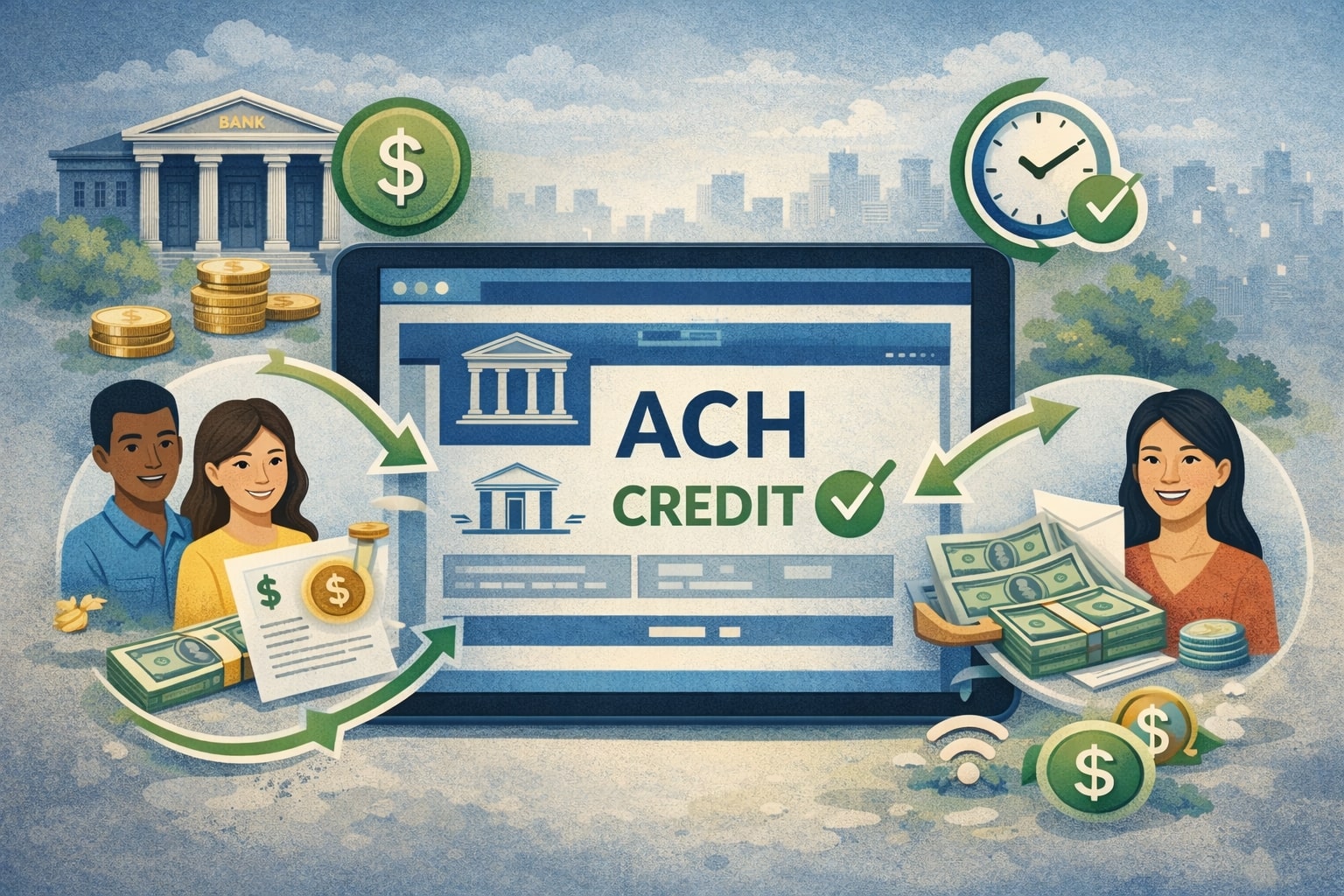
An ACH credit is a type of electronic bank transfer that pushes money from the sender’s bank account to the recipient’s bank account through the Automated Clearing House (ACH) Network.
In plain terms, the sender authorizes their bank (or payment provider) to send funds out, and the recipient receives those funds—typically on the next banking day, or sooner if the transfer is eligible for Same Day ACH.
You’ll see ACH (Automated Clearing House) credit used for direct deposit payroll, vendor payments, insurance claim payouts, tax refunds, gig-worker payouts, and many other situations where a business or individual needs a predictable, low-cost way to move money between bank accounts.
The ACH Network is designed for batch processing (transactions are grouped and processed in cycles), which is a big reason ACH credit is usually cheaper than wire transfers while still being highly scalable.
Because “ACH credit” is both a payment term and a daily-business tool, understanding it isn’t just about definitions. To use ACH (Automated Clearing House) credit well—and avoid delays, returns, and risk—you need to know how the ACH system routes transactions, what information is required, how timing works, and what rule changes are coming next.
ACH Credit Meaning: The “Push Payment” Explained
The core idea behind an ACH credit is simple: the payer initiates the payment. That’s why it’s often described as a push transaction. The sender (an employer, a business, a government agency, or an individual) instructs their financial institution to send money to a recipient.
This differs from a pull-style transaction, where the payee requests funds from the payer (that’s typically an ACH debit).
An ACH (Automated Clearing House) credit typically includes:
- Bank routing information (routing number) and an account number
- Amount
- Effective entry date (the date the sender wants it to settle)
- Transaction type and codes (such as payroll, vendor payment, consumer payment)
- Addenda information (optional but extremely useful for reconciliation in business payments)
In practice, ACH credit is popular because it balances cost, reliability, and coverage. The ACH Network is widely used for everyday financial transfers and is considered a backbone payment rail for domestic account-to-account movement.
From an operational standpoint, ACH (Automated Clearing House) credit is also easier to scale than many alternatives. Businesses can send thousands of ACH credit entries in a single batch file, automate payment scheduling, and attach addenda data so the recipient can match payments to invoices.
If your goal is to reduce check printing, mailing delays, and manual reconciliation, ACH credit is often the first place to look.
How an ACH Credit Works Step by Step (ODFI, RDFI, and ACH Operators)
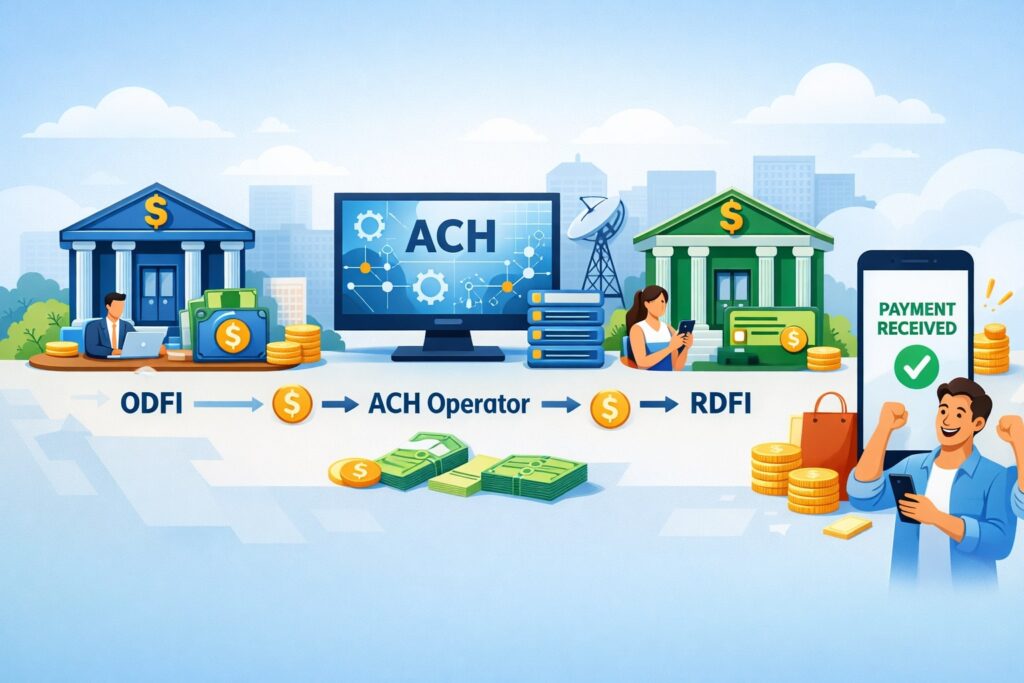
An ACH credit moves through a structured flow with defined participants. Understanding the roles below is the fastest way to diagnose why an ACH (Automated Clearing House) credit is “pending,” delayed, or returned.
1) Originator and ODFI: Where the ACH Credit Begins
The originator is the party sending money (for example, an employer paying wages). The originator works with an ODFI (Originating Depository Financial Institution). The ODFI is the bank (or the bank behind a payment provider) that accepts the payment instructions, applies risk controls, and transmits the ACH file into the network.
At this stage, the originator or their provider formats a batch of ACH (Automated Clearing House) credit entries and submits it for processing. Because ACH is a batch-based system, originators often send files on schedules—daily payroll runs, weekly vendor runs, or multiple disbursement windows per day for marketplaces.
2) ACH Operator: Routing and Clearing Through the Network
After the ODFI submits the file, it goes to an ACH Operator. There are two national operators commonly referenced: the Federal Reserve’s ACH service (FedACH) and EPN, which is operated by The Clearing House.
The ACH Operator:
- Validates and sorts entries
- Routes entries to the appropriate receiving institutions
- Manages processing windows and settlement schedules
This is where timing becomes real: your ACH credit’s speed depends on when your file is submitted relative to processing deadlines and whether it qualifies for Same Day ACH windows.
3) RDFI and Receiver: Funds Post to the Destination Account
On the receiving side, the RDFI (Receiving Depository Financial Institution) receives the entries and posts them to the receiver’s account based on ACH posting rules, internal bank processes, and the effective entry date. If account details are wrong or the account is closed, the RDFI can return the ACH credit.
This end-to-end structure is why ACH credit is dependable at scale: clear roles, standardized files, and centralized operators that route transactions efficiently.
ACH Credit vs ACH Debit: Key Differences That Matter
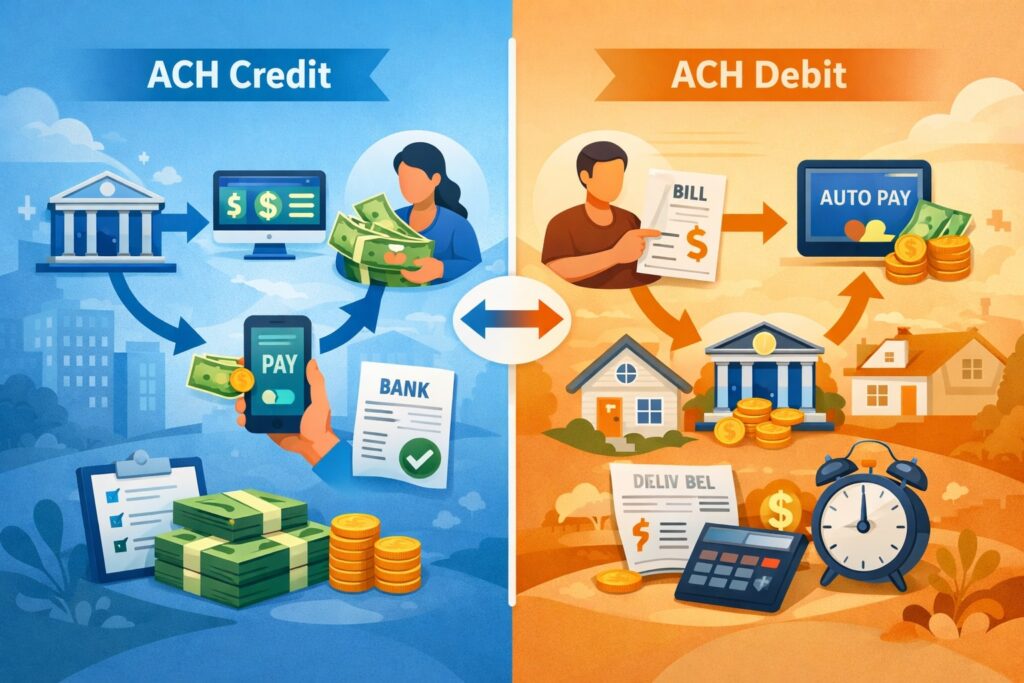
It’s easy to confuse ACH (Automated Clearing House) credit with ACH debit because both use the same network rails. But operationally—and from a risk standpoint—they are very different.
Who initiates the transaction (push vs pull)
- ACH credit (push): the payer sends money out.
- ACH debit (pull): the payee requests money from the payer’s account (think: bill payments, subscriptions, rent pulls).
This matters because it changes who needs authorization, who carries certain risks, and how disputes typically arise.
With an ACH credit, the sender is actively initiating payment—so errors usually come from wrong account numbers, incorrect amounts, duplicate files, or mis-timed submission. With an ACH debit, risk often centers on authorization and consumer disputes.
Typical use cases
ACH credit is commonly used for:
- Payroll and contractor payouts
- Vendor payments
- Refunds and reimbursements
- Account-to-account transfers where the sender is pushing funds
ACH debit is commonly used for:
- Utility and recurring bills
- Membership/subscription payments
- Loan repayments
- Rent pulls and “autopay” arrangements
Risk profile and control
ACH credit usually gives the sender tighter control—because the sender controls when and how much to pay. That’s a big reason many organizations prefer ACH (Automated Clearing House) credit for disbursements: it reduces the operational complexity of collecting authorizations and managing returns tied to disputes.
ACH credit still requires strong validation and internal approval workflows, but the risk is more about fraud and mistakes than consumer authorization disputes.
Common Types of ACH Credit Transfers (With Real-World Examples)
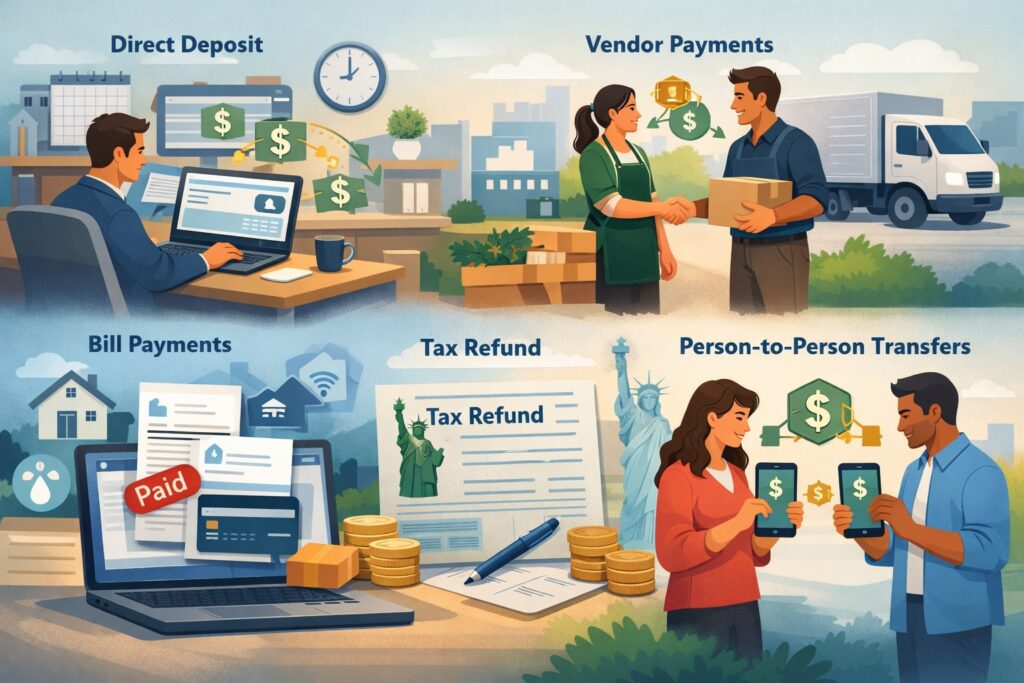
“ACH (Automated Clearing House) credit” is a category, but within it there are multiple practical formats and business patterns. Thinking in types helps you design payment workflows that reconcile cleanly.
Payroll ACH Credit (Direct Deposit)
Payroll is the classic ACH (Automated Clearing House) credit use case. An employer pushes funds to employee accounts on payday. Payroll ACH credit works well because it’s:
- Predictable (scheduled batches)
- Low cost compared to alternatives
- Supported by nearly every bank and credit union account
Payroll files also often include reference information that helps recipients identify the deposit source. When payroll is run correctly, ACH credit reduces paper checks, minimizes lost payments, and improves employee satisfaction.
Vendor and B2B Payments (Invoice Settlement)
B2B ACH credit is commonly used to pay suppliers, contractors, and service providers. The biggest advantage is that ACH (Automated Clearing House) credit can include remittance data (often through addenda records).
That remittance data is what turns “money moved” into “books closed,” because it helps the recipient match a payment to an invoice without manual effort.
As Same Day ACH capabilities have expanded, business use cases have grown, especially for urgent invoice settlement, last-minute payroll adjustments, and time-sensitive payouts. Nacha has historically expanded Same Day ACH limits over time and continues to evaluate additional expansions.
Refunds, Claims, and Reimbursements
Insurance claim payouts, merchant refunds (when sent to bank accounts), healthcare reimbursements, and expense reimbursements are all strong ACH (Automated Clearing House) credit fits. ACH credit helps organizations reduce check issuance and deliver a better recipient experience—especially when combined with account validation and clear payment notifications.
ACH Credit Timing, Settlement, Limits, and Fees (What to Expect)
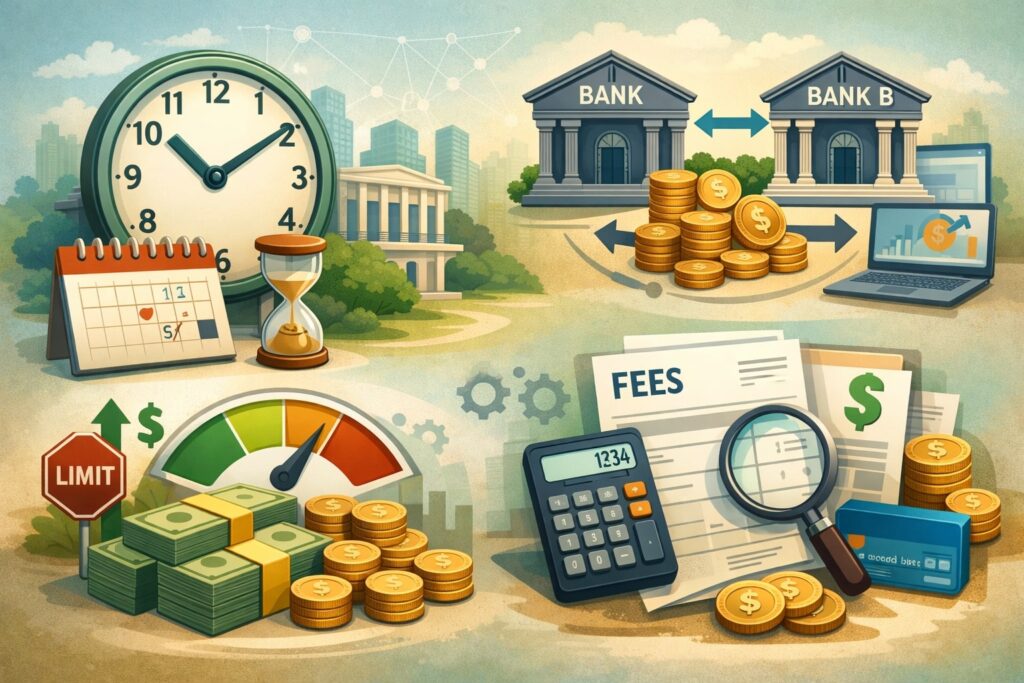
ACH credit is not a single-speed system. Timing depends on cutoffs, eligibility, and whether Same Day ACH is used.
Standard ACH Credit timing
Standard ACH (Automated Clearing House) credit typically settles on the next banking day, though exact posting can vary by institution and processing schedules. Because ACH is batch-based, a payment “sent today” may not be posted today if it misses a processing window.
Same Day ACH (Automated Clearing House) credit: faster batch payments
Same Day ACH allows eligible ACH entries to settle the same banking day if submitted by specific deadlines. Same Day ACH has continued to evolve, and industry proposals have looked at raising the Same Day ACH per-transaction dollar limit significantly—reflecting demand for larger-value, faster ACH credit use cases.
Even when Same Day ACH is available, not every institution posts at the same moment. “Same day settlement” does not always mean “instant posting,” so it’s smart to set expectations with recipients and to monitor RDFI posting behaviors if you manage high-volume payouts.
ACH credit limits and fees
There is no single universal ACH (Automated Clearing House) credit limit across all banks and providers. Limits are often imposed by:
- The sender’s bank or payment processor risk policy
- Account history and underwriting
- Same Day ACH eligibility rules and per-entry caps
Fees also vary widely. Many banks charge low per-item fees for ACH credit origination, while some platforms bundle ACH credit pricing. Compared to wires, ACH (Automated Clearing House) credit is typically far less expensive, which is why it’s heavily used for recurring payouts and supplier payments.
Data Requirements, Nacha Rules, and Compliance Basics for ACH Credit
To originate an ACH (Automated Clearing House) credit reliably, you need both correct bank data and rule-aligned operational controls. The ACH Network is governed by Nacha Operating Rules, and participating institutions and many third parties align their processes to those rules.
Core data elements you must get right
Most ACH credit failures come from simple data issues:
- Incorrect routing number
- Wrong account number
- Account type mismatch (checking vs savings)
- Receiver name mismatches (sometimes tolerated, sometimes flagged)
- Wrong transaction code or formatting problems
For businesses, the best practice is to use account validation methods, maintain clean beneficiary records, and implement change controls (so bank details cannot be updated without verification).
SEC codes and “what kind of payment is this?”
ACH entries use Standard Entry Class (SEC) codes that describe the payment context (for example, consumer vs corporate). SEC codes impact formatting and sometimes authorization expectations and downstream processing.
If you originate ACH (Automated Clearing House) credit through a bank or payment processor, they’ll usually guide you on which SEC code fits your use case (payroll, vendor, consumer payout, etc.). Choosing correctly helps reduce exceptions and returns.
Compliance is operational, not just legal
For ACH credit, compliance often looks like:
- Clear internal approval workflows for payment release
- Secure storage and handling of bank account data
- Audit trails for who created, approved, and released files
- Monitoring for unusual payout patterns
Even if you outsource file creation to a provider, you still benefit from understanding these basics—because when something goes wrong, you’ll need to troubleshoot quickly with your bank or processor.
Returns, Reversals, and Mistakes: What Happens When an ACH Credit Goes Wrong?
ACH credit is reliable, but it isn’t immune to errors. When problems occur, they usually fall into one of these buckets:
ACH credit returns
An RDFI may return an ACH credit for reasons like:
- Invalid account number
- Account closed
- Unable to locate account
- Recipient deceased (in certain contexts)
- Other posting restrictions
Returns matter because they impact cash forecasting and can create operational work (reissuing payments, updating beneficiary data, notifying recipients). A strong payout operation tracks return reasons and fixes root causes rather than repeatedly retrying failed credits.
Reversals vs corrections
A common misconception is that ACH credit can always be “pulled back.” In reality, ACH credit is not like a card chargeback process. Reversals may be possible in limited scenarios—often tied to specific rules and time windows—and in many cases require the sender to work directly with the recipient to recover funds if the credit is posted successfully.
That’s why prevention is everything:
- Validate bank details before the first live payment
- Use payee management controls and dual approvals
- Send penny tests or verification where appropriate
- Flag unusual payout behavior automatically
When combined, these controls dramatically reduce misdirected ACH credit incidents.
Security and Fraud Prevention for ACH Credit
Because ACH credit is a push payment, fraud often focuses on changing the destination account rather than “stealing” the payment mid-stream.
The most common real-world threat is business email compromise (BEC) or vendor impersonation—where an attacker convinces an organization to update bank details and then routes ACH credit payouts to a fraudulent account.
Best-practice controls that actually work
To protect ACH credit operations, prioritize:
- Out-of-band verification for bank detail changes (call a known number, not the email signature)
- Role-based access so no single user can create + approve + release payouts
- Dual approval for new beneficiaries and high-dollar ACH credit entries
- Anomaly detection (new payee + high amount + urgent language is a common fraud pattern)
- Secure storage of bank data and encryption in transit and at rest
Why Same Day ACH increases the need for strong controls
Faster settlement is great for recipients—but it can reduce the time you have to catch mistakes. As Same Day ACH use cases grow and proposed limits increase, internal controls become more important, not less.
If you’re implementing ACH credit for business disbursements, treat fraud prevention like part of product design: build it into onboarding, payee management, approvals, and ongoing monitoring.
How to Set Up ACH Credit for Business: A Practical Implementation Blueprint
If you’re planning to use ACH credit for payroll, vendor payments, or customer payouts, implementation is less about “turning on ACH” and more about designing a clean, controlled workflow.
Step 1: Choose how you will originate ACH credit
Most organizations originate ACH credit through:
- Their bank’s ACH origination portal
- Treasury management services
- A payment processor or payout platform (with a bank sponsor behind the scenes)
The right option depends on volume, reporting needs, approval complexity, and whether you need API-based automation.
Step 2: Build payee onboarding and verification
Payee onboarding is where you win or lose. Collect bank data securely, validate it, and require verification for any change. For vendor payments, consider capturing remittance preferences so you can attach meaningful addenda data and reduce payment reconciliation work.
Step 3: Define payout schedules and cash planning
ACH credit works best when you standardize payout windows:
- Daily cutoff for same-day or next-day
- Weekly vendor runs
- Payroll calendars with clear pre-notification timelines
Then align those schedules to internal funding and accounting processes.
Step 4: Monitor returns and continuously improve
Track:
- Return rates by payee source
- Return reasons
- Time-to-reissue metrics
- Fraud attempts and blocked changes
Over time, you’ll reduce exceptions, lower support tickets, and create a smoother recipient experience.
The Future of ACH Credit: What’s Changing and What to Watch Next
ACH credit is not being “replaced,” but it is being reshaped by faster payments, higher expectations, and evolving rule proposals.
Same Day ACH expansion and higher-value use cases
Industry activity has included proposals to increase the Same Day ACH per-transaction dollar limit to $10 million, with a proposed effective date in March 2027 in at least one published request-for-comment document.
If adopted, this kind of change could expand ACH credit into new territory—larger B2B invoice settlement, real estate-related disbursements (where permitted by participants), and higher-value corporate payments that currently default to wires.
ACH alongside instant payments (not either/or)
Payment ecosystems are increasingly “multi-rail.” Nacha itself describes electronic payment options—ACH, instant payments, cards, wires—as complementary choices based on the use case.
That means the future for ACH credit is likely:
- Continued dominance for predictable, low-cost batch payouts
- More Same Day ACH usage for urgent but non-instant needs
- Integration into platforms that can route payments intelligently (ACH credit vs instant rails vs wire) depending on cost, timing, and risk
Better data and reconciliation expectations
Businesses will continue pushing for richer remittance data and automated reconciliation. Expect ongoing innovation around addenda usage, payment messaging, and ERP integrations so that an ACH credit doesn’t just “arrive,” but arrives with the information needed to close the loop.
FAQs
Q.1: What is an ACH credit used for most often?
Answer: An ACH credit is most often used for situations where the sender needs to push funds directly into someone else’s bank account with predictable timing and low fees.
The most common example is payroll direct deposit, where an employer sends ACH credit payments to employees on payday. Another major use is business-to-business payments—like paying suppliers, contractors, and service providers—where an ACH credit can replace paper checks and reduce manual work.
ACH credit is also widely used for reimbursements, refunds, insurance claim payouts, and marketplace or gig-worker disbursements. In these cases, the ability to send many payments in a batch and automate scheduling is a big advantage.
Because ACH is a foundational batch payment system, it’s frequently chosen when cost and scale matter more than instant delivery.
If you’re deciding between payment methods, ACH credit tends to be a strong fit when you want consistent operations, broad bank coverage, and easier accounting—especially if you include meaningful remittance information for reconciliation.
Q.2: How long does an ACH credit take to process?
Answer: ACH credit timing depends on processing windows and whether you use standard ACH or Same Day ACH. Standard ACH credit commonly settles on the next banking day, though the exact posting time can vary by receiving institution.
Because ACH is processed in batches, the cutoff time for submitting your payment instructions matters—a file submitted after a cutoff may process in the next available window.
Same Day ACH can accelerate eligible ACH credit entries so they settle the same banking day if they meet requirements and are submitted before the relevant deadlines. Same Day ACH capabilities have expanded over time, and industry efforts continue to explore broader use cases and higher-value thresholds.
Even with same-day settlement, “settled” does not always mean the recipient sees funds immediately—some banks post multiple times per day, while others post later. For the best recipient experience, communicate expected timelines clearly and, for critical payments, test how key receiving institutions post Same Day ACH credits.
Q.3: Can an ACH credit be reversed or canceled?
Answer: An ACH credit can sometimes be stopped or corrected, but it’s not as simple as pressing an “undo” button.
Once an ACH credit has been processed and posted to the recipient’s account, recovering those funds typically requires cooperation from the recipient or a formal process through financial institutions—often depending on timing, the reason for the issue, and applicable rules.
The practical takeaway is that prevention is far easier than reversal. Most “ACH credit gone wrong” cases come from incorrect account details, duplicate files, or beneficiary change fraud. Strong controls—like payee verification, dual approvals, and change-management policies—are the best way to avoid situations where you need a reversal.
If you realize a mistake quickly, contact your bank or payment provider immediately. They can advise whether the ACH credit is still in a window where it can be halted before settlement. As Same Day ACH grows and settlement accelerates, that reaction window can shrink, increasing the importance of validation and approvals.
Q.4: Is an ACH credit the same as a wire transfer?
Answer: No—an ACH credit and a wire transfer are different payment methods with different processing models, typical fees, and timelines.
An ACH credit is a batch-based electronic transfer that moves through the ACH Network and often settles next-day (or same-day for eligible entries). A wire transfer is generally processed individually, is often faster in practice, and usually comes with significantly higher fees.
ACH credit is commonly chosen for payroll, vendor payments, and recurring disbursements because it’s cost-effective and scalable. Wires are more often used for high-value, time-critical transfers where the sender needs immediate finality and is willing to pay for it.
In modern payment operations, organizations frequently use multiple rails—ACH credit for routine payouts, and wires (or instant payment options) for urgent or special cases. Nacha itself frames these payment options as complementary choices depending on the use case.
Conclusion
An ACH credit is one of the most practical ways to move money from one bank account to another because it’s a push payment built for scale, predictable processing, and broad coverage. It powers direct deposit, vendor payments, reimbursements, and many other payout flows that businesses rely on every day.
When you understand how ODFIs, ACH Operators, and RDFIs work together—and when you build strong payee verification and approval controls—ACH credit becomes a reliable backbone for disbursements.
Looking ahead, ACH credit is likely to become even more capable through ongoing Same Day ACH expansion discussions and higher-value eligibility proposals, while continuing to coexist with instant payment options as part of a multi-rail strategy.
If your goal is to lower payment costs, reduce manual work, and deliver dependable account-to-account payouts, designing a clean, secure ACH credit workflow is one of the highest-leverage improvements you can make.
Leave a Reply