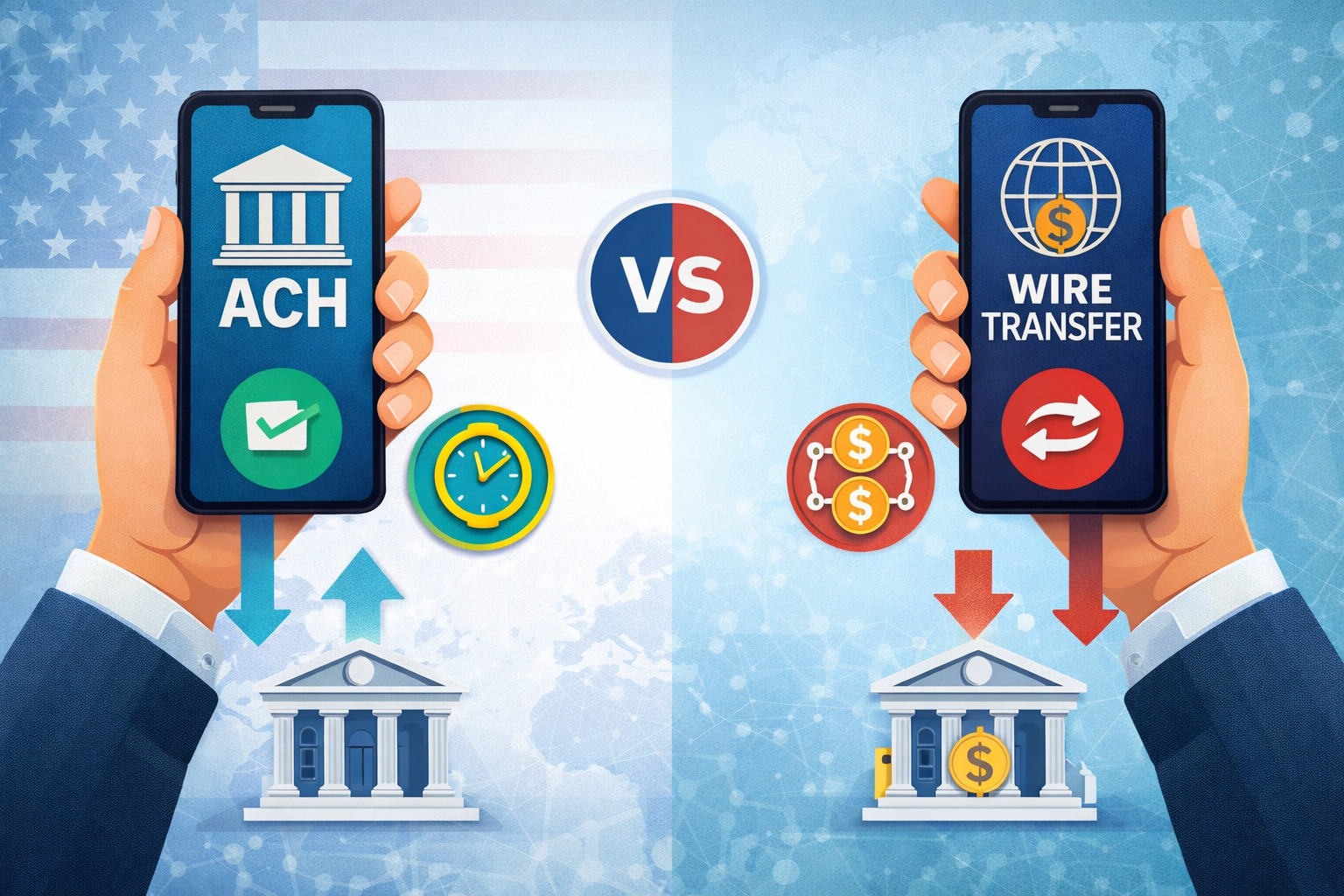
Understanding ACH Transfer vs. Wire Transfer isn’t just a banking detail—it affects cash flow, vendor relationships, payroll timing, fraud exposure, and how quickly money becomes available (not just “sent”).
For small business owners, finance managers, entrepreneurs, freelancers, and individuals, choosing the right transfer method can reduce fees, prevent avoidable delays, and lower the risk of sending money to the wrong place.
Here’s the quick takeaway on the difference between ACH and wire transfer:
- ACH (Automated Clearing House) transfers are batch-processed electronic funds transfers (EFTs) that are typically low-cost and ideal for payroll, recurring bills, and routine vendor payments. They usually settle in 1–3 business days, with same-day ACH available in many cases if you meet cutoff times and eligibility rules.
- Wire transfers move funds through real-time gross settlement systems (for many domestic wires) or correspondent banking networks for international wires. They are typically faster, more expensive, and often treated as final/irrevocable once processed, making them best for large, time-sensitive transactions.
Below, you’ll get a practical, plain-English breakdown of ACH vs wire transfer differences, with real-world scenarios, cost and timing expectations, security considerations, and a decision guide you can actually use.
What Is an ACH Transfer?

An ACH transfer is an electronic movement of money through the Automated Clearing House (ACH) network—one of the most common bank transfer methods in the U.S. ACH is a type of electronic funds transfer (EFT) used for everything from direct deposit to utility payments. Unlike wires, ACH transactions are generally processed in batches at scheduled intervals rather than individually in real time.
From a business perspective, ACH is the “workhorse” payment rail: predictable, scalable, and usually inexpensive. That’s why it’s widely used for payroll, vendor payables, and recurring customer billing. It’s also frequently integrated into accounting tools and payment platforms, making reconciliation easier than many ad-hoc payment methods.
What makes ACH especially useful is its flexibility:
- You can push money out (payroll, vendor payments).
- You can pull money in (customer bank debits).
- You can automate schedules (weekly payroll, monthly subscriptions).
- You can often send large volumes efficiently (batch pay runs).
That said, ACH has tradeoffs. Because it’s not typically real-time, you must plan around ACH processing time, bank cutoff times, and potential return windows (the “oops” factor that can be a benefit or a risk depending on which side of the payment you’re on).
How ACH works, step by step
ACH transfers move through a structured flow involving your bank (or payment provider), ACH operators, and the recipient’s bank. The key concept is that ACH is clearing-based—instructions are exchanged first, and funds settlement follows according to network schedules.
A simplified process looks like this:
- Authorization or initiation
- For ACH debit (pull), the receiver gets authorization from the payer (e.g., customer signs an e-mandate).
- For ACH credit (push), the sender initiates payment (e.g., employer sends payroll).
- Originating bank (ODFI) submits the file
- The sender’s bank/payment provider batches entries and submits them into the network.
- ACH operator processes
- Operators sort and route the entries to the receiving institutions on defined schedules (standard or same-day).
- Receiving bank (RDFI) posts the entry
- The recipient’s bank posts the credit or debit to the account, subject to availability rules.
- Settlement occurs
- Banks settle net positions; timing depends on standard ACH versus same-day ACH windows.
This structure is why ACH is often cheaper than wires: it’s designed for high volume and operational efficiency, not individualized real-time handling.
ACH debit vs ACH credit
A practical way to understand ACH is to separate it into ACH debit vs ACH credit—who is pushing and who is pulling.
ACH Credit (Push):
- Money moves from the payer to the payee.
- Common examples:
- Payroll direct deposit
- Sending money to a vendor
- Paying a contractor
- Why businesses like it:
- You control when payments are initiated.
- It reduces “collections risk” compared to pulling from customers.
ACH Debit (Pull):
- Money moves from the customer/payer to the business/payee.
- Common examples:
- Monthly subscriptions
- Utility/insurance autopay
- Loan payments
- Why businesses like it:
- Efficient collections for recurring revenue.
- Fewer card processing costs in many cases.
The key operational difference is authorization. Debits usually require the payer’s permission (and proper recordkeeping), while credits generally only require the sender to initiate from their own account.
ACH processing timelines and same-day ACH
For most people, the biggest question is: “How long does ACH take?” The honest answer is: it depends on your bank’s processing, the type of ACH (standard vs same-day), and when you submit.
Typical timing patterns:
- Standard ACH: often 1–3 business days end-to-end for many use cases.
- Same-day ACH: can settle the same business day if submitted before relevant cutoffs and if the transaction is eligible.
Important nuance: “same-day” is not the same as “instant.” Same-day ACH still runs on scheduled windows and cutoff times; miss the window and you’re pushed to the next processing cycle.
Common ACH use cases for businesses and individuals
ACH is best when predictability and cost matter more than minute-by-minute speed:
- Payroll and contractor payments
- Vendor payments (especially recurring suppliers)
- Customer billing for subscriptions and invoices
- Rent and utilities
- Tax payments (depending on agency options)
- Marketplace payouts and platform disbursements
If you’re building a payments playbook for your business, ACH is often the default for routine transactions—especially when you can schedule ahead and avoid last-minute urgency.
What Is a Wire Transfer?

A wire transfer is an electronic transfer of funds that’s typically processed individually (not in batches) and is commonly used for high-value, time-sensitive payments. In the U.S., many domestic wires travel through systems such as Fedwire, which is designed for immediate, final settlement between participating institutions.
For businesses, wires are the “express lane” when you need money to arrive quickly and with strong payment finality. That’s why wires are common in real estate closings, large supplier payments, earnest money, M&A-related transfers, and urgent international obligations.
Wires come with tradeoffs:
- They’re usually more expensive than ACH.
- They often have stricter handling and cutoff times.
- Once sent and accepted, they may be very difficult to reverse (which is great when you want certainty, and stressful if you made a mistake).
How wire transfers work (domestic and international)
Wire transfers move through bank-to-bank messaging and settlement rails. The “how” differs depending on whether you’re sending a domestic wire transfer or an international wire transfer.
Domestic wire transfer (U.S. common flow):
- You provide recipient details (name, bank routing info, account number).
- Your bank sends the payment order through the wire system.
- Settlement occurs on a real-time basis (for many domestic wires), meaning each payment is settled individually and promptly.
- The recipient’s bank credits the beneficiary account, often the same day.
International wire transfer (common flow):
- Your bank sends an instruction message, often using the SWIFT network as the secure messaging standard.
- One or more intermediary/correspondent banks may be involved (especially if the banks don’t have a direct relationship).
- Funds settle through the chain based on each bank’s processes, time zones, and local payment systems.
A crucial clarification: SWIFT is primarily a messaging network that standardizes and transmits payment instructions; it doesn’t necessarily “move the money” by itself. The actual funds movement depends on the banks and settlement systems involved.
Domestic vs international wires
The differences between domestic and international wires show up in cost, speed, and predictability:
- Domestic wires (within the same country) are often faster and more straightforward.
- International wires can take longer due to:
- time zones and banking hours
- compliance screening (sanctions/AML checks)
- intermediary banks
- foreign exchange processing
Because intermediaries may touch the payment, international wire fees can be less transparent (you might see a “sender fee,” “recipient fee,” and sometimes intermediary deductions).
Real-time settlement and payment finality
One of the defining features of many wire systems is finality: once the wire is processed and accepted, it’s typically treated as final and irrevocable. The Federal Reserve describes Fedwire transfers as immediate and final/irrevocable once processed.
This is a double-edged sword:
- Good: sellers and counterparties trust wires for big transactions.
- Risky: fraudsters love wires because clawbacks are hard if you act too late.
That’s why strong verification procedures matter more for wires than almost any other bank transfer method.
Common wire transfer use cases
Wires shine when timing and certainty are worth the extra cost:
- Real estate transactions (down payments, closing funds)
- Large supplier payments with strict shipping deadlines
- Urgent B2B payments to avoid penalties
- International vendor payments
- High-value purchases (equipment, vehicles, inventory)
- Legal settlements or escrow funding
If the payment must arrive today (or the next available banking window) and the recipient demands a bank-to-bank irrevocable method, wire is usually the answer.
ACH Transfer vs Wire Transfer: Key Differences
This is where most decision-making lives: speed, cost, security, reversibility, and whether you can send money internationally.
At a high level:
- ACH is optimized for high-volume, lower-cost, scheduled payments.
- Wires are optimized for time-critical, high-value payments with finality.
The table below summarizes the most practical ACH vs wire transfer differences.
Comparison Table: Difference Between ACH and Wire Transfer
| Feature | ACH Transfer (Automated Clearing House) | Wire Transfer (Domestic / International) |
|---|---|---|
| Processing model | Batch processing (clearing-based) | Individual processing (often RTGS for domestic) |
| Speed | Usually 1–3 business days; same-day ACH possible in many cases | Same-day common for domestic; international varies (often 1–5 business days depending on route) |
| Cost | Often low or free; business ACH fees vary by bank/provider | Higher; wire transfer fees commonly charged to sender and sometimes recipient |
| Best for | Payroll, subscriptions, recurring bills, routine vendor payables | Real estate, large/urgent payments, international high-value transfers |
| Reversibility | More potential for returns/adjustments (rules and timelines vary by entry type and reason) | Often difficult after acceptance; cancellation windows can be narrow |
| International capability | Mostly U.S.-focused; cross-border options exist but are not “standard ACH” | Strong for international payments; commonly uses SWIFT messaging |
| Transaction limits | Bank/provider-specific; can be constrained by risk controls | Bank-specific; can support very high values (system rules apply) |
| Typical use experience | Scheduled, automated, integrated with billing/payroll | Manual review, higher friction, more verification steps |
Speed and Settlement: “Sent” vs “Settled” vs “Available”
A common misunderstanding is thinking “speed” is a single number. In practice, speed includes:
- Submission time: When you initiate the payment.
- Payment settlement time: When banks settle the funds between them.
- Funds availability: When the recipient can actually use the money.
ACH can be initiated instantly (you click “send”), but settlement and posting depend on processing windows. Same-day ACH helps, but it still depends on eligibility and cutoff schedules.
With wires, settlement is often quicker and more final—especially for domestic wires in RTGS systems—so availability is often faster when sent during banking hours and processed successfully.
Cost and fee predictability
ACH is usually the low-cost winner, especially for recurring payments. Wires cost more because the transaction is handled individually, often with more bank operations, compliance checks, and higher service expectations.
The practical takeaway:
- If you’re paying 50 contractors monthly, wires are usually an expensive habit.
- If you’re closing on a property tomorrow morning, ACH is usually the wrong tool.
Reversibility, errors, and risk
Reversibility is one of the most important (and most overlooked) differences.
- ACH has defined return/error flows that can sometimes help recover from mistakes (but can also create chargeback-like risk for merchants using debits).
- Wires can be extremely difficult to unwind once processed; legal and network rules prioritize finality, and cancellation requests may only work if the wire hasn’t been accepted/posted yet.
Fees and Processing Times
If you’re building a payments policy, you need realistic expectations for both wire transfer fees and ACH fees for businesses, plus a clear view of what drives delays.
The challenge is that banks and providers price differently. Some offer free ACH credits but charge for ACH debits. Some bundle a number of wires into treasury packages. International wires can introduce intermediary fees that are hard to predict.
So instead of promising a single number, the best approach is understanding common patterns and the levers that change cost and speed.
Typical ACH fees and what influences them

ACH is often low-cost because it’s built for volume. You’ll commonly see:
- Free ACH for consumers at many banks (especially standard transfers)
- Low per-transaction fees for business ACH through treasury services or payment processors
- Monthly platform fees for ACH-enabled invoicing/billing tools
- Higher fees for:
- same-day ACH
- high-risk categories or new accounts
- returns management and dispute handling for debits
Factors that influence ACH cost and speed:
- Submission cutoff times (miss the window, add a day)
- Standard vs same-day ACH eligibility and operator windows
- Account verification (micro-deposits vs instant verification)
- Risk controls (new payees, unusual amounts)
- Bank posting policies (some post faster than others)
Real-world example:
A marketing agency pays freelancers every Friday. Switching from same-day payroll panic to scheduled ACH credits on Wednesday can reduce fees and avoid weekend delays—without changing the actual payday experience for recipients.
Typical wire transfer fees and what influences them

Wire pricing is generally higher and more variable. You may encounter:
- Outgoing domestic wire fees charged by the sender’s bank
- Incoming wire fees charged by the recipient’s bank (common in some business accounts)
- International wire fees that can include:
- sender fee
- recipient fee
- intermediary bank fees
- FX spread (if currency conversion is involved)
Speed influencers for wires:
- Cutoff times (often earlier than you expect)
- Time zone differences for international wires
- Compliance screening (sanctions/AML checks can delay)
- Correspondent routing (more hops can mean more time)
- Incorrect details (name mismatch, wrong account/routing/SWIFT code)
Real-world example:
An importer needs to pay a supplier in another country before shipping goods ship. A wire is appropriate—but using correct beneficiary details and confirming whether the supplier expects SHA/OUR/BEN fee handling (where applicable) can prevent short-paid invoices and shipping delays.
Comparison table: fees and timing expectations
| Category | ACH (Standard / Same-Day) | Wire (Domestic / International) |
|---|---|---|
| Typical cost | Low; often free/low-cost; same-day can cost more | Higher; domestic moderate; international highest (plus possible intermediary/FX costs) |
| Typical timing | Standard often 1–3 business days; same-day possible within windows | Domestic often same-day; international often 1–5 business days (varies widely) |
| Key delay drivers | Cutoffs, weekends/holidays, return handling | Cutoffs, compliance checks, correspondent hops, wrong details |
| Best operational use | Planned, recurring, routine payments | Urgent, high-value, high-finality payments |
Security Comparison: Fraud, Controls, and Protections
A payment security comparison between ACH and wires shouldn’t be reduced to “which is safer.” The more useful question is: What are the most common failure modes, and what controls reduce the risk for my situation?
Both methods are secure in a technical sense (banks use strong security and authentication). Most losses come from process failures—phishing, invoice manipulation, incorrect account details, weak internal controls, or misunderstanding reversal rights.
Fraud risks: what attackers target
Wire fraud risks (common patterns):
- Business email compromise (BEC): attacker impersonates a vendor and sends “updated wire instructions.”
- Real estate closing scams: buyer receives fake wiring instructions hours before closing.
- Urgency manipulation: “Send within 30 minutes to avoid penalties.”
Wires are attractive to criminals because of speed and finality—once sent, recovery is difficult if you don’t act immediately.
ACH fraud risks (common patterns):
- Unauthorized ACH debits using stolen account/routing details
- Fraudulent bank debits in low-verification environments
- Friendly fraud or disputes (especially for consumer-authorized debits)
ACH debits can be higher-risk for merchants because returns can happen, and that uncertainty can affect cash flow forecasting.
Authorization requirements and internal controls
Strong controls beat “picking the right rail.” For both ACH and wires, the best defenses are procedural:
- Use call-back verification for any new or changed bank instructions
- Call a known number from your vendor master file (not the email signature)
- Dual approval for wires and high-value ACH
- Maker-checker workflows reduce single-point failure
- Vendor onboarding discipline
- Verify tax IDs, business identity, and bank ownership where possible
- Limit permissions
- Separate “create payee” from “approve payment”
- Train for BEC red flags
- last-minute changes, secrecy, urgency, new bank accounts
Banks and treasury platforms often support layered security (multi-factor authentication, device verification, approval routing). Use them—especially for wires.
Error correction and dispute pathways
This is where ACH and wires differ sharply.
ACH error correction:
- ACH has established return and correction processes depending on the entry type and reason.
- If a customer claims a debit was unauthorized, there may be formal return processes available (timelines vary by scenario and account type).
- This can protect payers, but it can create collections uncertainty for businesses relying on ACH debits.
Wire error correction:
- Wire cancellation or recall may be possible only if the wire hasn’t been accepted/posted; after acceptance, rules strongly favor finality.
- In the U.S., wire transfer disputes are commonly governed by UCC Article 4A and related system rules, and reversal is often limited.
Regulatory protections: what to know at a high level
A safe way to think about it:
- ACH (especially consumer-related payments) often has clearer pathways for certain disputes and returns.
- Wires prioritize finality and certainty, and legal frameworks can place more responsibility on the sender—particularly if the bank followed agreed security procedures.
If you’re making high-stakes decisions (real estate, large vendor onboarding, or suspected fraud), consult your bank and, when needed, qualified counsel—because the details of liability can be fact-specific.
When to Use ACH
ACH is usually the best choice when you value low cost, automation, and predictable operations more than “arrive in the next hour.” For many small businesses, a well-designed ACH workflow reduces payment overhead and improves cash flow planning.
Below are the most common situations where ACH is the right tool.
Recurring payments and predictable schedules
If a payment happens more than once, ACH is often the most operationally efficient option. The ACH network is built for routine flows—payroll cycles, monthly billing, recurring vendor relationships—where you can schedule ahead.
Examples:
- Payroll every two weeks
- Monthly retainers for contractors
- Subscription billing for clients
- Rent, utilities, and insurance premiums
- Standard vendor invoices with net terms
Why it works:
- Lower processing costs help margins.
- Automation reduces manual work and errors.
- Scheduling reduces last-minute urgency.
Scenario:
A landscaping company collects monthly payments from 150 customers. Card fees are expensive and checks are slow. Using ACH debits with clear authorization language and pre-notification lowers costs and improves on-time collections.
Lower-cost transfers for payables and payroll
If you’re paying many vendors or contractors, wire fees can quietly become a recurring expense that adds up.
ACH is often ideal for:
- paying suppliers with standard lead time
- disbursing marketplace payouts
- reimbursing employees
- sending contractor payments
Operational tip:
- Build a “pay run” schedule (e.g., vendor payables initiated Tuesday/Thursday).
- Use same-day ACH only as a paid exception, not the default.
Non-urgent transactions where reversibility matters
ACH can be a better fit when the ability to correct or return errors matters—especially for new payees or first-time payments where you want a safer “test run.”
A practical approach many finance teams use:
- Send a small ACH test payment to validate details.
- Confirm receipt with the vendor.
- Then scale to higher payments.
This won’t eliminate risk, but it reduces the chance you accidentally send a large wire to incorrect details.
When to Use Wire Transfers
Wire transfers are the right call when speed and certainty outweigh cost—and when the recipient expects a bank-to-bank transfer that’s treated as final once processed.
This isn’t about using wires “because they’re serious.” It’s about using wires when the downside of waiting (or the risk of reversal) is more expensive than the fee.
Large, time-sensitive transactions
Wires are commonly used when timing is critical and the amount is meaningful.
Examples:
- A supplier won’t release goods until funds arrive.
- A contract requires same-day payment to avoid penalties.
- A deal closes today, and the escrow agent requires a wire.
Because domestic wire systems are designed for immediate, final settlement, they’re trusted for high-value, time-critical use cases.
Scenario:
A restaurant needs replacement refrigeration equipment immediately after failure. The vendor can deliver today if paid today. The wire fee is small compared to lost inventory and downtime.
International payments and SWIFT-based routing
For cross-border payments, international wire transfers are often the default option at traditional banks. Many international wires rely on SWIFT network messaging to communicate standardized payment instructions between institutions.
International wires are appropriate when:
- the supplier is overseas and expects wire settlement
- you need a clear banking audit trail for the transaction
- the amount is high enough that fees are acceptable
Key practical tip:
- Confirm beneficiary details carefully (bank name, address where required, SWIFT/BIC, account/IBAN when applicable).
- Clarify fee handling expectations (to avoid “short pay”).
High-value purchases where the seller needs finality
For sellers, wires reduce the risk of late returns compared to some other payment types. That’s why high-value transactions often specify wires:
- real estate closings
- vehicle purchases from dealers or auctions
- equipment purchases
- escrow funding
Because wires are generally difficult to reverse once accepted, many counterparties treat them as “good funds.”
Pros and Cons Summary
This section is designed to be scannable. Use it as a “sanity check” before choosing a method.
ACH transfers: pros and cons
Pros
- Usually low-cost or free (especially compared to wires)
- Excellent for recurring and high-volume payments
- Supports both push (credit) and pull (debit) workflows
- Easy to automate and integrate with billing/payroll systems
- Same-day ACH can speed up eligible payments within processing windows
Cons
- Not typically real-time; ACH processing time can be 1–3 business days
- Cutoff times and non-business days can add delays
- ACH debits can carry return risk for businesses (cash flow uncertainty)
- Limits and holds can apply based on bank risk policies
Wire transfers: pros and cons
Pros
- Fast for domestic payments (often same-day during banking windows)
- Strong payment finality; widely accepted for high-value transactions
- Common and practical for international payments (via SWIFT messaging and correspondent routing)
- Preferred in real estate, escrow, and urgent B2B transactions
Cons
- Higher wire transfer fees; cost can be significant for frequent payments
- Hard to reverse once processed; mistakes can be expensive
- International wires can be slower and less predictable than expected
- Fraud risk is high if your verification process is weak
Common Mistakes to Avoid
Most costly payment failures aren’t caused by the network—they’re caused by assumptions and rushed processes. Avoid these mistakes and you’ll reduce both fees and fraud exposure.
1) Sending wires without verification
This is the classic business email compromise setup: a vendor invoice arrives with “updated wiring instructions.” If you wire without verifying via a trusted channel, you may not get the money back.
Safer process:
- Verify changes using a known phone number from your vendor file.
- Require dual approval for any wire.
- Treat “urgent” instruction changes as suspicious.
2) Assuming ACH is instant
ACH can feel instant because initiation is easy. But settlement and posting depend on processing windows, cutoff times, and bank policies. Same-day ACH helps, but it’s still schedule-based.
Fix:
- Build lead time into your payables calendar.
- Use same-day ACH for exceptions, not as the baseline.
3) Ignoring cutoff times and non-business days
Both ACH and wires have deadlines. If you initiate after cutoff:
- ACH may shift by a day (or more around weekends/holidays).
- Wires may wait until the next business day, depending on bank windows.
Fix:
- Put cutoff times into your internal payment checklist.
- For critical transfers, initiate early in the day.
4) Overpaying unnecessary wire fees
Many businesses default to wires for vendor payments simply because “that’s how we’ve always done it.” If you’re sending frequent domestic payments that aren’t urgent, ACH is usually the better fit.
Fix:
- Segment payments: recurring/routine → ACH; urgent/high-value → wire.
- Negotiate treasury pricing if you send many wires.
5) Not clarifying reversals and dispute expectations
“Can we reverse it?” is a common question asked after the mistake happens.
- ACH may offer returns in certain situations.
- Wire reversals are often limited after acceptance; quick action matters, but recovery isn’t guaranteed.
Fix:
- Train staff on what “final” means for wires.
- Use small test payments for new payees.
Quick Decision Guide
Use this simple framework to decide between ACH and wire transfer without overthinking it.
Step 1: How fast does the money need to be usable?
- Today (or next banking window) is mandatory: lean wire (especially domestic).
- 1–3 business days is fine: lean ACH.
- Same-day is nice but not required: ACH (standard) with better scheduling often beats same-day fees.
Step 2: What’s the cost of being late?
Ask: If this arrives tomorrow instead of today, what happens?
- Lost shipment / penalties / deal risk → wire
- No material downside → ACH
Step 3: What’s fraud and error tolerance?
- New payee, changed details, or high fraud risk context → prefer ACH test payment first, or delay until verified.
- High-trust, verified beneficiary where finality is desired → wire
Step 4: Is it domestic or international?
- Domestic routine payments: usually ACH
- International payments: usually international wire transfer (often SWIFT-instructed)
- If your “international ACH” option is offered, confirm exactly what rail it uses and how settlement works before assuming it behaves like U.S. ACH.
Step 5: Choose the tool—and set the control level
- For wire:
- dual approvals
- call-back verification for new/changed instructions
- initiate early
- For ACH:
- plan lead time
- confirm eligibility for same-day if needed
- document authorization for debits
FAQs
Q1) Is ACH safer than a wire transfer?
Answer: “Safer” depends on what you mean. Technically, both use bank-grade security. Operationally, ACH can be more forgiving because some ACH entries may be returnable under defined rules, while wires are often difficult to reverse once processed.
Wires can be riskier in fraud scenarios because criminals exploit urgency and finality. The safest approach is strong internal controls—especially verification of bank details for wires and authorization management for ACH debits.
Q2) Can an ACH payment be reversed?
Answer: Some ACH payments can be reversed or returned under specific conditions (for example, errors, unauthorized debits, or certain administrative returns).
Exact outcomes depend on the entry type, timing, and reason code categories used by banks and the network. If you’re accepting ACH debits, treat returns as a real operational risk and build cash flow buffers and verification procedures accordingly.
Q3) What are wire transfer reversal rules?
Answer: In many cases, wire transfers are treated as final once accepted/processed, and reversal may be difficult or impossible unless the receiving bank agrees or the wire hasn’t been accepted yet.
In the U.S., disputes and cancellation timing are commonly tied to UCC Article 4A and related system rules, which emphasize finality and security procedures.
Q4) Why are wire transfers more expensive?
Answer: Wires are generally processed individually, often with higher operational overhead, compliance screening, and service expectations—especially for international wires that may involve correspondent banks. That individualized handling, plus the expectation of speed and finality, typically drives higher pricing than batch-based ACH.
Q5) How long does ACH take?
Answer: Standard ACH often settles in 1–3 business days, though timing varies by bank processing, posting policies, and when you submit. Same-day ACH can deliver faster for eligible payments submitted within the required windows and cutoff times.
Q6) Are wire transfers instant?
Answer: Domestic wires are often same-day and can be very fast during banking hours, but they aren’t guaranteed “instant” in every case. Processing depends on bank cutoff times, verification steps, and whether the payment is flagged for review.
International wires are rarely instant and can take longer due to compliance checks, time zones, and intermediary routing.
Q7) Can I send international payments via ACH?
Answer: Traditional U.S. ACH is primarily domestic. Some providers offer cross-border bank transfer options that may be marketed as “international ACH,” but the underlying rails and settlement behavior can differ. If you’re paying overseas, international wire transfers (often using SWIFT messaging for instructions) are the more common bank option.
Q8) What happens if I send a wire to the wrong account?
Answer: You should contact your bank immediately. A recall request may be attempted, but recovery isn’t guaranteed—especially if the wire has been accepted and credited. This is why verification and dual approval are so important for wires, and why many businesses use a test payment approach for new beneficiaries.
Q9) What are ACH transfer limits?
Answer: ACH limits vary widely by bank and payment provider. Some set per-transaction caps, daily caps, or rolling limits based on account history and risk.
Businesses using treasury services may have higher limits than consumer accounts. If you regularly send large ACH credits (e.g., payroll), ask your bank about configurable limits and approval workflows.
Q10) What are typical wire transfer limits?
Answer: Wire limits are also bank-specific. Some banks allow very large wires—especially for established business customers—while others enforce daily caps or require extra verification for high amounts. Certain systems support extremely high-value transfers under their own rules.
Q11) What’s the difference between ACH and wire transfer settlement?
Answer: ACH typically settles through scheduled clearing cycles (net settlement), while many domestic wire systems settle each transfer individually in real time (gross settlement) with strong finality once processed.
Q12) Is same-day ACH the same as a wire?
Answer: No. Same-day ACH is faster than standard ACH, but it still uses scheduled windows and cutoff times rather than continuous real-time processing. Wires are generally handled individually and are often chosen for immediate, final settlement expectations.
Q13) Which is better for paying contractors: ACH or wire?
Answer: For most contractor payments, ACH credit is usually the better default: lower cost, easier to automate, and appropriate when you can schedule ahead. Use wires for exceptions—like urgent payments or situations where the contractor requires same-day confirmed funds and you’ve verified details.
Q14) Which is better for real estate: ACH or wire?
Answer: Real estate transactions commonly require wires because parties want confirmed, final funds on a deadline. Wire instructions should always be verified using trusted contact methods because real estate wire fraud is a frequent scam pattern.
Q15) How can I reduce risk with either method?
Answer: Use a consistent checklist:
- verify bank details (especially changes)
- use dual approvals
- set sensible limits
- document ACH debit authorizations
- initiate before cutoff times
- train staff to spot urgency-based fraud
Conclusion
The core difference between ACH and wire transfer comes down to what each system is built to optimize:
- ACH is designed for low-cost, high-volume, repeatable payments. It’s ideal for payroll, subscriptions, routine vendor payables, and any situation where you can plan ahead and want to keep costs down.
- Wire transfers are designed for speed and finality, which makes them the right tool for real estate, large time-sensitive purchases, urgent supplier payments, and many international transactions.
Leave a Reply