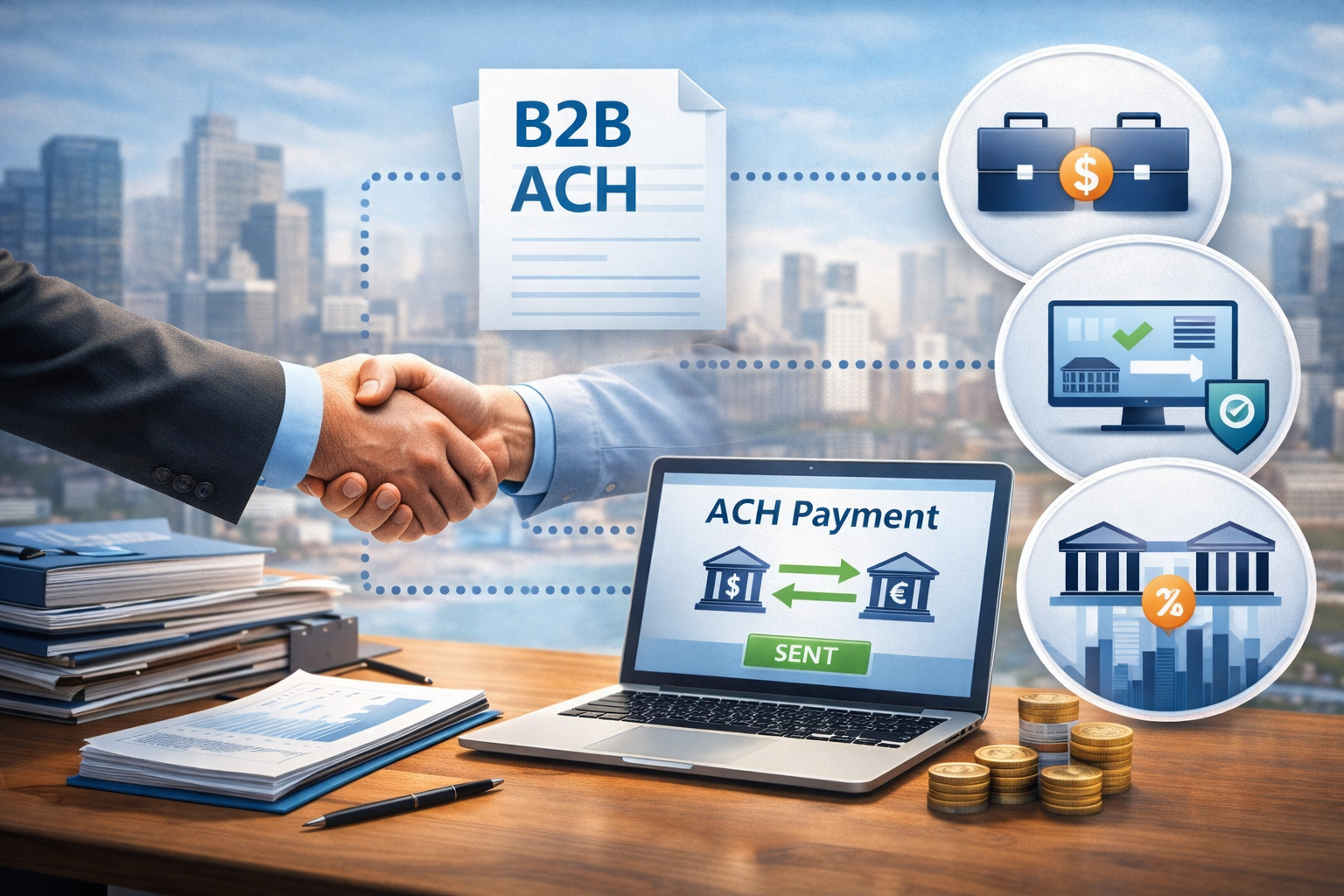
B2B ACH (Automated Clearing House) is one of the most widely used ways to move money between businesses in the U.S. When people say B2B ACH payments, they’re talking about business-to-business ACH payments that run over the ACH network—a regulated system that moves bank-to-bank payments as an electronic funds transfer (EFT) instead of paper checks, cash, or card rails.
For small business owners, CFOs, and finance teams, B2B ACH transfer workflows matter because they sit at the center of accounts payable (AP) and accounts receivable (AR): paying vendors, collecting invoices, running payroll, and automating recurring supplier payments.
Compared with wires, cards, and checks, ACH can reduce costs, improve control, and simplify reconciliation—especially when paired with AP automation and good payment policies.
This guide explains how B2B ACH works in practical, business-friendly terms: what it is, the step-by-step flow, standard vs. same-day timelines, costs, security and compliance, common challenges, and how to set it up the right way.
What Is B2B ACH?
B2B ACH is a category of ACH payments where both parties are businesses (or a business and another organization like a municipality). It uses the Automated Clearing House network to transfer funds between bank accounts in the United States. Unlike card payments, ACH doesn’t rely on card networks.
Unlike checks, it doesn’t require physical delivery or manual deposit. Instead, the payment data is transmitted electronically, and settlement happens through established banking rails and rules.
A helpful way to think about it: ACH is the “bank-to-bank” workhorse behind direct deposit, bill pay, and many vendor payment programs. For B2B use cases, it’s commonly used for invoice payments, supplier payouts, rent, franchisor fees, insurance premiums, tax payments, and recurring obligations that need predictability and lower costs.
Consumer ACH vs. business-to-business ACH payments

Consumer ACH often involves personal accounts and consumer authorization patterns (like paying a utility bill or a mortgage). Business-to-business ACH payments typically involve higher transaction values, more formal approval workflows, tighter reconciliation requirements, and greater focus on controls like dual approval and vendor verification.
Key differences you’ll usually see in B2B:
- More complex approvals: multi-person authorization, purchase order matching, or treasury review.
- More data needs: invoice numbers, remittance addenda, and structured references for reconciliation.
- Higher risk management expectations: vendor onboarding, account validation, and return monitoring.
ACH credit vs ACH debit in B2B
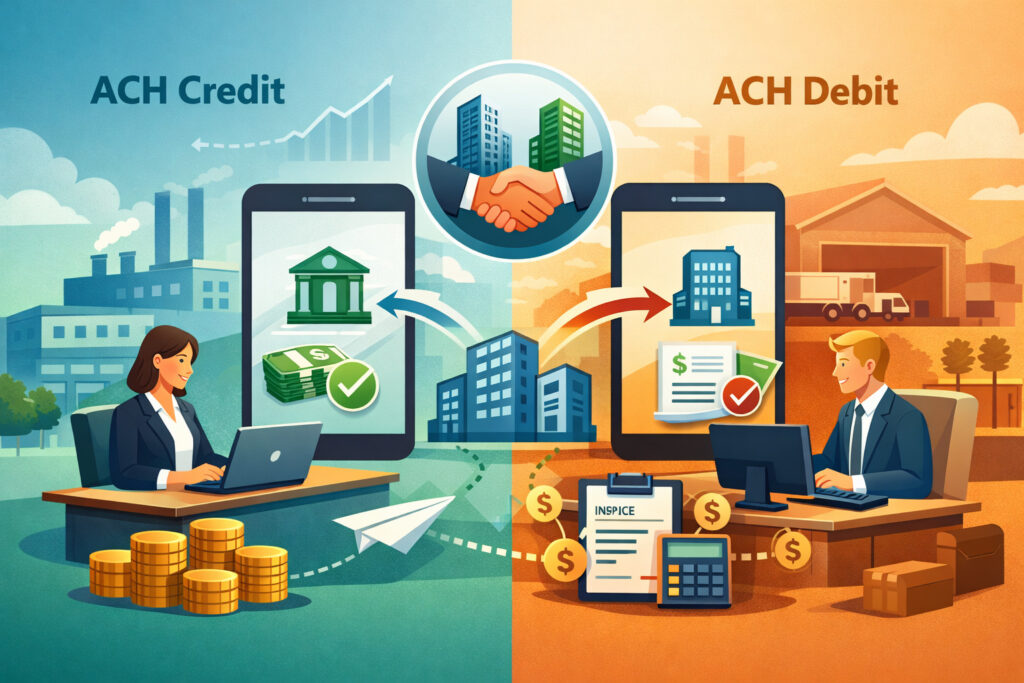
ACH transactions generally fall into two operational styles:
- ACH Credit (push payment): Your business “pushes” funds to a vendor or partner. This is common for vendor payments, payroll, and refunds.
- ACH Debit (pull payment): Your business “pulls” funds from another account after authorization. This is common for recurring billing, subscription billing, and certain B2B collections.
ACH debit vs ACH credit is less about which is “better” and more about who initiates the movement of funds and what your controls require. Many businesses prefer ACH credit for paying vendors because it reduces the risk of pulling funds without proper internal approval.
Meanwhile, businesses collecting recurring payments may prefer ACH debit because it supports consistent collections after authorization.
How B2B ACH Works Step-by-Step
B2B ACH isn’t a single “instant” event—it’s a sequence that moves through banks and ACH operators in batches. Understanding the flow helps finance teams set expectations, reduce delays, and tighten controls.
At a high level, ACH has these parties:
- Originator: the business initiating the transaction (your company, if you’re paying).
- ODFI: the Originating Depository Financial Institution (your bank/payment provider’s bank).
- ACH Operator: typically a clearing operator that sorts and delivers batches (e.g., operators that support ACH processing schedules).
- RDFI: the Receiving Depository Financial Institution (vendor’s bank).
- Receiver: the business receiving funds (your vendor, if you’re paying).
Timing and availability vary based on processing windows and whether you use standard or same-day ACH processing schedules. The Federal Reserve publishes a FedACH processing schedule that outlines daily deadlines and settlement windows for ACH items.
Authorization
Authorization is the “permission layer” that makes ACH work safely and compliantly. In B2B, authorization is typically documented through:
- a signed ACH authorization form,
- a contract clause authorizing ACH debits,
- or an online onboarding flow with identity verification and agreement capture.
For ACH debits, authorization is especially critical because the payer’s account is being debited based on permission. Your vendor onboarding process should capture:
- legal business name and DBA,
- bank routing and account numbers,
- account type (checking/savings),
- authorization scope (one-time vs recurring),
- effective date and cancellation terms.
Strong authorization reduces disputes and lowers return rates. It also supports audit readiness, especially when finance teams need to prove that debits were properly authorized.
Payment initiation
Payment initiation is where your system (ERP/accounting/AP platform) creates a payment instruction. In practical terms, this might be:
- an AP clerk selecting invoices and scheduling a vendor payment run,
- an automated rule triggering a recurring payment,
- or a treasury user initiating an ACH credit for a large vendor.
This step is where internal controls matter most. Common control points include:
- dual approval thresholds (e.g., payments over $10,000 require CFO approval),
- vendor bank change verification,
- invoice matching (PO + receiving + invoice),
- payment file review before release.
When businesses talk about accounts payable automation, they’re often referring to tools that streamline these steps: invoice capture, approvals, and payment creation with cleaner audit trails.
Batch processing
ACH is designed for efficiency at scale, so transactions are typically bundled into batches. Your bank or processor collects payment instructions and formats them into ACH files that conform to network standards.
Batching is one reason ACH is usually cheaper than wires, but it also explains why ACH isn’t always “instant.” The ACH operator processes files according to daily schedules and deadlines. The FedACH schedule details the timing of same-day eligible items and other processing windows.
Clearing and settlement
Clearing is the “sorting and routing” step: the operator distributes transactions to the receiving banks (RDFIs). Settlement is when the money movement is finalized between banks at scheduled settlement times.
In standard ACH, settlement typically happens on the next banking day (often described as “next-day” or “1–2 business days,” depending on when you submit and how your bank processes).
Same-day ACH can settle the same business day if you meet submission deadlines and the item is eligible. Nacha provides resources showing same-day schedules and funds availability, and operators follow published processing windows.
Funds posting
Funds posting is when the receiving bank credits (or debits) the receiver’s account. This can happen quickly after settlement, but posting time can still vary by bank:
- some post throughout the day,
- some post in specific cycles,
- and some hold funds based on account status or risk rules.
For vendor relationships, it’s smart to communicate “expected availability” rather than promise an exact hour—especially for end-of-day submissions or holiday-adjacent runs.
Timeline explanation
Your ACH processing time depends on:
- when you initiate (cutoff times),
- whether your bank submits the same day,
- whether you use standard or same-day processing,
- weekends and federal holidays,
- and whether the transaction triggers review (fraud/risk flags).
As a working rule of thumb for standard ACH:
- submitted early: often settles next business day,
- submitted late: may settle the following business day,
- weekends/holidays: push settlement to the next banking day.
For same-day ACH, eligibility and deadlines are key. The FedACH processing schedule outlines same-day processing windows and distribution targets.
Same-day ACH option
Same-day ACH allows eligible payments to clear and settle on the same business day when submitted by the relevant deadlines. Same-day ACH is widely used for urgent payroll corrections, time-sensitive vendor payments, and last-minute invoice settlement.
There is also a per-transaction dollar limit for same-day ACH. As of 2025, Nacha communicated a proposal to increase the same-day ACH limit from $1 million to $10 million, and the banking industry has published commentary about the timing and implications of that proposed change.
If your payments approach the current limit, your processor may route large-value items as standard ACH, split payments (when appropriate), or recommend wires for certain deadlines.
Types of B2B ACH Payments
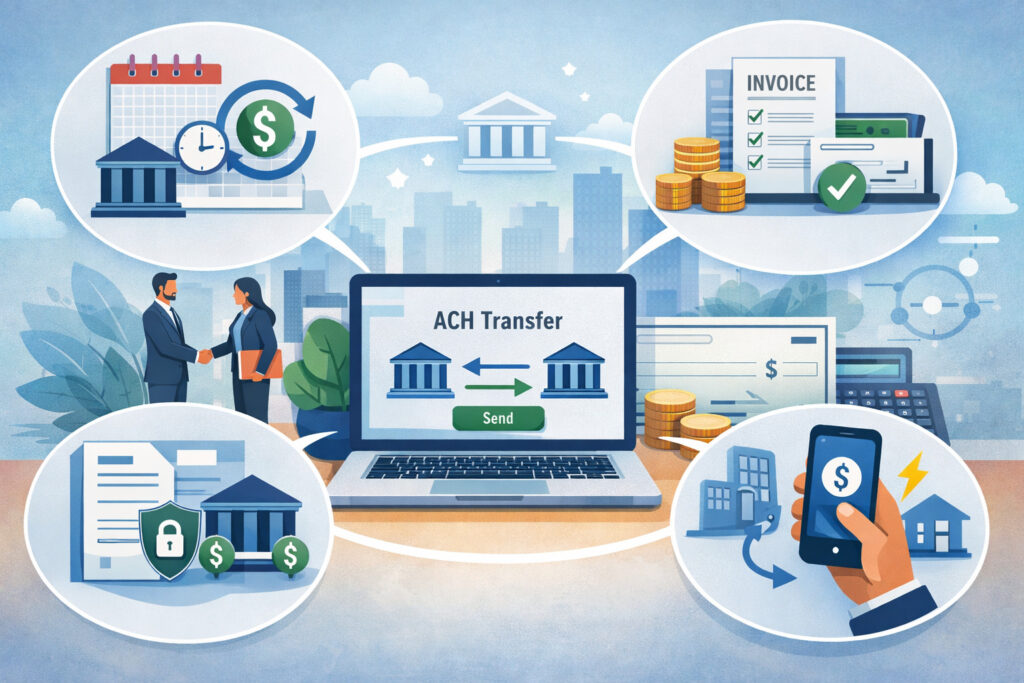
B2B ACH is flexible: it supports both “push” and “pull” payment styles and can be adapted to one-off and recurring obligations. The most common B2B use cases align with AP, AR, and payroll needs—especially where businesses want predictable costs and fewer manual steps.
Vendor payments
Vendor payments are the classic B2B ACH use case: paying suppliers, contractors, service providers, landlords, and distributors. Many businesses move vendors from checks to ACH to reduce printing/mailing work, prevent lost checks, and gain better visibility.
In a modern flow, vendor payments often include:
- invoice approval inside an AP tool,
- scheduling a payment date aligned to due dates,
- sending remittance details (invoice numbers, credits, and adjustments),
- and automatic matching inside accounting systems.
This is where ACH can materially improve payment reconciliation. When you include strong remittance data (often via addenda or structured references), it’s easier for vendors to apply cash and for your team to close the books without chasing “what did this payment cover?”
Recurring supplier payments
Recurring ACH payments are common for:
- monthly services (IT support, facilities, logistics),
- lease/rent payments,
- insurance premiums,
- subscriptions billed via invoice.
A predictable schedule helps cash flow management, but recurring payments also demand strong controls. Best practice is to:
- lock vendor banking details behind change controls,
- use standardized authorization language,
- and monitor returns and exceptions.
If you’re using ACH debit for recurring billing, ensure your authorization covers frequency, amount variability (if applicable), and cancellation terms. If you’re using ACH credit, build your payment calendar so approvals and cutoffs don’t cause late payments.
Payroll processing
Payroll is often thought of as a consumer use case, but it’s fundamentally a business ACH workflow. Employers originate payroll files, and employees receive direct deposit credits.
For SMBs, the “B2B angle” shows up in:
- paying payroll providers,
- funding payroll accounts,
- and issuing contractor payments.
If payroll timing is tight, same-day ACH can be helpful for corrections or off-cycle payments, but eligibility and deadlines still apply. The FedACH schedule is a practical reference for timing windows.
Subscription billing and B2B collections
B2B companies that bill on subscription models—software, managed services, equipment rental—often use ACH debit to reduce card fees and improve retention. Compared with cards, ACH debit can lower processing costs and reduce churn from expired cards.
Strong collection setups usually include:
- a clear authorization capture flow,
- bank account validation (to reduce returns),
- customer notifications before debits,
- and a retry strategy aligned with return codes.
Even in B2B, treat authorization and dispute management like a first-class process, not an afterthought.
Tax payments
Many businesses pay federal, state, and local taxes electronically, and ACH can be part of those payment options depending on the agency and platform. Taxes are time-sensitive, so the key is timing: schedule initiation early enough to avoid cutoff surprises, weekends, and holiday delays.
For tax payments, document retention matters:
- confirmation numbers,
- payment effective dates,
- and saved remittance details for audit trails.
If your tax payment must be received same-day, confirm whether the agency supports same-day crediting and what method they recommend (ACH, wire, or other options).
B2B ACH vs Other Payment Methods
B2B finance teams rarely use only one payment rail. The right choice depends on urgency, cost tolerance, control requirements, reconciliation needs, and vendor preferences.
Comparing B2B payment methods side by side helps set policies (for example: “ACH for most vendor payments, wires only for urgent international/large-value deadlines, cards for specific categories”).
ACH vs wire transfer
Wire transfer vs ACH is one of the most common questions in B2B payments. Wires are typically faster and final, while ACH is typically cheaper and batch-based.
| Feature | ACH (Standard / Same-Day) | Wire Transfer |
|---|---|---|
| Speed | Standard: typically next-day/1–2 business days; Same-day: same business day if eligible and submitted by deadlines | Often same day (domestic), but depends on bank cutoffs |
| Cost | Usually low per transaction; providers may add service fees | Usually higher, often a flat fee per wire |
| Reversibility | Limited; can be returned/reversed under specific conditions | Generally difficult once sent; typically treated as final |
| Best for | Routine vendor payments, recurring payments, payroll, AR collections | High-urgency, high-value, certain escrow/closing needs |
| Reconciliation | Can include addenda/remittance details | Often fewer remittance details unless sent separately |
Wires are useful when time is non-negotiable, but many SMBs overuse wires for payments that could be planned and paid via ACH. A strong payment calendar plus same-day ACH (when appropriate) often covers most “urgent” needs without paying wire fees.
ACH vs paper checks
Checks still exist in B2B because they’re familiar and easy to issue—but they’re slow, manual, and vulnerable to theft and alteration.
| Feature | ACH | Paper Check |
|---|---|---|
| Delivery | Electronic | Mail/courier |
| Speed | Predictable settlement windows | Unpredictable: mail + deposit + clearing |
| Fraud risk | Strong controls possible; authorization + bank monitoring | Higher risk (check washing, stolen mail, forged endorsements) |
| Cost | Low per transaction + automation savings | Printing, postage, labor, stop payment, reissue costs |
| Reconciliation | Easier with remittance data and automation | Often manual matching and bank statement review |
For many businesses, converting the top 20–50 vendors from checks to ACH produces outsized operational savings because it removes repeated manual work.
ACH vs credit cards
Cards are convenient but can be expensive for B2B invoices, especially at higher ticket sizes. A card also introduces chargeback frameworks that don’t always align with B2B invoicing and delivery acceptance.
Cards can make sense when:
- you need short-term float,
- the vendor offers card acceptance and the fees are justified,
- or you want card-based rewards for certain spend categories.
But for many recurring supplier payments and invoice settlement, ACH is a cost-effective alternative—especially when you want direct bank-to-bank movement and cleaner reconciliation.
ACH vs real-time payments (RTP)
Real-time payments (RTP) systems are designed for immediate clearing and funds availability, often with rich messaging. Compared to ACH, RTP can be better for:
- instant settlement needs,
- just-in-time supplier releases,
- emergency payouts where timing is critical.
ACH remains dominant for many B2B flows because it’s widely supported, integrates well with existing banking operations, and is cost-effective for routine payments. Many finance teams adopt a blended approach:
- ACH for most routine vendor payments,
- same-day ACH for urgent domestic needs within limits and deadlines,
- RTP where instant settlement is required and both banks support it,
- wires for exceptional deadlines or high-value constraints.
Costs and Processing Times
Costs and timing are where ACH decisions become practical. Businesses want to know: “How fast will it arrive?” and “What will it cost us all-in?” The answers depend on your bank, processor, risk profile, volumes, and whether you use standard or same-day settlement.
Typical ACH fees and where they come from
At the network/operator level, ACH item fees can be extremely small. For example, the Federal Reserve’s FedACH 2025 fee schedule lists per-item fees measured in fractions of a cent for participating institutions, with separate line items for same-day service surcharges and addenda records.
However, end-user business pricing is usually higher because banks and processors include:
- platform and support costs,
- risk management and compliance programs,
- return handling and exception workflows,
- and integration/automation features.
In practice, SMB pricing is commonly structured as:
- a per-transaction fee (often low, but varies),
- plus monthly platform fees (for AP tools),
- plus occasional fees for returns/chargebacks.
Return and chargeback-related fees can be materially higher than “successful payment” fees. Some consumer-facing guidance cites ACH return fees commonly in the low single digits per return, and chargeback fees higher than return fees. Your processor agreement will define your actual pricing and fee schedule—especially for returns.
Factors that affect cost
Your all-in ACH cost depends on more than “per payment.” Common cost drivers include:
- volume: higher volumes typically qualify for better pricing tiers.
- risk profile: new businesses or higher-risk categories may have more reserves or monitoring.
- payment type: debit programs can carry different risk controls than credit-only.
- same-day usage: some providers price same-day as an add-on, aligned to operator surcharges.
- addenda/remittance needs: richer remittance data may add per-record fees.
- return rates: poor authorization and invalid accounts increase returns and operational costs.
If you’re implementing ACH to reduce card fees, compare apples to apples: include internal labor savings (fewer checks), reduced bank trips, and faster reconciliation, not just the processor’s per-transaction line item.
Standard vs same-day ACH timelines
Standard ACH is batch-based and typically settles on a next-business-day or 1–2 business day rhythm depending on bank cutoffs and processing windows. Same-day ACH can settle the same business day if eligible and submitted by deadlines, which are published by operators and reflected in schedules like the FedACH processing schedule.
Practical timing tips:
- Submit early in the business day to reduce “missed window” delays.
- Avoid initiating time-sensitive payments on Fridays after cutoffs.
- Account for federal holidays.
- Build a vendor-payment calendar with approval lead time (don’t make treasury the bottleneck).
Also note the same-day ACH transaction limit. There has been public discussion and a proposal to raise the limit substantially in the future; until any changes take effect, your bank will follow current rules and thresholds.
Security and Compliance
ACH is heavily rules-driven, and security depends on both network requirements and your own internal controls. Businesses that treat ACH like “just another payment button” often run into preventable issues: unauthorized debits, elevated returns, vendor fraud, and messy audit trails.
NACHA rules and what they mean for businesses
The ACH Network is governed by NACHA rules (Nacha Operating Rules), which set expectations for authorization, formatting, timelines, and responsibilities between parties.
Nacha also publishes guidance and operational bulletins that clarify processing expectations—such as recommendations around using same-day windows for returns and how same-day entry fees apply.
For businesses, the practical takeaways are:
- authorization must be clear and retained,
- entries must be properly formatted and transmitted,
- returns must be handled correctly and within deadlines,
- and parties must manage risk responsibly.
Even if you outsource ACH to a processor, you still have operational responsibilities: vendor onboarding, permission capture, and safeguarding banking data.
Fraud prevention measures that actually help
B2B ACH fraud often targets process weaknesses rather than “hacking the network.” Common attack patterns include vendor email compromise and bank detail change scams.
Controls that reduce risk:
- vendor bank change verification: confirm via a second channel (phone callback to a known number).
- dual approval: separate initiator and approver roles.
- positive pay-like practices for ACH: where available, monitor and approve outbound payment files.
- limits and alerts: thresholds by vendor, per-day caps, new vendor holds.
- segregation of duties: no single user should add a vendor and release payments without review.
Data encryption and secure storage
Banking data should be treated like sensitive financial credentials:
- encrypt data in transit (TLS),
- encrypt data at rest,
- restrict access by role,
- log all changes and approvals,
- and avoid storing full account details when tokenization is available through your provider.
If you integrate ACH into your software stack, confirm where bank details are stored (your system vs the processor vault) and who is responsible for breach notifications and compliance obligations.
ACH return codes and why they matter
ACH returns happen for many reasons: insufficient funds, closed accounts, invalid routing numbers, revoked authorization, and more. Return codes are operational signals that your team should treat as actionable.
A practical approach:
- classify returns by category (data error vs authorization vs funds),
- route them to the right owner (AP vs AR vs onboarding),
- and implement prevention (validation + improved authorization capture).
Nacha has emphasized operational best practices around return processing windows and how returns interact with same-day processing.
Risk management practices for sustainable ACH
To keep ACH healthy at scale, implement:
- a vendor onboarding checklist and periodic re-verification,
- a documented authorization policy,
- monitoring for return spikes and anomalies,
- incident playbooks (what happens if a vendor is compromised),
- and regular audits of user access and approval workflows.
This is especially important if you’re pursuing accounts payable automation: automation multiplies both efficiency and mistakes. Strong governance ensures the efficiency gains don’t become risk exposure.
Benefits of B2B ACH Payments
B2B ACH adoption is often framed as “lower cost,” but the biggest benefits for finance teams are usually control, predictability, and operational efficiency—especially once payments are integrated into AP workflows.
Lower fees compared to many alternatives
ACH is typically less expensive than cards (percentage-based) and wires (often flat fees). Even when processors charge per-transaction fees, ACH is often cost-effective for routine vendor payments and recurring obligations.
The operator-level economics reflect why: network item fees can be very low, with separate charges for addenda and same-day services in published fee schedules.
Your actual savings depend on your current mix of checks, wires, and cards.
Automation and fewer manual steps
B2B ACH works well with AP automation because it supports:
- scheduled payment runs,
- approvals and audit trails,
- remittance delivery (email or portal),
- and integration into accounting systems.
This reduces repetitive work like printing checks, stuffing envelopes, chasing signatures, and reissuing lost payments. It also improves controls because approvals are captured and reported consistently.
Improved cash flow management
ACH supports deliberate timing:
- schedule payments on due dates,
- avoid early payment leakage,
- negotiate vendor terms and stick to them,
- and reduce “panic wires” caused by poor forecasting.
Same-day ACH adds flexibility for urgent domestic needs—within eligibility rules and deadlines.
Reduced fraud compared to checks
Checks are vulnerable to interception and alteration. ACH fraud risk tends to be more controllable through:
- authorization,
- role-based access,
- vendor validation,
- and systematic monitoring.
No payment rail is fraud-proof, but ACH makes it easier to build consistent controls and logs compared to paper processes.
Easier reconciliation and cleaner books
When payments include accurate remittance details (invoice references, credit memos, split payments), matching becomes easier. That means:
- faster month-end close,
- fewer vendor inquiries,
- and fewer “mystery payments” sitting in suspense accounts.
If reconciliation is a pain today, ACH combined with remittance discipline often produces immediate relief.
Common Challenges to Expect
ACH is reliable, but it’s not “set and forget.” Most ACH problems in B2B come from onboarding mistakes, weak authorization practices, missed cutoffs, or unclear exception handling.
Payment returns
Returns are inevitable at some volume. Common causes include:
- incorrect routing/account numbers,
- closed accounts,
- insufficient funds (for debits),
- revoked authorization,
- account blocks or bank risk actions.
Returns create operational drag: you need to notify stakeholders, correct data, possibly reinitiate, and reconcile the reversal. Return-related fees may apply depending on your bank/processor agreement, and some guidance notes that return/chargeback fees can exceed successful transaction fees.
Authorization issues
Authorization problems show up as:
- disputes (“we never agreed to this debit”),
- unclear scope (one-time vs recurring),
- missing documentation,
- or outdated authorization after a contract changes.
The fix is process-driven: use standardized authorization language, store proof centrally, and align debits to clear notifications and schedules.
Processing delays and cutoffs
Delays often happen because:
- approvals happen too late in the day,
- files miss submission windows,
- weekends/holidays intervene,
- or the bank flags a payment file for review.
Using operator schedules as a planning reference helps set realistic expectations for “when funds arrive.”
Bank limits and eligibility rules
Banks may impose:
- per-transaction limits,
- daily origination caps,
- new vendor holds,
- or enhanced review for unusual activity.
Same-day ACH has eligibility rules and dollar limits, and industry proposals to raise limits are not the same as limits that are currently in effect. Build your payment policy around what your bank supports today.
How to Set Up B2B ACH for Your Business
Setting up B2B ACH is part banking configuration, part process design. The technology is often straightforward; the success depends on vendor onboarding, internal controls, reconciliation workflows, and change management.
Choosing a payment processor or bank solution
You can originate ACH through:
- your bank’s treasury portal,
- an AP automation platform,
- a payment processor/payment facilitator,
- or an ERP-integrated payments solution.
When evaluating options, prioritize:
- transparent pricing (including returns),
- support for ACH credit and/or ACH debit as needed,
- same-day ACH availability and operational support,
- addenda/remittance capabilities,
- approval workflows and audit logs,
- accounting integrations (QuickBooks, NetSuite, Xero, etc.),
- vendor onboarding tools (validation, secure bank detail capture).
Also ask how the provider aligns with operator schedules and cutoffs for predictable funding.
Bank setup requirements
Expect to provide:
- legal business information and EIN,
- beneficial ownership/identity details (KYC),
- bank account verification and funding setup,
- expected volumes and transaction sizes,
- and use case details (vendor payments, collections, payroll, etc.).
Banks may set initial limits that expand after history is established. Plan for a ramp-up period where large payments might require additional review.
Merchant underwriting and risk review
If you work with a processor, underwriting assesses:
- business model and industry risk,
- chargeback/return risk (especially for debits),
- average ticket size and maximum exposure,
- customer and vendor base,
- and operational controls.
Underwriting isn’t just paperwork. It affects:
- your limits,
- how quickly you can scale,
- reserve requirements (if any),
- and how exceptions are handled.
Integration with accounting software
Good ACH programs connect payments to accounting entries. Look for:
- automatic sync of vendor records,
- invoice-to-payment linking,
- payment status updates (sent/settled/returned),
- and exportable remittance and reconciliation files.
If you can’t integrate directly, define a repeatable process:
- naming conventions for payment references,
- a standard remittance email template,
- and a daily reconciliation routine.
Implementation checklist
Use this checklist to reduce common failures:
- Define payment policy: which rails for which scenarios (ACH vs wire vs card vs check).
- Map approvals: thresholds, roles, and segregation of duties.
- Design vendor onboarding: secure collection of bank info + verification process.
- Set cutoffs: internal “submit by” deadlines earlier than bank cutoffs.
- Create exception workflows: how returns, disputes, and bank-change requests are handled.
- Train the team: AP, treasury, and accounting roles know the new process.
- Pilot with top vendors: start with a small group, validate reconciliation, then expand.
Best Practices for Reliable Vendor Payments
Once ACH is live, consistent practices make the difference between “smooth operations” and “constant exceptions.” The goal is to reduce returns, prevent fraud, and keep payments predictable.
Secure authorization forms and vendor onboarding
Use a standardized onboarding flow that includes:
- clear authorization language (scope, timing, cancellation),
- secure submission of bank details (avoid email attachments),
- account validation where possible,
- and documented verification for bank changes.
Bank-change requests should always trigger a second-channel verification. Treat them as high-risk events because vendor impersonation is a common fraud vector.
Payment timing strategies
Build a payment calendar with:
- internal approval deadlines,
- buffer time for ACH processing windows,
- and rules for when to use same-day ACH vs standard.
Operator schedules can help you plan cutoffs, but internal deadlines should be earlier than external bank cutoffs to avoid last-minute misses.
A simple strategy many teams use:
- routine vendor payments: standard ACH, scheduled 1–2 business days before due date,
- urgent domestic payments: same-day ACH when eligible,
- truly time-critical or high-value constraints: wire (exception-only).
Monitoring returns and exception trends
Track:
- return rate by vendor and by source (onboarding vs funds vs authorization),
- time-to-resolve for exceptions,
- and the operational cost of rework.
Use return trends to improve processes:
- frequent “invalid account” returns → better validation at onboarding,
- frequent “authorization” returns → tighten permission capture and notifications,
- frequent “late payments” → adjust approval timing and schedules.
Nacha and operator guidance around processing windows underscores why timing and return handling are part of operational excellence, not just back-office cleanup.
Automating accounts payable without losing control
Automation should increase speed and control. Implement:
- role-based access,
- dual approval for sensitive actions (vendor adds/changes + payment release),
- audit logs reviewed periodically,
- and alerts for unusual activity (new vendor + large payment same day).
If you’re adding accounts payable automation, don’t skip governance. Automation magnifies both good systems and weak systems.
FAQs
Q1) How long does a B2B ACH transfer take?
Answer: Most B2B ACH payments settle on a next-business-day or 1–2 business day timeline depending on bank cutoffs, processing windows, and whether you submit on a banking day.
Same-day ACH can settle the same business day if the payment is eligible and submitted by the required deadlines. The FedACH processing schedule and Nacha’s same-day schedule resources are useful references for understanding windows and funds availability.
In practice, timing also depends on your internal approvals. Many “ACH delays” are actually internal delays—an invoice approved late in the day misses the bank cutoff and pushes settlement out by a day. If timing is critical, set internal deadlines earlier than bank deadlines and reserve same-day ACH for true exceptions.
Q2) Is ACH safe for business payments?
Answer: ACH can be very safe when you pair network rules with strong internal controls. The ACH Network operates under Nacha Operating Rules, and operational guidance emphasizes responsible processing and return handling.
Most B2B ACH fraud succeeds through process weaknesses like vendor impersonation or compromised email, not because the ACH rails are inherently unsafe.
Secure bank detail collection, vendor change verification, dual approvals, and role-based access provide strong protection. If you treat bank detail updates as “high risk” and monitor exceptions, ACH is often safer than checks and easier to control at scale.
Q3) What is the difference between ACH debit and ACH credit?
Answer: ACH credit is a push payment: you send money to a vendor or partner. ACH debit is a pull payment: you collect money from another account after authorization. In B2B, ACH credit is common for vendor payments and payroll, while ACH debit is common for subscription billing and recurring collections.
From a controls perspective, many businesses prefer ACH credit for payables because it aligns with invoice approval workflows—funds leave only after internal authorization. ACH debit can be extremely efficient for predictable collections, but it requires strong authorization capture, clear customer communication, and robust return/exception management.
Q4) Can ACH payments be reversed?
Answer: ACH reversals are possible in limited circumstances, typically tied to errors (wrong amount, duplicate, wrong account) and specific network rules. More commonly, issues are resolved through returns and adjustments rather than a simple “undo” button.
Operationally, you should assume ACH is not casually reversible. Build controls to prevent mistakes: approval thresholds, vendor verification, and payment file review. When something does go wrong, document the reason, act quickly, and coordinate with your bank or processor on the appropriate path (return vs correction vs reversal entry).
Q5) How much does ACH cost for businesses?
Answer: Costs vary widely by bank and processor. At the operator level, published fee schedules can show very low per-item fees for participating institutions, with separate charges for addenda and same-day surcharges.
What businesses actually pay may include:
- per-transaction fees,
- monthly platform fees (especially for AP automation),
- and return/exception fees (which can be meaningfully higher than successful transaction fees).
To estimate your true cost, include internal labor savings from fewer checks and faster reconciliation, not just processor line items.
Q6) Is same-day ACH available for B2B?
Answer: Yes, same-day ACH is widely used in B2B, especially for urgent payroll issues and time-sensitive vendor payments. Eligibility depends on timing, bank participation, and transaction rules. FedACH publishes processing schedules, and Nacha provides schedule/funds availability resources.
Same-day ACH also has a dollar limit per transaction. There has been a public proposal to increase that limit in the future, but businesses should plan around current limits and what their bank supports today.
Q7) Are there limits on ACH transactions?
Answer: Yes. Limits can come from multiple places:
- bank-imposed caps (per day, per transaction, new vendor holds),
- risk-based limits that expand with history,
- same-day ACH per-transaction limits.
The same-day ACH limit has been the subject of public proposals and industry commentary.
If you anticipate large vendor payments, ask your provider about limits early so you don’t discover constraints during a critical payment run.
Q8) What is the ACH network, and who runs it?
Answer: The ACH network is a U.S. bank-to-bank payment system that processes electronic credits and debits in batches. It’s governed by Nacha Operating Rules and operated through ACH operators and participating financial institutions. Schedules and windows are published by operators like the Federal Reserve’s FedACH service.
For businesses, the key point is that ACH is not a single proprietary platform. It’s a national network with standardized formats and rules, which is why it’s broadly supported and integrates well with common banking and accounting workflows.
Q9) What causes ACH returns in B2B?
Answer: Common causes include invalid account information, closed accounts, insufficient funds (for debits), and authorization problems. In B2B, returns often trace back to onboarding mistakes or vendor bank changes that weren’t properly verified.
Treat return codes as operational signals. Monitor which vendors generate returns and why, then adjust onboarding and controls. Nacha operational guidance emphasizes the value of timely return processing and clarity on how same-day windows apply in return workflows.
Q10) How do I reduce ACH return rates?
Answer: Start with prevention:
- validate routing/account details at onboarding,
- require secure authorization capture,
- verify vendor bank changes through a second channel,
- and send pre-notifications for debits when appropriate.
Then add monitoring:
- track returns by reason and vendor,
- implement holds for high-risk changes,
- and build a playbook for exceptions.
Reducing returns is one of the fastest ways to lower operational cost and improve vendor satisfaction.
Q11) Do ACH payments work on weekends and holidays?
Answer: ACH processing generally follows banking days. If you initiate late on a Friday or during a federal holiday period, settlement may occur on the next banking day. That’s why planning around schedules and internal cutoffs matters.
If weekend availability is essential, consider whether RTP options are viable for those particular payments, or schedule ACH earlier so vendors receive funds before the weekend.
Q12) Is ACH better than wires for vendor payments?
Answer: For most routine vendor payments, ACH is often a better fit because it’s typically lower cost and easy to automate and reconcile. Wires are best reserved for time-critical, high-urgency payments where cutoffs and finality matter more than cost.
A common best practice is to create a payment policy: ACH by default, same-day ACH for approved urgent exceptions, wires only when necessary. Use the published processing schedule to set realistic expectations for same-day and standard timing.
Q13) Can I send remittance details with ACH?
Answer: Yes. Many ACH payments support addenda and references that can carry remittance details like invoice numbers. Operator fee schedules even show separate addenda record fees at the institutional level, reflecting that remittance data is a recognized part of ACH processing.
In practice, the amount and format of remittance data your vendor receives depends on your bank/processor and the vendor’s bank systems. When reconciliation matters, choose a platform that supports rich remittance delivery (email remittance, portal, structured invoice references) rather than relying on a single free-text memo field.
Q14) What’s the best way to roll out B2B ACH to vendors?
Answer: Start with your highest-volume vendors (or the ones causing the most check work). Use a secure onboarding method, confirm bank details, and pilot payments to ensure reconciliation is smooth. Then expand in waves.
Communicate clearly:
- when payments will arrive (standard vs same-day expectations),
- how remittance details will be delivered,
- and who vendors contact for exceptions.
A phased rollout reduces disruption while you refine approvals, cutoffs, and reconciliation workflows.
Conclusion
B2B ACH is a practical, scalable way to move money between businesses using the Automated Clearing House network. Once you understand the basics—ACH credit vs ACH debit, batch processing, settlement timing, and same-day options—you can build a payment program that reduces costs, improves control, and makes reconciliation easier.
Your best next steps:
- Map your current B2B payment mix (checks, wires, cards, ACH) and identify where ACH can replace manual or expensive rails.
- Define a payment policy (when to use standard ACH, same-day ACH, wire, or card).
- Strengthen vendor onboarding with secure bank detail capture and bank-change verification.
- Set internal cutoffs earlier than bank deadlines so timing is predictable. Use published schedules as planning references.
- Invest in reconciliation and remittance discipline so finance doesn’t spend month-end chasing payment details.
- Monitor returns and exceptions and continuously improve authorization and validation to reduce operational drag.
If you want, tell me what your business is optimizing for (lowest cost, fastest vendor payouts, best reconciliation, or maximum fraud control), your approximate monthly vendor payment volume, and whether you need ACH debit for collections—and I’ll recommend an ACH setup and policy framework tailored to your use case.
Leave a Reply