
An instant ACH transfer is a popular phrase, but it can be confusing because the ACH network was originally designed for batch processing, not true real-time movement. In everyday business language, an instant ACH transfer usually means one of two things:
- Same Day ACH (an ACH entry that is processed and settled on the same banking day), or
- A provider-assisted “instant” experience layered on top of ACH—where a payment platform verifies the account, reduces risk, and may front funds or accelerate availability so the recipient feels like the money arrives “instantly,” even if settlement still follows ACH timing.
So how much faster is an instant ACH transfer? Compared to standard ACH that often takes 1–3 business days, an instant ACH transfer (in the “Same Day ACH” sense) can move money within hours—sometimes the same afternoon—depending on submission cutoffs, bank processing, and funds availability rules.
This guide explains what an instant ACH transfer really is, what “instant” can and can’t mean, how the timelines work in real life, and how to decide between an instant ACH transfer, Same Day ACH, and newer instant-payment rails.
How ACH Transfers Work (And Why Standard ACH Isn’t Instant)

To understand an instant ACH transfer, it helps to understand what ACH is built to do. ACH payments were designed for reliable, low-cost bank-to-bank transfers using a structured file format and batch submission.
In a typical ACH flow, a business (or consumer app) sends instructions to an originating bank (ODFI). The entry is then sent to an ACH operator for processing, and delivered to the receiving bank (RDFI), which posts the transaction to the recipient’s account.
That batch orientation is the key reason a standard ACH transfer is not naturally “instant.” Even when everything is automated, there are still scheduled processing cycles, bank posting windows, and rules that govern when funds must be made available.
Same Day ACH is essentially an upgrade to the existing ACH framework that introduces multiple same-day processing windows—without turning ACH into a continuous, real-time rail.
In practical terms, standard ACH tends to be slower because it is queued, processed in cycles, and posted with bank-specific timing. If you initiate a standard ACH late in the day, the entry may not begin processing until the next banking day.
If there is a weekend or holiday, the timeline can stretch further. That’s why many businesses look for an instant ACH transfer option—to reduce the “float” and uncertainty that comes with multi-day bank transfers while still keeping costs lower than wires and cards.
What “Instant ACH Transfer” Usually Means in Real Life

The phrase instant ACH transfer is not a single official network product you can point to and say, “That is it.” Instead, it’s commonly used as a shorthand for faster ACH. Most often, it refers to Same Day ACH, where eligible ACH entries can be processed in same-day windows so settlement occurs the same day.
But many platforms also use “instant ACH transfer” to describe an enhanced user experience: the sender connects a bank account, the system verifies account status and balance (or otherwise assesses risk), and the platform provides rapid confirmation and sometimes faster access to funds.
In these setups, the ACH transfer still exists underneath, but the user sees something that feels close to instant—especially if the provider accelerates availability or supports quicker crediting on the recipient side.
This is why two companies can both claim “instant ACH transfer,” yet deliver different speeds. One might mean “Same Day ACH if initiated before the cutoff,” while another might mean “we verify and reduce risk instantly, and we can sometimes make funds available quickly.”
When you evaluate an instant ACH transfer product, you’re really evaluating (a) whether it uses Same Day ACH windows, (b) the provider’s risk model and posting practices, and (c) whether any prefunding or advance-to-recipient mechanism is involved.
How Much Faster Is an Instant ACH Transfer?

Speed is the headline reason people want an instant ACH transfer, but the honest answer is: it depends on the type of “instant” and on timing. Standard ACH is commonly described as 1–3 business days in many business contexts.
An instant ACH transfer using Same Day ACH can reduce that to the same day—often within a few hours—if you hit the right submission window and the receiving bank posts the credit promptly.
Nacha publishes schedules and deadlines that show how Same Day ACH processing windows work and how they differ from traditional ACH timing. Those windows matter because Same Day ACH isn’t “anytime.” It’s “same day if submitted before the right cutoff.”
Also, speed and funds availability aren’t always identical. Settlement can happen, but the receiving bank’s posting and availability practices still influence what the recipient experiences. Nacha also has rules focused on accelerating funds availability for certain ACH credits, which is part of the broader effort to reduce delays across the ecosystem.
Instant ACH Transfer vs Same Day ACH vs True Instant Payments
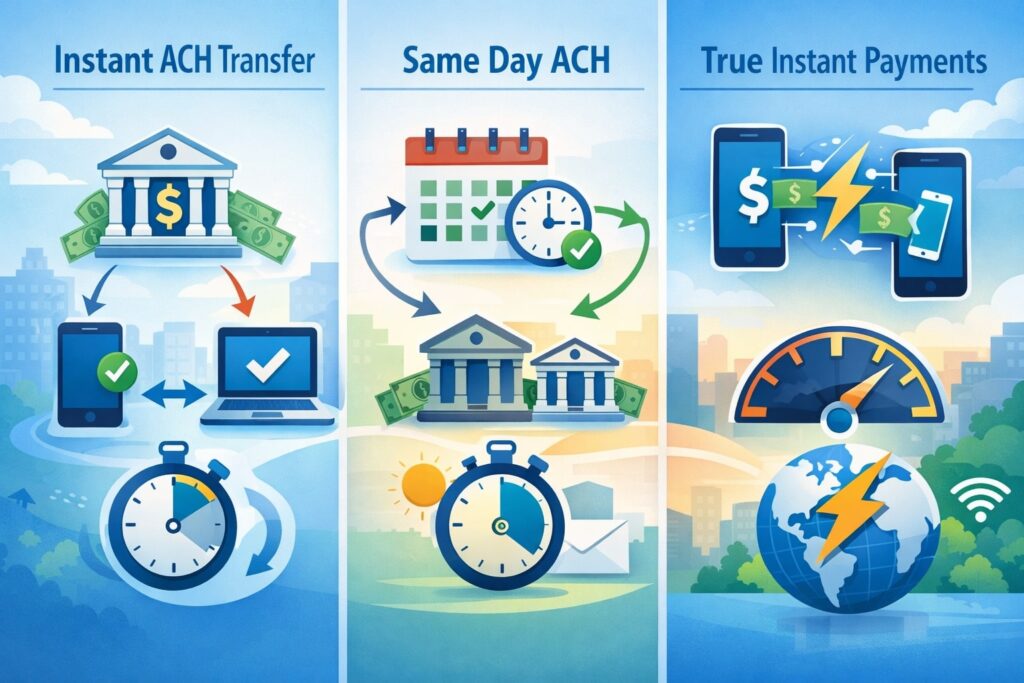
It’s important not to mix up an instant ACH transfer with true instant payment rails. ACH—even when “instant” is used in marketing—still lives in a framework with batch windows, returns, and bank posting steps. Same Day ACH is faster than traditional ACH, but it’s still ACH.
True instant payment systems are designed for 24x7x365 clearing and near-immediate settlement. In the market, the Federal Reserve’s FedNow Service is an example of an instant payments platform designed to support always-on payments, with additional features introduced over time.
Nacha’s Faster Payments resources also reflect how the industry thinks about multiple rails working together: ACH for broad coverage and low cost, plus instant payment options for use cases that need immediate movement.
So when someone asks, “Is an instant ACH transfer as fast as instant payments?” the practical answer is: sometimes it can feel close, but the rails are different. An instant ACH transfer is often a best-effort faster ACH experience; instant payment rails are built for real-time operation as a core feature.
When to choose an instant ACH transfer vs a real-time rail
Choose an instant ACH transfer when you want:
- Lower cost behavior typical of ACH
- Broad bank connectivity and familiar workflows
- Faster-than-standard delivery (same day or quicker experience), even if not guaranteed real-time
Choose an instant payment rail when you need:
- Always-on availability (including weekends/holidays)
- Immediate confirmation and settlement characteristics
- A product designed from the ground up for real-time payments
Many businesses end up using both: instant ACH transfer options for predictable low-cost payouts and collections, and true instant rails for time-critical moments.
How an Instant ACH Transfer Works End-to-End
An instant ACH transfer can look simple to a user—tap a button, confirm an amount, done. Under the hood, there’s a structured sequence of steps that determine how fast and how safely the money can move.
First, the sender’s bank account is linked and validated. Many modern payment products do more than just collect routing and account numbers; they use bank connectivity and risk checks to verify the account is active and reduce the chance of insufficient funds or unauthorized activity.
Next comes authorization and entry creation. The payment platform or originator creates the appropriate ACH entry (debit or credit, depending on the use case), attaches required data, and submits it through the ODFI into the ACH network.
If Same Day ACH is used, timing becomes critical, because processing windows and deadlines dictate whether the transfer can be delivered the same day.
Then the receiving bank posts the transaction. Even after the network delivers the entry, the RDFI must process and post it to the recipient’s account. Funds availability and posting rules influence the recipient’s experience.
Nacha’s rules around faster funds availability for certain credits are meant to reduce unnecessary delays and make outcomes more consistent.
Finally, there’s the reality of returns and exceptions. ACH has defined return processes and timeframes that can affect risk. That’s one reason many “instant ACH transfer” products rely on verification and risk controls—because “fast” is only valuable if it remains reliable and fraud-resistant.
Verification and risk scoring in an instant ACH transfer
Risk controls are a big part of why an instant ACH transfer can be faster in practice. If a provider can quickly confirm account legitimacy and reduce the probability of failure, it can justify quicker decisions and quicker access.
Many platforms describe instant ACH transfer experiences as being enabled by real-time verification, balance checks (where available), and risk signals.
This layer matters because ACH itself doesn’t magically become instantaneous. Instead, the provider shortens the “uncertainty window.”
If the system has high confidence that the payment will clear, it may deliver a faster experience to the user—sometimes by accelerating when it sends the ACH file (Same Day ACH), and sometimes by accelerating the user-facing availability based on risk.
For businesses, this means evaluating an instant ACH transfer isn’t only about advertised speed. You should also ask: What verification methods are used? How are returns handled? What fraud controls exist? What happens when something goes wrong? Those details determine whether “instant” becomes a reliable operational tool or a support headache.
Costs, Limits, Cutoffs, and Other Constraints That Affect Speed
An instant ACH transfer is usually cheaper than card acceptance for many use cases and cheaper than wires for many business transfers. But “instant” often comes with trade-offs: higher per-transfer fees than standard ACH, stricter limits, and tighter operational rules.
The first constraint is cutoff timing. Same Day ACH runs on processing windows with deadlines. If you miss a cutoff, the transfer won’t be same-day, even if the product is marketed as instant ACH transfer.
Nacha’s schedule guidance is the reference point for understanding how those windows and funds availability expectations work.
The second constraint is bank posting behavior. Two recipients at different banks can see different results from the same instant ACH transfer initiation time. Some banks post multiple times per day; others post on a schedule. Even with improved rules, posting practices still vary.
The third constraint is weekends and holidays. Traditional ACH processing is tied to banking days, while instant payment rails are built to run 24x7x365. If your business needs consistent weekend delivery, an instant ACH transfer may not be the best fit for that use case.
Finally, there are transaction limits and risk-based restrictions. Some providers cap instant ACH transfer amounts or restrict certain customer segments.
On the instant payments side, the FedNow Service continues to introduce enhancements and features over time, which can influence how businesses design payment experiences across rails.
Bottom line: the true speed of an instant ACH transfer is shaped as much by operational details as by the rail itself.
Best Business Use Cases for an Instant ACH Transfer
An instant ACH transfer is especially valuable when “faster cash movement” improves operations but you still want ACH-like economics and bank-to-bank simplicity. Many businesses adopt instant ACH transfer options in situations where delays create customer friction, missed deadlines, or extra support tickets.
- Payroll and contractor payouts are a classic example. When workers expect money quickly—especially gig workers, on-demand staff, or contractors—an instant ACH transfer can improve satisfaction and reduce payout anxiety. Even if it’s not always real-time, moving from multi-day to same-day can change the experience dramatically.
- Accounts payable and supplier payments is another strong fit. If a business can pay vendors faster without paying wire fees for every transaction, an instant ACH transfer can help maintain supplier relationships and avoid late-payment penalties. For time-sensitive invoices, same-day movement can be the difference between “paid today” and “paid next week.”
- Customer refunds and dispute resolutions can also benefit. A fast refund reduces support volume and improves trust. In many industries, “refund speed” is a competitive differentiator, and instant ACH transfer workflows help businesses deliver a better post-purchase experience.
- Rent, bill payments, and time-bound transfers are also common. If a consumer or small business needs money to arrive by end of day to avoid fees, an instant ACH transfer can provide a practical middle ground between slow ACH and expensive wires.
Across these use cases, the value is consistent: an instant ACH transfer reduces uncertainty, improves cash flow predictability, and can create a better customer experience without forcing every payment onto higher-cost rails.
Risks, Compliance, and Fraud Controls for Instant ACH Transfer Programs
Speed is great, but payments are only “better” when they stay safe and compliant. An instant ACH transfer program touches fraud risk, authorization standards, third-party oversight, returns management, and customer dispute processes.
Fraud trends have pushed the industry to update rules and guidance over time. Banks and networks emphasize controls against scams and credit-push fraud patterns, and rule updates are often positioned as part of a broader risk management roadmap.
A core reality is that ACH has return mechanisms and defined timeframes that impact finality. That means instant ACH transfer providers frequently invest in stronger onboarding, identity checks, transaction monitoring, and anomaly detection.
If your program is paying out fast, you need strong controls to prevent account takeover, synthetic identity patterns, and social-engineering-driven losses.
From a compliance standpoint, your obligations depend on your role (originator, third-party sender, platform, etc.) and your banking partners.
You should expect requirements around customer identification, sanctions screening expectations, recordkeeping, and clear consumer disclosures where applicable. Operationally, you also need a plan for exceptions: failed entries, returns, incorrect account details, and disputes.
A strong instant ACH transfer setup typically includes:
- Clear user messaging about timing and eligibility
- Real-time validation where possible
- Risk-based limits and velocity controls
- A returns and reconciliation workflow that is built into finance operations
- Monitoring tuned specifically for fast payout abuse patterns
If you treat “instant” as a marketing label without investing in controls, the program can become expensive quickly—through charge-offs, support volume, and partner-bank friction.
Implementation Guide: How to Offer Instant ACH Transfer the Right Way
Implementing an instant ACH transfer capability usually comes down to choosing a bank partner and/or payments provider, then designing a workflow that sets correct expectations while maximizing successful, fast delivery.
Start by defining your objective. Are you trying to speed up collections, payouts, or both? Collections often involve debit entries and risk of insufficient funds; payouts involve credit entries and risk of misdirected payments or fraud. The best provider fit depends on the direction of money movement and your customer base.
Next, evaluate how “instant” is achieved. Some providers emphasize Same Day ACH usage; others emphasize bank connectivity and risk scoring to speed confirmation and availability.
Your implementation should match your promise. If you can only deliver same-day for payments initiated before a cutoff, your UX should say that plainly.
Then design the operational backbone:
- Reconciliation: Make sure your ledger reflects pending vs settled states cleanly.
- Notifications: Communicate milestones (initiated, processing, delivered) without overpromising.
- Customer support: Provide self-serve tracking and clear “why it’s delayed” explanations.
- Fallback rails: For urgent cases, consider offering an instant payment rail option where available.
Finally, tune your risk strategy. An instant ACH transfer product lives or dies on risk performance. Start with conservative limits, build monitoring early, and expand as you learn your customers’ behavior.
This is where the “latest and updated” approach matters most: fraud patterns evolve, and instant money movement attracts abuse. Staying current with rule updates and partner expectations helps keep the program stable.
The Future of Instant ACH Transfer: What’s Next and What to Expect
The direction of travel is clear: businesses want faster movement, better availability, and fewer “mystery delays.” Industry conversations continue around changes that could make ACH-based experiences faster and more uniform—such as adding more same-day processing capacity or improving funds availability timing.
For example, there have been proposals and debates around potential ACH network changes like additional same-day processing windows and accelerated funds availability—along with industry feedback that highlights operational impacts on banks.
This kind of push-and-pull is normal: faster payments create customer value, but they also require operational readiness and risk controls.
At the same time, instant payment rails are expanding, and central infrastructure like the FedNow Service continues to highlight growth and ongoing enhancements, reinforcing the broader shift toward 24x7x365 expectations.
As instant rails mature, many businesses will use a multi-rail strategy: instant ACH transfer for cost-efficient speed, and true instant rails for urgent, always-on requirements.
Future prediction: over the next few years, you should expect instant ACH transfer products to become more consistent through:
- Better account validation and data connectivity
- Smarter risk decisioning (including real-time signals)
- Continued rule and operating updates that reduce posting friction
- Cleaner interoperability between ACH-based “fast” experiences and instant rails
In short, “instant ACH transfer” will likely keep evolving toward “fast enough for most cases,” while truly instant rails increasingly cover the remaining time-critical scenarios.
FAQs
Q.1: Is an instant ACH transfer actually instant?
Answer: Most of the time, an instant ACH transfer is not truly instant in the strict technical sense. It is usually “instant” in one of two ways: (1) it uses Same Day ACH to reduce the transfer to a same-day timeline, or (2) it provides an instant-feeling experience by verifying accounts and reducing risk quickly—sometimes pairing that with faster availability.
Same Day ACH can be very fast compared to standard ACH, but it still relies on processing windows and banking-day mechanics. That’s why you might see an instant ACH transfer arrive in a few hours in one situation and take longer in another.
The word “instant” often reflects the user experience (immediate confirmation, quick processing) more than guaranteed real-time settlement.
If you need “always-on, any time, even weekends” behavior, you’re often looking for an instant payment rail rather than an instant ACH transfer marketing label. In business planning, it’s best to treat “instant ACH transfer” as “faster ACH” and confirm the specific cutoffs and availability policies in your provider’s documentation.
Q.2: How long does an instant ACH transfer take, in hours?
Answer: An instant ACH transfer can take minutes to a few hours in the best cases, and same day in many typical cases—especially when it is driven by Same Day ACH and initiated early enough to make the processing windows.
However, timing depends on when the payment is initiated, whether it qualifies for same-day processing, and how the receiving bank posts incoming entries. If initiated late in the day, it may roll into the next banking day. If there is a weekend or holiday, ACH constraints can extend timelines.
To get the most consistent speed from an instant ACH transfer, initiate earlier, set clear cutoffs in your product UX, and use a provider that supports strong verification and risk controls so failures are minimized.
Q.3: Can an instant ACH transfer be sent on weekends or holidays?
Answer: In many cases, an instant ACH transfer that relies on ACH processing windows is still tied to banking days, which means weekends and holidays can limit processing. This is one of the biggest differences between an instant ACH transfer and always-on instant payment rails.
That said, some platforms may still allow users to initiate an instant ACH transfer on a weekend, then process it as soon as the next banking window opens. The user experience may still feel smoother—especially if the provider shows “scheduled” or “pending” states clearly and posts quickly when processing resumes.
If weekend and holiday delivery is a core requirement (for example, emergency payouts, time-critical disbursements, or 24×7 services), consider offering an instant payment rail option alongside instant ACH transfer. FedNow is designed to help enable 24x7x365 instant payments, with enhancements introduced over time.
Q.4: Are there limits on an instant ACH transfer amount?
Answer: Yes, instant ACH transfer programs commonly have limits, and they can vary by provider, bank partner, customer profile, and risk level. Some limits are tied to Same Day ACH operational constraints and bank risk appetite. Others are set by the payment platform to manage fraud and return exposure.
Limits can be per-transaction, per-day, or based on velocity. New users might have lower limits that expand over time with a good history. Certain industries or higher-risk patterns may remain capped.
This is one reason “instant ACH transfer” is not identical across providers—two services can have the same headline promise but very different practical usability for larger transfers.
When you’re choosing an instant ACH transfer solution, ask specifically about maximum transaction size, daily caps, how limits change over time, and what actions trigger a review. Then align those answers with your real use cases (payroll, refunds, supplier payments, etc.) so you don’t build a flow that fails at the moment customers rely on it.
Q.5: How do I reduce failures and returns with instant ACH transfer?
Answer: Reducing failures in an instant ACH transfer program starts with better data and better controls. Account verification is a major lever: validating that the account is real, open, and correctly linked reduces misdirected transfers and authorization disputes.
Many providers position real-time verification and risk assessment as core to delivering a faster experience.
Next, use smart limits and monitoring. Most early losses in fast payout programs come from “too much, too fast” exposure: high first-transaction limits, no velocity controls, and weak anomaly detection. Implement tiered limits, step-up verification for higher amounts, and clear triggers for manual review.
Finally, communicate expectations clearly. A surprising number of “failures” are actually expectation gaps: users assume a transfer is immediate when it is still processing.
Use transparent statuses (initiated, processing, delivered), define cutoffs in plain language, and provide self-serve tracking. This reduces support load and prevents repeated attempts that increase risk.
Conclusion
An instant ACH transfer is best understood as faster ACH, not magical real-time ACH. Most commonly, it means Same Day ACH and/or a provider-enhanced experience that uses verification and risk controls to deliver speed and confidence.
In terms of speed, the practical improvement is big: instead of 1–3 business days, an instant ACH transfer can often deliver in hours or by end of day when initiated before cutoffs. But the real-world result depends on timing, bank posting behavior, weekends/holidays, and the specific provider’s implementation.
For businesses, the best approach is to treat instant ACH transfer as one tool in a multi-rail strategy: use it where low cost and broad bank reach matter, and complement it with true instant-payment rails where 24x7x365 immediacy is required.
With continued rule discussions and ongoing innovation across faster payments, you can expect the “instant ACH transfer” experience to become more consistent—but it will remain important to confirm cutoffs, availability, and risk controls before you promise “instant” to customers.
Leave a Reply