
Customer authorization requirements for ACH payments are a fundamental part of accepting bank-to-bank payments responsibly. Whether a business collects invoices, rent, membership dues, recurring donations, subscription fees, deposits, or service payments, it needs the customer’s permission before initiating an ACH debit against the customer’s bank account.
That permission is more than a customer providing a routing number and account number. A useful ACH payment authorization identifies who is collecting the payment, how much may be debited, when the debit will occur, whether it is one-time or recurring, and how the customer may stop future payments.
Authorization protects both sides of the transaction. Customers receive clear information about what they are approving, while businesses gain a record showing that payment permission was obtained.
Organized authorization procedures may reduce billing confusion, unauthorized return claims, duplicate payments, incorrect amounts, and disagreements about recurring billing.
Consumer preauthorized electronic fund transfers are subject to specific requirements. Regulation E states that preauthorized transfers from a consumer account must be authorized through a writing signed or similarly authenticated by the consumer, and the person obtaining the authorization must provide the consumer with a copy.
The Nacha Operating Rules also require originators to maintain proof of authorization and follow the requirements applicable to the payment channel and transaction type.
This guide explains customer ACH authorization, one-time and recurring ACH authorization, written, online, and phone authorization methods, recordkeeping, cancellation, account verification, payment security, ACH returns, and dispute prevention.
The information is general and educational. Requirements may depend on the transaction, account type, authorization channel, financial institution, payment provider, agreement, and applicable law. Businesses should obtain qualified legal, accounting, banking, cybersecurity, or payment compliance guidance for their specific circumstances.
What Are Customer Authorization Requirements for ACH Payments?
Customer authorization requirements for ACH payments refer to the permission a business must obtain before initiating an ACH debit from a customer’s bank account. The customer is commonly called the receiver, while the business initiating the debit is commonly called the originator.
An ACH debit allows the originator to request funds through the Automated Clearing House network. The originator’s financial institution, known as the ODFI, submits the payment. The customer’s financial institution, known as the RDFI, receives the entry and debits the designated account when the transaction is accepted.
Because an ACH debit pulls funds from an account, the authorization should establish the limits of the business’s payment permission. Those limits may include the payment amount, debit date, frequency, bank account, reason for payment, and duration of the authorization.
Why Authorization Is Required Before ACH Debits
An ACH debit does not begin with the account holder actively pushing money to the business. Instead, the business initiates an instruction to debit the customer bank account. For that reason, the business needs evidence that the account holder approved the transaction.
Clear ACH debit consent helps prevent situations in which customers do not recognize a debit, misunderstand a payment schedule, dispute an amount, or believe a cancelled arrangement is still active. It also gives billing and customer service teams a reliable source to review when questions arise.
An authorization should be obtained before the debit is initiated. It should be connected to the actual transaction or payment arrangement rather than treated as a general approval to collect any amount at any time.
Authorization requirements can differ depending on whether the payment involves a consumer account or business account, whether it is single or recurring, and whether permission is collected through paper, an online form, a phone call, or another supported channel.
The business’s ODFI and payment processor may also impose procedures beyond the minimum network rules.
Customer Authorization vs. Payment Information
A customer may provide an account number, routing number, voided check, bank letter, or instant account connection without giving the business permission to initiate a debit. Payment information identifies where funds may come from. Authorization explains whether the business is allowed to use that information for a particular payment.
This distinction matters in online banking and open-banking workflows. Permission to access or share financial data is separate from permission to initiate an ACH payment. A customer who connects a bank account or permits access to account data still needs to authorize the applicable debit transaction.
The authorization should state what the customer is approving. For example, it may permit a single invoice payment of a stated amount, monthly membership dues, variable utility-style charges, or recurring donations until cancellation.
Businesses should avoid assuming that a saved payment method creates unlimited ACH payment permission. A bank account stored for one invoice should not automatically be used for a second invoice, subscription, late fee, or unrelated balance unless the authorization supports that use.
ACH Authorization Requirements at a Glance
A dependable ACH authorization process connects customer identity, payment terms, recordkeeping, cancellation, and security. The following table provides a practical overview that billing, finance, and payment teams can use when designing or reviewing an ACH payment workflow.
| Authorization Area | What It Should Explain | Why It Matters | Priority |
| Customer identity | Who is authorizing the payment | Connects consent to the account holder or authorized representative | High |
| Business identity | Who will initiate the debit | Helps the customer recognize the transaction | High |
| Payment amount | Fixed amount, range, or calculation method | Reduces unexpected-amount disputes | High |
| Payment timing | Debit date or recurring schedule | Establishes when funds may leave the account | High |
| Payment frequency | One-time, recurring, or customer-initiated | Defines the scope of permission | High |
| Bank account | Which account will be used | Supports accurate processing | High |
| Authorization method | Written, electronic, or supported oral method | Establishes how consent was collected | High |
| Cancellation terms | How future authorization may be revoked | Gives customers an understandable stopping process | High |
| Confirmation | Receipt or copy of the authorization | Helps both sides remember the approved terms | Medium/High |
| Record retention | How proof of consent will be stored | Supports disputes, audits, and provider requests | High |
| Security | How bank information will be protected | Reduces exposure of sensitive financial data | High |
How to Use the Table
The table can serve as a pre-launch checklist for any business preparing to accept ACH payments. Start by reviewing the proposed customer journey from the customer’s perspective. Determine what the customer sees before entering bank information, what authorization statement appears, and what happens after the customer approves the payment.
Next, review the operational journey. Identify where the authorization record is stored, who can access it, how it is connected to the customer and transaction, and how a cancellation request reaches the billing system. The authorization should not remain isolated in an employee’s inbox or an unindexed folder.
Businesses can also compare the table against existing ACH customer authorization forms. A form may collect bank details and a signature but fail to identify the recurring schedule, variable payment method, business name, or revocation procedure.
Finally, test whether the record could be retrieved quickly. A payment team should be able to locate the authorization text, customer approval, transaction details, and subsequent changes without reconstructing the history from multiple systems.
Why Authorization Needs Differ by Payment Type
A one-time invoice payment does not require the same operational structure as an open-ended recurring payment. The invoice authorization may identify one amount and one processing date. A subscription authorization must explain an ongoing schedule, the amount or calculation method, and how the customer may cancel future debits.
Variable payments require additional attention because the amount may change from one debit to the next. Rent adjustments, usage-based services, changing invoice balances, property charges, and donation pledges may require notices or carefully defined calculation terms.
Phone authorization creates different documentation needs from an online payment form. Business-to-business payments may involve an authorized employee, treasury approval process, vendor agreement, or corporate bank account controls.
A membership organization may need to distinguish annual renewal from monthly dues. A property manager may need separate authorization for rent, deposits, utilities, repairs, or late charges. A nonprofit may need to distinguish a single donation from an ongoing pledge.
Authorization should therefore be designed around the actual payment type rather than using one generic statement for every situation.
What Is ACH Payment Authorization?

ACH payment authorization is the customer’s permission for a business to initiate an ACH entry under defined terms. It establishes the agreement between the receiver and the originator and supports the originator’s ability to demonstrate that the transaction was properly approved.
An authorization may cover an ACH debit, an ACH credit, a single transaction, a recurring series, or individual payments initiated under a standing arrangement. The required form and documentation depend on the account, entry type, channel, and applicable rules.
Businesses seeking a broader explanation of the document itself can review this guide to what an ACH authorization form is.
What ACH Authorization Should Make Clear
A complete ACH payment authorization should identify the customer and the business initiating the transaction. It should indicate the bank account being used, usually through the account type and masked account details in customer-facing confirmations.
The authorization should describe the amount. For a fixed payment, it may state the exact amount. For a recurring fixed payment, it should state both the amount and frequency. For a variable payment, it should explain how the amount is calculated and how the customer will be informed.
Timing is also important. The authorization may list a specific date, a recurring day of the month, an invoice due date, or another understandable schedule. It should distinguish a one-time ACH authorization from recurring ACH authorization.
The agreement should also describe how authorization can be cancelled or revoked. Useful instructions identify the communication method, contact information, and any reasonable processing deadline before the next scheduled debit.
Finally, the record should show the customer’s affirmative approval, including a signature, electronic signature, authenticated action, recorded oral authorization, or other method permitted for that transaction.
Why Clear Wording Matters
Customers should be able to understand the payment arrangement before providing ACH payment consent. Dense wording, hidden terms, preselected consent, or vague statements can leave customers uncertain about what they approved.
The authorization should prominently state that the customer is permitting an ACH debit from a bank account. It should not require the customer to infer this from wording such as “continue,” “save payment method,” or “complete purchase.”
Important terms should appear near the approval action. These include the amount, payment date, frequency, recurring status, business identity, and cancellation method. A customer should not have to search through unrelated service terms to understand the bank debit.
Clear wording is especially important when the billing name that appears on the customer’s account statement may differ from the name used in the service relationship. The authorization and confirmation should help the customer recognize the debit.
A well-written authorization supports customer understanding while creating a more useful audit trail for billing teams, financial institutions, and payment providers.
ACH Debit Authorization, ACH Credits, and Common Payment Uses

ACH debit authorization gives a business permission to pull funds from a designated account. An ACH credit works in the opposite direction: the payer instructs its financial institution to push funds to the recipient.
Both transactions require proper payment authority, but ACH debit authorization usually needs more detailed customer-facing consent because the originator controls the timing of the debit after receiving permission.
ACH Debit vs. ACH Credit Authorization
With an ACH debit, the business sends an entry through its ODFI requesting funds from the receiver’s account at the RDFI. The customer’s authorization establishes the business’s right to initiate that request according to the agreed terms.
With an ACH credit, the party sending the money generally instructs its own bank or payment service to send funds. Examples include payroll, vendor payments, refunds, and customer-initiated invoice payments. The recipient does not pull the funds in the same manner.
Debit authorization is especially important because the business may retain payment information and initiate the transaction later. A recurring billing system might submit monthly debits without further action by the customer. The authorization must therefore define what the system may do.
Businesses should not use an ACH credit instruction, bank verification, prior payment, or account connection as evidence that future ACH debits were authorized. Each workflow should be mapped to the appropriate payment direction and approval method.
The Nacha Operating Rules define responsibilities for originators, ODFIs, RDFIs, receivers, and other participants throughout the ACH network.
Examples of ACH Debit Authorization
A professional service firm may obtain one-time ACH payment permission for a specific invoice. The authorization identifies the invoice, amount, customer account, and scheduled debit date.
A subscription business may use recurring ACH authorization for a monthly service fee. The customer approves the amount, monthly schedule, starting date, bank account, and cancellation process.
A property manager may collect rent on a fixed monthly date. Separate permission may be appropriate for variable utilities, repairs, deposits, or other charges that are not included in the regular rent amount.
A nonprofit may receive a single donation or an ongoing monthly pledge. The customer ACH authorization should distinguish those options and explain how recurring donations can be changed or cancelled.
A membership organization may collect monthly, quarterly, or annual dues. The authorization should reflect renewal timing and any amount adjustments.
A B2B company may debit a customer’s corporate account for approved invoices. The agreement should identify the authorized representative, invoice process, account, payment timing, and internal approval conditions.
One-Time, Recurring, and Variable ACH Authorization
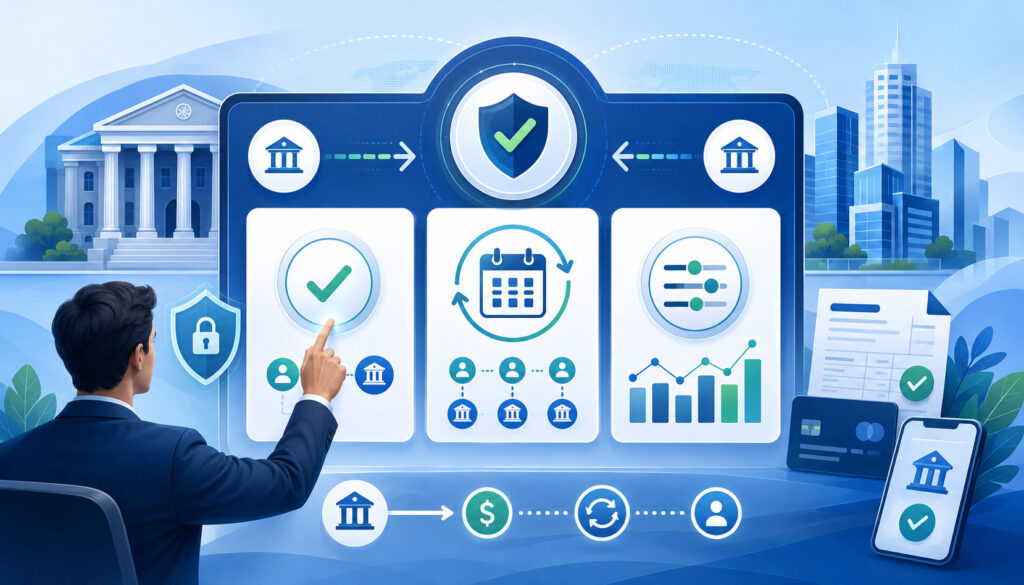
The scope of ACH payment permission should match the payment arrangement. One-time authorization covers a single debit. Recurring authorization covers an ongoing series. Variable authorization permits amounts that may change according to stated terms.
Using the wrong authorization type can create confusion. A one-time payment should not quietly become recurring billing, and a fixed recurring authorization should not be treated as permission to debit unrelated variable balances.
One-Time ACH Authorization
A one-time ACH authorization permits one identified debit. Common uses include invoice payments, deposits, single donations, tuition payments, event fees, one-off services, account balances, and individual ecommerce orders.
The authorization should state the customer name, business identity, payment amount, payment date or processing window, bank account, and one-time nature of the payment. It should also include a clear authorization statement and a reliable record of customer approval.
A common mistake is reusing the authorization after the original payment fails or after another balance becomes due. Whether a debit may be resubmitted depends on the return reason, applicable rules, provider requirements, and the scope of the original authorization. A new and separate obligation should generally be supported by appropriate payment permission.
Another mistake is changing the amount after approval without obtaining updated consent. If the invoice changes, the safer operational approach is to present the revised amount and document the customer’s approval before submitting the debit.
Recurring ACH Authorization
Recurring ACH authorization permits a business to initiate a series of debits according to an agreed schedule. It is commonly used for subscriptions, memberships, service contracts, rent, donation pledges, retainers, installment plans, and scheduled invoice payments.
The authorization should identify the frequency, start date, amount, or method used to determine the amount. It should explain whether the arrangement has an end date or continues until the customer cancels it.
Consumer preauthorized debits require a writing signed or similarly authenticated by the consumer, along with a copy provided to the consumer. Electronic authorization may satisfy the writing requirement when it is implemented appropriately and creates a record the consumer can retain.
Recurring ACH authorization needs extra clarity because customers may forget the schedule or fail to recognize the billing description. Confirmation messages, upcoming-payment reminders, accessible account history, and cancellation acknowledgments can reduce that confusion.
Businesses should also document changes to the amount, schedule, account, or service arrangement rather than editing the billing profile without retaining evidence of the customer’s updated permission.
Variable Amount ACH Authorization
Variable authorization may be used when payment amounts change from one period to another. Examples include invoice balances, usage-based services, property expenses, utility-style charges, professional service hours, changing donations, and amounts based on customer activity.
The authorization should explain how the amount will be calculated, when the customer will learn the final amount, and when the debit will occur. An undefined statement allowing the business to debit “any amount due” may not give the customer enough information to understand the payment arrangement.
Regulation E generally requires written notice of the amount and date of a varying preauthorized consumer transfer at least 10 days before the scheduled transfer.
It also provides an alternative under which the consumer may choose to receive notice only when the transfer falls outside an agreed range or differs by more than an agreed amount. Businesses should obtain professional guidance on how this applies to their workflow.
Invoices, reminders, portal notifications, and payment confirmations can help prevent surprise debits. The notice process should be documented so the business can show what information was sent and when.
Written, Online, and Phone ACH Authorization
ACH payment consent may be collected through different channels. The correct method depends on the account, transaction type, Standard Entry Class code, provider capabilities, and applicable rules.
A business should not choose a channel based only on convenience. It should confirm that the authorization method is supported by its ODFI or processor and that the resulting record can be retained and reproduced.
Written ACH Authorization
Written ACH authorization may appear on a paper form, signed service agreement, rental agreement, donation form, payment plan, or separate ACH authorization agreement. A scanned signed document may be stored as part of the customer record when the original process meets applicable requirements.
A written ACH authorization form commonly includes the customer name, business identity, bank name, account type, routing number, account number, payment amount, payment date, frequency, authorization statement, cancellation instructions, signature, and date.
The authorization should be visually distinguishable from unrelated contract terms. Customers should be able to identify the bank debit permission and understand whether it covers a one-time payment or recurring billing.
Paper documents require secure handling. Completed forms should not be left on desks, stored in open cabinets, or shared broadly. Scanned copies should be placed in a controlled system rather than an unrestricted shared drive.
Businesses should also avoid requesting completed forms through unsecured email when the document displays full routing and account numbers. A secure upload process or provider-hosted form can reduce unnecessary exposure.
Online ACH Authorization
Online ACH authorization may be collected through a hosted payment page, invoice portal, customer account, payment link, electronic agreement, or checkout form. The customer should see the relevant payment terms before taking the action that indicates approval.
The form should display the business identity, amount, timing, frequency, bank account being used, authorization statement, and cancellation terms. For recurring payments, the customer should not discover the ongoing schedule only after submitting the form.
Digital recordkeeping may include the exact authorization text, timestamp, customer account identifier, transaction reference, masked bank details, electronic signature information, confirmation receipt, and relevant authentication data.
IP address or device information may be retained when appropriate, but it should not be treated as the only proof of consent.
Nacha’s industry guidance for internet-initiated entries emphasizes connecting authorization evidence with authentication, transaction information, and the process used to demonstrate customer assent.
A secure payment form should also prevent employees from routinely handling raw account numbers when tokenization or provider-hosted collection is available.
Phone ACH Authorization
Phone ACH authorization may be available for certain supported transactions, but it requires careful procedures. The business should confirm the applicable entry type, customer relationship requirements, authorization language, recording process, and confirmation obligations with its provider.
For a single telephone-initiated entry, Nacha rules provide that the originator must either make an audio recording of the oral authorization or send written confirmation of the authorization before settlement. The applicable record must also be retained according to the rule requirements.
A phone script should identify the business, customer, payment amount, debit date, account being used, one-time or recurring status, and customer’s authorization. Staff should not rush through the statement or replace it with an informal “Is that okay?”
Records may include the call date, employee name, customer verification steps, authorization audio, written confirmation, transaction details, and follow-up communication.
Because recurring consumer debits have additional written or similarly authenticated authorization requirements, businesses should not assume that a routine unrecorded phone conversation is sufficient.
ACH Authorization Forms and Recurring Billing Workflows
An ACH authorization form is the document or electronic record used to capture ACH payment permission. The form is only one part of the process. The business must also connect the authorization to payment scheduling, customer communication, storage, access control, cancellation, and return handling.
A step-by-step overview of how to set up an ACH authorization form can provide additional operational context.
Common Fields and Form Best Practices
A practical ACH customer authorization form may include the customer’s full name, business name where applicable, billing address, email, phone number, account type, routing number, account number, and confirmation that the signer is authorized to use the account.
Payment fields should identify the transaction type, amount, frequency, start date, end date if applicable, and method for calculating variable charges. A recurring authorization should not look identical to a one-time authorization without a clear selection.
The authorization statement should identify ACH debits and the business initiating them. Cancellation instructions should provide a workable contact channel and explain how much processing time may be needed before the next scheduled debit.
The approval section may include a handwritten signature, electronic signature, similarly authenticated action, date, and transaction reference. The customer should receive a copy or durable confirmation when required.
For security, forms should mask account details after submission. Employees who need to confirm the payment method usually do not need to see the entire account number.
Managing Online and Recurring Authorizations
An online recurring billing workflow should preserve the terms the customer originally approved. If the authorization wording changes later, the business should still be able to reproduce the earlier version connected to the customer’s approval.
The system should record the recurring schedule, next debit date, amount, variable calculation method, customer communications, and cancellation status. Bank account updates should create a new record or auditable change history rather than silently replacing prior information.
When customers cancel, the recurring payment profile should be disabled promptly and the cancellation should be confirmed. Customer service notes alone may not stop an automated billing system, so cancellation workflows should connect support, billing, and payment tools.
Failed payments should be classified by return reason. An NSF return, closed account, revoked authorization, and unauthorized claim require different responses. Automated retries should not override authorization status.
The business should also reconcile scheduled debits against submitted transactions. This helps identify duplicate files, incorrect amounts, debits processed after cancellation, and payments submitted on the wrong date.
Authorization Requirements for ACH Debits From Business Customers
Business-to-business ACH payments often involve corporate bank accounts, invoice approval procedures, treasury controls, vendor agreements, and employees acting on behalf of an organization.
Regulation E generally focuses on consumer accounts, but business debits remain subject to the Nacha Operating Rules, contractual obligations, bank agreements, and other applicable requirements.
A business should not assume that any employee who provides bank details is permitted to authorize debits from the organization’s account.
Confirm Authorized Representatives
The person approving a B2B ACH debit should have authority to act for the customer organization. Depending on the relationship, this may be an owner, officer, controller, accounts payable manager, treasury employee, or another designated representative.
The authorization record may include the representative’s name, title, business email, phone number, company name, customer account number, and acknowledgment of authority. For higher-value or unusual transactions, the business may use additional verification or a second approval.
B2B authorization may be contained in a service contract, vendor agreement, payment addendum, invoice arrangement, or separate ACH authorization agreement. Regardless of format, the payment terms should be identifiable.
Businesses should also review requests to change bank information carefully. A compromised email account could be used to submit fraudulent instructions. Independent confirmation through a known contact method can reduce this risk.
Corporate customers may apply debit blocks or filters to their accounts, so payment setup may also require coordination with the customer’s financial institution.
Keep B2B ACH Records Organized
Business payment records should connect the authorization to the agreement, invoices, account details, approvals, debit schedule, and transaction history. This is especially important when different departments manage sales, contracts, accounts receivable, and payment processing.
A searchable record may include the signed agreement, authorized representative, customer account, invoice references, payment confirmation, account updates, return notices, and cancellation or suspension requests.
Businesses should document whether the authorization applies to every invoice, a defined payment plan, a maximum amount, or only invoices separately approved by the customer. “Account on file” should not replace a clear description of the payment workflow.
When the authorized representative leaves the customer organization, the business may need to obtain updated confirmation. Similarly, material changes to contract terms, payment amounts, or debit timing may justify updated ACH payment consent.
Organized B2B records help teams respond when a corporate customer reports that a debit was not authorized, was submitted for the wrong invoice, or did not follow the agreed approval process.
Customer Consent Language and Bank Account Verification
ACH payment consent should communicate the actual payment arrangement without hiding key terms. Account verification should confirm that account information is usable or connected to the customer, but it serves a different purpose from authorization.
A reliable workflow uses both where appropriate: verification reduces errors, while authorization establishes payment permission.
Writing Effective ACH Payment Consent
An authorization statement should clearly say that the customer authorizes the identified business to initiate an ACH debit from the designated account. It should distinguish between one-time, recurring, and variable payments.
The statement should include or reference the amount, date, frequency, payment purpose, and revocation procedure. Important details should appear before the customer signs or submits the form.
Phrases such as “save my bank details,” “process my order,” or “use my account” may not adequately explain the scope of an ACH debit authorization. The wording should make the debit itself clear.
Consent should not combine unrelated permissions in a way that makes approval difficult to understand. Marketing consent, service terms, privacy notices, and ACH payment authorization may be presented together, but the bank debit authorization should remain readily identifiable.
Businesses should treat sample authorization language as a starting point rather than a final legal template. The wording should be reviewed against the payment type, account type, provider instructions, and applicable requirements.
Verification Does Not Replace Authorization
Bank account verification may use routing-number validation, micro-deposits, instant account verification, account ownership signals, or customer identity checks. These procedures can help identify invalid account information and reduce some administrative returns.
However, successful verification does not prove that the customer authorized a particular debit. It may show that the account exists, that credentials were used, or that the customer can access the account. The authorization must still explain what payment the business is permitted to initiate.
Nacha requires account validation for the first use of consumer account information in certain online debit contexts. Businesses should review the current account validation guidance and their provider’s procedures.
Verification also does not replace confirmation that the person is an authorized signer. This is particularly important for business accounts, joint accounts, property management arrangements, and accounts managed by someone other than the named customer.
The best workflow documents both the verification result and the customer’s separate payment authorization.
ACH Authorization Records, Retention, and Cancellation
Authorization records provide evidence of who approved the payment, what was approved, when approval occurred, and how the business collected consent. They should be retained in a form that can be accurately reproduced and retrieved.
The record should remain connected to changes, cancellations, payment history, and customer communications rather than being stored as an isolated form.
Why Authorization Records Matter
Authorization records help businesses answer customer questions, investigate unauthorized return claims, respond to ODFI or processor requests, and conduct internal reviews. A business that cannot retrieve the authorization may have difficulty demonstrating that the debit followed the approved terms.
Useful records may include a signed ACH authorization form, electronic consent log, timestamp, authorization wording, identity verification, confirmation email, payment receipt, account update, recorded call, recurring schedule, cancellation request, and staff action history.
Under the Nacha Operating Rules, originators generally must retain the original or a copy of each written authorization, or a reproducible record of another authorization method, for two years after termination or revocation. Channel-specific requirements may also apply.
A business may choose a longer retention period based on contractual obligations, dispute exposure, provider requirements, recordkeeping policy, or professional advice.
Records should be indexed by customer, transaction, authorization type, payment date, and status. The ability to retrieve the correct version is as important as storing it.
Authorization Revocation and Cancellation
Revocation means the customer withdraws permission for future debits covered by the authorization. Cancellation procedures should be stated on authorization forms, payment pages, confirmations, receipts, and customer account portals where applicable.
The business should identify supported cancellation channels, such as a secure portal, email address, phone number, or written notice. It should also explain any reasonable cutoff needed to stop a debit already in process.
Regulation E permits consumers to stop payment of a preauthorized electronic fund transfer by notifying their financial institution orally or in writing at least three business days before the scheduled transfer. This right is separate from contacting the business to revoke authorization.
When a business receives a revocation, it should record the request, update the recurring schedule, prevent future submissions, and send confirmation. Staff notes should be synchronized with the payment system so an automated debit is not sent after cancellation.
A new authorization should be obtained before resuming debits when the previous permission has been revoked or when required by the return circumstances.
ACH Payment Disputes, Returns, and Security
Missing, unclear, or poorly managed authorization can lead to customer disputes and unauthorized ACH returns. Other returns may result from insufficient funds, closed accounts, invalid account information, stop payments, or transactions that do not match the authorization.
Return handling should combine payment knowledge, customer communication, documentation, and security controls.
Why Unauthorized Returns Happen
Unauthorized returns may occur because no authorization was obtained, the customer does not recognize the originator, the authorization was revoked, or the debit did not match the approved amount, timing, or frequency.
Nacha distinguishes between R10, which may indicate that the customer does not know the originator or did not authorize the debit, and R11, which indicates that a relationship and authorization exist but the entry did not conform to the authorization terms.
R07 relates to revoked authorization, while R29 is used when a corporate customer advises that a debit was not authorized.
Duplicate debits, outdated billing descriptors, unexpected renewals, and missed cancellation requests may also lead customers to contact their banks.
Businesses should investigate the reason code before retrying a returned payment. Authorization-related returns should not be handled like ordinary NSF returns.
A practical guide to resolving common ACH return codes can help teams distinguish temporary payment failures from account-data and authorization problems.
How to Reduce ACH Payment Disputes
ACH payment dispute prevention begins before the debit is submitted. The customer should know the business identity, payment amount, debit date, recurring schedule, cancellation procedure, and statement description.
After authorization, send a confirmation or receipt that repeats the important terms. For recurring or variable payments, reminders can help customers maintain sufficient funds and recognize the upcoming transaction.
Accurate payment descriptors are important. Customers are more likely to dispute a debit when the statement name does not resemble the business or service they know.
Billing teams should monitor return patterns. A rise in R10 or R11 returns may indicate weak authorization wording, unexpected amounts, incorrect dates, or poor customer communication. A rise in account-related returns may indicate ineffective validation or outdated bank information.
Businesses should also make cancellation reasonably accessible. Customers who cannot stop recurring billing through the business may instead use their financial institution’s dispute or stop-payment process.
Broader ACH risk mitigation guidance can support reviews of authorization, verification, access, and return procedures.
Protect Customer Bank Information
Routing numbers, account numbers, authorization records, and transaction histories should be treated as sensitive financial information. They should not be stored in unsecured spreadsheets, email threads, customer service notes, personal devices, or broadly accessible shared folders.
Whenever practical, businesses can use hosted payment forms and tokenization so the payment provider stores the full account information. Internal systems may retain a token, masked account number, account type, and bank name for reconciliation.
Stored sensitive data should be encrypted, and transmission should occur through secure sessions. CISA identifies encryption as an important method for protecting customer details, financial records, and other sensitive business information.
Access should follow job responsibilities. Customer service personnel may need to view payment status without seeing full bank details. Only approved roles should create debits, change bank accounts, issue refunds, export reports, or modify recurring schedules.
Multifactor authentication is particularly important for administrative users and employees handling sensitive data.
ACH Authorization Communication for Different Business Types
Strong authorization is supported by ongoing communication. Customers should be able to identify what they approved, when a payment will occur, what happens after a failed payment, and how to update or cancel the arrangement.
The communication method may vary by business model, but the objective remains consistent: reduce surprises and maintain an accurate payment record.
Confirm What the Customer Approved
After authorization, provide a receipt, email, downloadable record, or portal confirmation. The confirmation should identify the business, payment type, amount, date, frequency, masked account, and cancellation method.
For recurring billing, reminders may be especially useful before the first debit, annual renewal, changed amount, or debit after a long interval. Failed-payment messages should explain the next step without implying that every return will automatically be retried.
Cancellation confirmations should state that future scheduled debits have been stopped and identify any payment that was already submitted before the request could be processed.
When an amount or date changes, communicate the change through a channel the customer regularly uses. Retain evidence of the notice and any required updated consent.
Support contact information should be easy to find. A customer who can quickly ask about an unfamiliar payment may contact the business before filing a bank dispute.
Authorization Across Business Models
Service businesses may use one-time authorization for invoices, deposits, and project balances, or recurring authorization for retainers and ongoing contracts. Each payment should match the scope of the service agreement.
Property managers may collect rent through recurring ACH authorization while handling deposits, utilities, repairs, and other variable charges separately. Combining every possible charge under one broad authorization can increase confusion.
Nonprofits should distinguish a single donation from a recurring pledge. Donors should receive clear confirmation and an accessible method to change or cancel future contributions.
Membership organizations should identify whether dues renew monthly, quarterly, or annually. Renewal notices are particularly useful when long periods separate payments.
Subscription companies should connect payment cancellation with service cancellation rules without making the ACH revocation process difficult to understand.
B2B companies may rely on invoice approvals, contracts, or standing payment arrangements. They should verify the representative’s authority and maintain records that connect each debit to the agreed workflow.
Ecommerce businesses should ensure that a one-time checkout payment is not treated as permission for future debits unless the customer separately approves that arrangement.
Customer Authorization Requirements Checklist
The following checklist can help business owners, finance teams, billing teams, accounting staff, and office managers review ACH authorization procedures before accepting payments or launching recurring billing.
| Authorization Area | Question to Ask | Why It Matters | Priority |
| Customer identity | Do we know who authorized the payment? | Connects consent to the correct person | High |
| Representative authority | Can the person use the account? | Reduces unauthorized account use | High |
| Business identity | Is the debiting business clear? | Helps the customer recognize the payment | High |
| Payment amount | Is the amount or calculation method stated? | Reduces amount disputes | High |
| Payment date | Is the processing date understandable? | Sets timing expectations | High |
| Frequency | Is the payment one-time or recurring? | Defines the scope of permission | High |
| Variable terms | Are changing amounts explained? | Reduces surprise debits | High |
| Cancellation | Can future authorization be revoked? | Supports customer control | High |
| Confirmation | Does the customer receive a record? | Reinforces approved terms | Medium/High |
| Recordkeeping | Can proof be retrieved quickly? | Supports reviews and disputes | High |
| Verification | Are account details checked appropriately? | Reduces entry errors | Medium/High |
| Security | Is sensitive information protected? | Reduces data exposure | High |
| Staff access | Are permissions limited by role? | Prevents unauthorized changes | High |
| Return handling | Are return codes reviewed before retrying? | Prevents inappropriate resubmission | High |
How to Use the Checklist
Use the checklist before accepting the first ACH payment, adding a new authorization channel, or launching recurring billing. Assign each question to a responsible team member rather than treating ACH authorization as a payment-provider task alone.
Billing may own the authorization form and schedule. Customer service may own cancellations and payment questions. Finance may own reconciliation and return review. Information security may own access controls and data protection.
Test the complete workflow. Submit a sample authorization, locate the confirmation, schedule a payment, change the account, cancel the arrangement, and retrieve the original record. This reveals gaps that may not appear during a document-only review.
The checklist can also be used after a dispute. Identify whether the problem resulted from missing consent, unclear terms, a billing error, poor communication, incorrect account data, or delayed cancellation.
Reviewing the checklist periodically helps keep forms, staff procedures, provider settings, and customer communications aligned.
Records to Keep With ACH Authorizations
The authorization record should be supported by related documents that explain the payment history. These may include invoices, service agreements, recurring billing schedules, confirmation emails, account verification results, payment receipts, bank account updates, and customer communications.
Cancellation requests should be stored with the original authorization. The record should show when the request was received, who processed it, which scheduled payments were stopped, and when the customer received confirmation.
Return notices and reason codes should also be retained. They help the business determine whether a payment may be corrected, whether customer contact is needed, or whether authorization must be reviewed.
Refund and reversal records should identify the original payment and the reason for the adjustment. A reversal should not be used simply because a customer changed their mind or because the business lacks a clear refund process.
Processor statements, transaction exports, and reconciliation reports can provide additional evidence, but they do not replace the underlying ACH payment permission.
Common Mistakes and Best Practices for Customer ACH Authorization
Most authorization problems are operational rather than technical. A business may have a signed form but fail to send a copy, document changes, stop payments after cancellation, protect account data, or connect the authorization to the correct recurring schedule.
A strong process combines understandable consent, reliable records, customer communication, security, and trained staff.
Common ACH Authorization Mistakes
One of the most common mistakes is assuming that bank information equals authorization. A routing number and account number do not explain the amount, timing, frequency, or purpose of a debit.
Another mistake is using vague consent wording. Statements such as “I agree to pay” may not identify ACH debits or establish whether the payment is one-time or recurring.
Businesses may also fail to retain proof of consent. An authorization stored only in an employee’s email account may be difficult to retrieve after staff turnover or a customer dispute.
Poor recurring billing communication is another frequent problem. Unexpected renewal dates, changed amounts, unclear descriptors, and difficult cancellation processes may increase complaints.
Other mistakes include processing after revocation, retrying authorization-related returns without review, storing full bank details in unsecured locations, allowing excessive staff access, and changing account information without adequate verification.
Training should help staff recognize that payment failures, account-data returns, and authorization disputes require different responses.
Best Practices and Internal Policy
Businesses should obtain authorization before initiating ACH debits and use separate workflows for one-time, recurring, and variable payments. Forms should identify the business, customer, account, amount, timing, frequency, and cancellation method.
A written internal policy can define accepted authorization methods, required fields, confirmation procedures, record retention, cancellation handling, account changes, access controls, return management, and employee responsibilities.
The policy should explain who may create or modify ACH payments, who reviews higher-value transactions, how bank changes are confirmed, and how unauthorized returns are escalated.
Authorization procedures should be reviewed regularly. Useful review areas include customer complaints, recurring schedules, cancellation delays, R10 and R11 returns, account validation failures, duplicate payments, staff permissions, and the security of stored records.
Businesses should update forms when their payment model changes. A form designed for fixed monthly payments may not support usage-based billing or annual renewals.
Professional guidance should be obtained for legal, accounting, banking, cybersecurity, tax, payment compliance, investment, lending, or financial questions.
How to Obtain Authorization for ACH Payments Step by Step
A repeatable ACH authorization process reduces reliance on employee memory and makes customer experiences more consistent. The process should begin with the payment type and continue through confirmation, record storage, processing, return monitoring, and cancellation.
The following sequence provides a general operational framework:
- Identify whether the payment is one-time, recurring, variable, written, online, phone-authorized, consumer, or B2B.
- Confirm the authorization method supported by the ODFI or payment processor.
- Present the business identity, amount, timing, frequency, and cancellation terms.
- Collect the customer’s affirmative ACH debit consent.
- Verify account information where appropriate.
- Provide the customer with a copy, receipt, or confirmation.
- Store the authorization and related audit trail securely.
- Submit only transactions that match the authorization.
- Reconcile payments and review ACH returns.
- Document account updates, amount changes, cancellations, and new authorizations.
Start With the Payment Type
Before creating a form, determine exactly how the business intends to collect payment. A single invoice requires a different authorization from an indefinite monthly subscription. A variable invoice arrangement needs more detail than a fixed monthly fee.
Identify whether the account is a consumer or business account. Determine whether the customer will approve the payment on paper, through an online portal, during a supported phone call, or through another provider-approved process.
Next, define the payment amount and timing. For variable amounts, document how the amount is calculated and how notice will be provided. For recurring payments, establish the start date, frequency, duration, and cancellation procedure.
Confirm which ACH entry type and authorization procedures the payment provider expects. Do not design a phone, online, or recurring workflow without checking whether the provider supports it.
Once the transaction is clearly defined, the authorization can be written around the actual payment rather than relying on a broad generic statement.
Confirm, Store, and Process the Authorization
After the customer approves the payment, send a confirmation that restates the important terms. The customer should be able to retain or access the authorization when required.
Store the authorization in a secure, searchable system. Connect it to the customer account, transaction, recurring schedule, verification record, and version of the authorization text.
Before processing, confirm that the amount, date, account, and frequency match the authorization. Controls may flag unusually large payments, changed bank accounts, duplicate transactions, or debits scheduled after cancellation.
After submission, monitor settlement and returns. Classify return codes before deciding whether to retry, request updated information, obtain new authorization, or escalate the issue.
Document all later changes. An updated amount, new account, revised schedule, or resumed recurring plan may require updated authorization or confirmation.
The process should end only after the authorization is terminated, revoked, or no longer needed and the record has been retained according to the applicable policy.
How to Choose ACH Processing With Authorization Support
An ACH processing setup should make authorization easy for customers to understand and easy for the business to document. Payment price and speed matter, but authorization tools, record retrieval, return reporting, security, and cancellation support also affect long-term usability.
Businesses should evaluate how the platform supports their actual payment model rather than assuming that every ACH tool handles recurring, variable, phone, online, and B2B authorizations in the same way.
Questions to Ask an ACH Processor
Ask how the provider supports one-time, recurring, standing, online, written, and telephone authorization. Determine whether it supplies configurable forms or requires the business to create its own authorization process.
Ask whether hosted payment pages display the business identity, payment amount, timing, frequency, cancellation instructions, and authorization statement before submission.
Determine what authorization evidence is stored. Useful records may include timestamps, authorization text, electronic signatures, customer confirmations, transaction references, and account verification results.
Ask how long records remain accessible and how proof can be exported if an ODFI, RDFI, auditor, or customer requests it.
Review account validation, tokenization, encryption, user permissions, multifactor authentication, activity logs, and bank-change controls.
Ask how recurring payments are cancelled, whether customer notices can be automated, and how return codes are displayed. Confirm whether authorization-related returns automatically pause future debits.
Finally, ask what assistance is available when rules, entry types, or authorization procedures are unclear.
Choose Clear Workflows Over Guesswork
The best processing arrangement is not necessarily the one with the largest number of features. It is the one that fits the business’s payment types and produces a consistent, traceable authorization record.
Customers should see the terms before approval, receive confirmation afterward, and have a practical way to stop future payments. Staff should know where the authorization is stored and how to respond to changes, returns, and disputes.
The system should prevent avoidable mistakes. Examples include submitting a recurring payment without recurring consent, retrying a revoked authorization, exposing full account numbers, or processing after cancellation.
Reporting should connect the transaction to the customer, authorization, invoice, schedule, return code, refund, and reconciliation record.
A well-designed ACH workflow reduces dependence on assumptions. It establishes who may authorize payments, how permission is collected, what the business may debit, how records are retained, and what happens when the customer changes or withdraws that permission.
Frequently Asked Questions
What are customer authorization requirements for ACH payments?
They are the procedures used to obtain and document a customer’s permission before initiating an ACH debit. Authorization should identify the business, customer, account, payment amount, date, frequency, and cancellation method.
The exact requirements depend on the account, transaction type, payment channel, provider, and applicable rules. Recurring consumer debits are subject to specific written or similarly authenticated authorization and copy requirements.
What is ACH payment authorization?
ACH payment authorization is an agreement permitting an originator to initiate an ACH payment according to defined terms. It may cover a single debit, recurring series, variable payment arrangement, or another supported payment structure.
The authorization should be separate from merely collecting or verifying bank account information.
How can businesses obtain authorization for ACH payments?
Businesses may obtain authorization through a signed paper form, secure online form, electronic agreement, supported telephone procedure, or another method accepted for the transaction.
The business should present the payment terms, collect affirmative approval, send any required copy or confirmation, and securely retain proof of authorization before initiating the debit.
Is bank account information the same as ACH authorization?
No. A routing number, account number, voided check, bank connection, or verification result identifies or validates the payment account. It does not necessarily establish permission to debit the account.
Authorization must explain what payment the customer is approving, including the amount, timing, frequency, and business initiating the debit.
What should an ACH authorization form include?
A form commonly includes the customer name, business identity, account type, routing number, account number, payment amount, date, frequency, authorization statement, revocation instructions, signature or authenticated approval, and authorization date.
Variable and recurring arrangements may require additional information about calculation methods, notices, start dates, and cancellation.
How does recurring ACH authorization work?
The customer grants permission for the business to initiate multiple debits according to a defined schedule. The authorization may cover a fixed amount, variable amount, or payment plan.
It should explain frequency, timing, amount terms, duration, account information, and how the customer may stop future debits. Changes should be documented.
Can customers cancel ACH authorization?
Customers can revoke authorization for future debits according to applicable requirements and the authorization terms. They may also have rights to issue stop-payment instructions to their financial institution.
Businesses should provide accessible cancellation instructions, record the request, update billing systems promptly, stop future authorized debits, and confirm the cancellation.
How can businesses reduce unauthorized ACH returns?
Businesses can use clear authorization wording, accurate amounts and dates, recognizable billing descriptions, payment confirmations, recurring reminders, account verification, easy cancellation, and organized records.
They should review return codes before retrying payments and pause activity when a return indicates revoked or disputed authorization.
Conclusion
Customer authorization requirements for ACH payments are essential to responsible and organized bank payment processing. A business should obtain customer permission before initiating an ACH debit and make sure the permission matches the transaction it plans to submit.
A reliable authorization explains the business identity, payment amount, debit date, frequency, account, and cancellation process. It distinguishes one-time ACH authorization from recurring ACH authorization and gives additional attention to variable payment amounts.
Businesses should remember that bank information and account verification do not replace ACH payment consent. Payment details identify the account, while authorization establishes what the business may do with it.
Strong procedures also require secure recordkeeping. Signed forms, electronic consent records, confirmations, account updates, recurring schedules, cancellation requests, return notices, and payment histories should be organized and protected.
Clear customer communication can reduce confusion before and after payment. Confirmations, reminders, accurate descriptors, failed-payment notices, and cancellation acknowledgments help customers recognize what they approved.
Finally, authorization should be treated as an ongoing workflow rather than a single checkbox or document. When businesses collect permission carefully, protect bank data, honor revocations, review returns, train staff, and maintain accessible records, ACH payment workflows become easier to manage and less likely to create avoidable disputes.
Leave a Reply