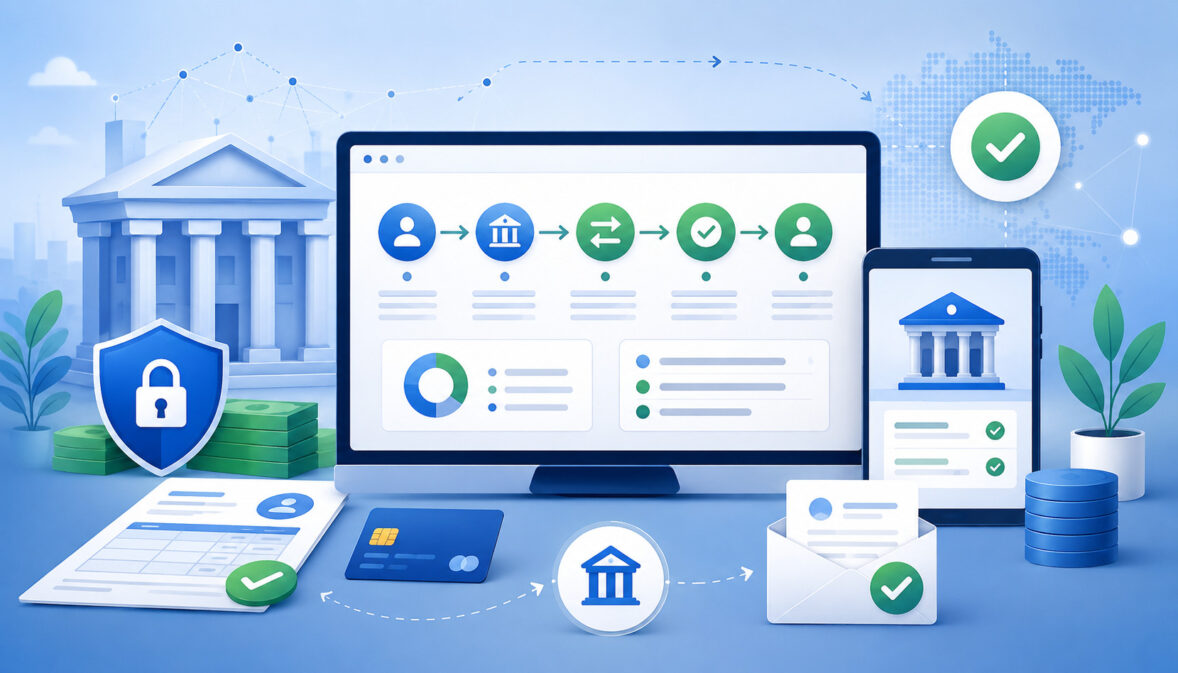
ACH payment processing gives businesses a way to move money electronically between bank accounts without relying on paper checks or card networks. It can support invoice collection, recurring billing, subscription payments, vendor payments, payroll deposits, rent collection, donations, and many other routine payment workflows.
For businesses that regularly receive larger invoice payments or collect repeat payments, ACH payments may provide a practical alternative to mailed checks and percentage-based card processing.
Customers can authorize an ACH bank transfer from their checking or savings account, while businesses can organize collections through payment links, invoices, customer portals, or accounting software.
However, ACH is not simply a matter of entering a routing number and waiting for funds. Businesses must understand authorization, bank account verification, batch processing, settlement timing, payment returns, security, reconciliation, fees, and access controls.
This guide explains what ACH payment processing is, how ACH transfer processing works, how businesses can accept ACH payments from customers, and what operational questions should be reviewed before adopting it.
The information below is educational and should not be treated as legal, tax, accounting, banking, cybersecurity compliance, payment compliance, investment, lending, or financial advice. Businesses should obtain qualified professional guidance for questions involving their specific obligations, contracts, payment practices, or risk exposure.
What Is ACH Payment Processing?
ACH payment processing is the electronic movement of money from one bank account to another through the Automated Clearing House network. Instead of sending a paper check or entering a card number, the payer authorizes funds to be transferred using bank account information.
A transaction may be initiated as an ACH debit or an ACH credit. With an ACH debit, an authorized business pulls money from the payer’s account. With an ACH credit, the account holder instructs its bank or payment service to push money to another account.
The process typically involves the business, an ACH payment processor, an originating financial institution, an ACH operator, and the financial institution receiving the payment. These participants exchange standardized transaction instructions before settlement occurs.
What ACH Means
ACH stands for Automated Clearing House. It is a payment network used to process electronic bank payments in organized batches.
Common examples include direct deposit, recurring bill payments, invoice payments, tax payments, membership dues, tuition payments, vendor transfers, payroll deposits, and certain person-to-person transfers.
The network does not normally move each transaction individually the moment it is submitted. Payment instructions are grouped, sorted, delivered to the appropriate financial institutions, and settled according to processing schedules. This structure helps the network handle large transaction volumes efficiently.
Why Businesses Use ACH Payments
Businesses often use ACH payments when customers prefer paying directly from a bank account or when card processing is not the best fit for the transaction.
Typical use cases include:
- Collecting professional service invoices
- Processing recurring subscriptions
- Receiving rent or property-related payments
- Collecting membership dues
- Accepting nonprofit donations
- Receiving B2B payments
- Paying vendors and contractors
- Processing payroll deposits
- Collecting tuition or scheduled service fees
- Managing installment or payment-plan transactions
ACH payment processing for businesses can also reduce manual check handling. Instead of waiting for checks to arrive, depositing them, and matching them to invoices, a business may receive electronic payment information and transaction reports through a centralized system.
ACH Payment Processing at a Glance
The following table summarizes the major areas a business should understand before accepting or sending business ACH payments.
| ACH Area | What It Means | Why It Matters | Priority |
| ACH debit | Pulls funds from a customer bank account with authorization | Useful for customer payments and recurring billing | High |
| ACH credit | Sends funds to another bank account | Useful for vendor payments, payroll, refunds, and payouts | Medium/High |
| Authorization | Customer permission to debit an account | Supports proper payment setup and dispute handling | High |
| Settlement | Funds move between participating banks | Affects cash flow and payment availability | High |
| Returns | Failed, rejected, or disputed ACH payments | Affects collection reliability and available funds | High |
| Verification | Confirms or validates bank account information | Reduces errors and certain fraud risks | High |
| Recurring billing | Scheduled ACH payments | Useful for subscriptions and repeat invoices | Medium/High |
| Fees | Costs charged for ACH services | Affects the total cost of payment acceptance | High |
| Security | Controls protecting customer bank data | Reduces exposure and supports customer trust | High |
| Reconciliation | Matches payments with invoices and accounts | Supports accurate financial records | High |
How to Use the Table
Business owners and finance teams can use the table as an initial risk and workflow review.
Items marked high priority should be addressed before live transactions begin. For example, a business should know how it will collect ACH payment authorization, verify account information, protect bank details, respond to ACH payment returns, and reconcile payments.
Medium/high items may depend more heavily on the business model. A company that does not offer subscriptions may not need advanced recurring billing tools, while a membership organization may consider recurring payment features essential.
Why ACH Needs Differ by Business Type
A professional service provider may use ACH for occasional high-value invoices. A subscription business may process hundreds of recurring ACH payments on scheduled dates. A property manager may need customer portals, unit-level reporting, and automated reminders.
A nonprofit may prioritize recurring donations and clear cancellation procedures. A medical office may need careful customer identification and secure access controls. An ecommerce business may need an ACH payment gateway that integrates with its checkout or customer account system.
The right setup therefore depends on transaction volume, average payment amount, customer preferences, return risk, staffing, software integrations, and reconciliation needs.
How ACH Payment Processing Works

Understanding how ACH payment processing works helps businesses set realistic expectations about timing, confirmation, and risk.
A typical transaction begins when a customer or business authorizes a payment. The payment instruction is submitted through a bank, accounting platform, payment gateway, or ACH payment processor. It then moves through originating and receiving financial institutions before settlement.
An ACH operator receives transaction files from originating financial institutions, sorts the entries, delivers them to receiving institutions, and facilitates settlement between participating institutions.
A more detailed explanation of how ACH transfer processing moves money step by step can help teams understand where authorization, submission, bank review, settlement, and returns occur.
The Basic ACH Payment Flow
The standard payment journey generally follows these steps:
- A customer authorizes the transaction.
- The business enters or submits the payment information.
- The ACH payment processor formats and transmits the payment instruction.
- The originating depository financial institution, or ODFI, submits the entry.
- An ACH operator sorts and routes the transaction.
- The receiving depository financial institution, or RDFI, receives the entry.
- The customer’s account is debited or credited.
- Settlement occurs between participating financial institutions.
- The business receives payment status and reporting information.
- The payment is matched with the correct invoice, customer, or account.
A payment may appear successful during the early stages but later be returned. Businesses should distinguish between submission, processing, settlement, funds availability, and final reconciliation.
ACH Processing Is Usually Batch-Based
ACH transfer processing is commonly batch-based. Transactions submitted before a processing cutoff may be included in one batch, while later transactions may move to another window or the next banking day.
This differs from payment methods that provide an immediate authorization response. ACH timing can be affected by weekends, bank holidays, processor cutoffs, account review, same-day eligibility, and the receiving institution’s posting procedures.
Batch processing is one reason ACH payment settlement time must be included in cash flow planning. A business should not assume that a payment submitted in the morning will be immediately available for spending.
ACH Debit Payments Explained
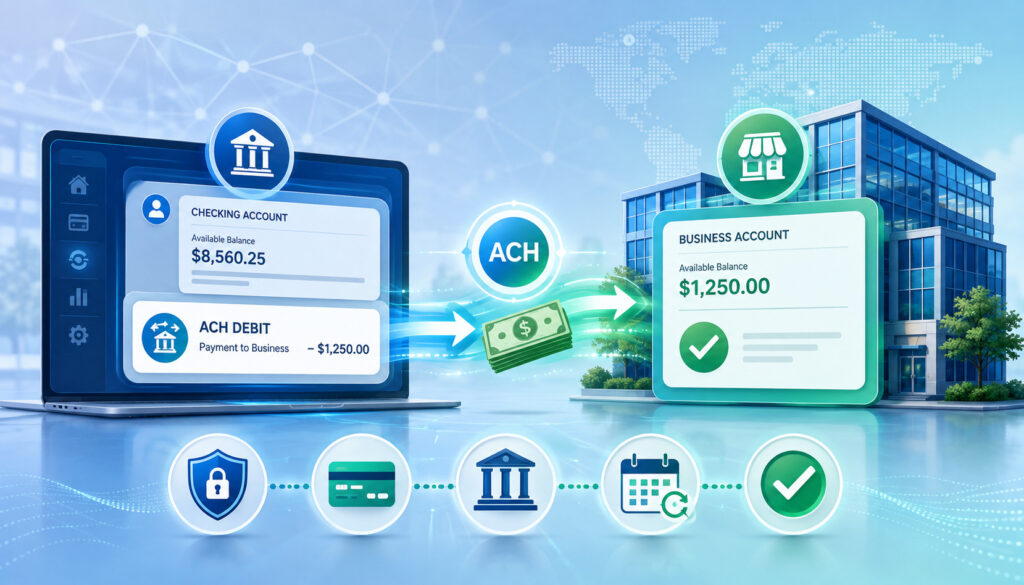
ACH debit payments allow an authorized business or organization to pull funds from a customer’s bank account. The customer provides permission before the debit is initiated.
ACH debit is frequently used for recurring billing, subscriptions, rent, memberships, insurance-related payments, service contracts, tuition, installment plans, utility-style payments, and invoice collection.
The business generally collects the customer’s routing number, account number, account type, authorization, and payment terms. Secure payment forms or tokenized account references should be used instead of keeping sensitive bank information in unsecured files.
When ACH Debit Is Useful
ACH debit can be useful when the business controls the billing schedule and needs to collect an agreed amount on a known date.
For example, a service business may initiate a debit after completing monthly work. A property manager may schedule rent payments. A membership organization may collect dues on the same day each month.
ACH debit payments can reduce the need to remind customers to manually initiate every payment. They may also improve invoice organization when the processor sends payment status, return information, and customer references back to the billing system.
ACH Debit Risks to Understand
ACH debits can be returned because of insufficient funds, invalid account information, closed accounts, stop-payment instructions, or unauthorized payment claims.
A business may also create problems by submitting the wrong amount, initiating a payment after authorization was cancelled, or charging on a different date than the customer expected.
Clear ACH payment authorization records are therefore essential. Businesses should also review return reports promptly, avoid automatically retrying payments without an approved procedure, and communicate respectfully with customers when payments fail.
ACH Credit Payments Explained

ACH credit payments push money from the sender’s bank account to a recipient’s bank account. The sender controls the initiation of the transfer.
Businesses may use ACH credits for vendor payments, payroll deposits, contractor payments, customer refunds, insurance-related payouts, expense reimbursements, intercompany transfers, and other approved disbursements.
Unlike an ACH debit, the recipient does not give the sender permission to pull money. Instead, the sender instructs its financial institution or payment platform to deliver funds to the recipient.
When ACH Credit Is Useful
ACH credit may be appropriate for routine outgoing payments when the business has verified the recipient and bank instructions.
A company might use ACH credits to pay suppliers every week, issue payroll deposits, send customer refunds, or distribute funds to contractors. Batch capabilities can be helpful when many approved payments must be sent together.
Payment approval controls are especially important. Employees who prepare payment files should not automatically have unrestricted authority to approve or release them.
ACH Credit vs ACH Debit
The simplest distinction is direction and control.
An ACH credit pushes funds out of the sender’s account. An ACH debit pulls funds from another account after authorization.
For customer collections, businesses frequently use ACH debit payments. For vendor payments and payroll deposits, businesses frequently use ACH credits. Some ACH payment processors support both, while others focus primarily on incoming customer payments.
ACH Payments vs Credit Card Payments
ACH payments and credit card payments use different payment rails and risk models.
Card payments generally involve a card account, issuing bank, acquiring relationship, card network, and processor. ACH payments use bank account information and the ACH network.
Cards often provide a rapid authorization response, which can be useful for retail, ecommerce, hospitality, and immediate fulfillment. ACH payments may take longer to settle and can be returned after submission.
Cost and Timing Differences
ACH payment processing fees are often structured as a flat transaction fee, percentage fee, or a combination of charges. Card pricing commonly includes a percentage of the transaction plus other processing costs.
This means low-cost ACH payments may be attractive for larger invoices or recurring billing. However, no payment method is universally cheaper. Monthly fees, return fees, verification fees, minimums, gateway fees, and internal administrative work all affect the real cost.
ACH timing may range from same-day processing for eligible transactions to multiple business days, depending on the service and submission time. Card authorization may be faster, but card settlement and funding still follow provider schedules.
Risk and Dispute Differences
ACH payment returns are not the same as card chargebacks.
A cardholder may dispute a transaction through the card system, leading to a chargeback process. An ACH entry may be returned by the receiving institution for reasons such as insufficient funds, invalid account information, a closed account, or an unauthorized debit claim.
The time available for returns can depend on the transaction type and reason. Businesses should not assume that an ACH payment is irreversible merely because it initially appears in a balance or settlement report.
ACH Payments vs Wire Transfers
ACH payments and wire transfers both move funds between bank accounts, but they are designed for different workflows.
ACH is commonly used for routine, repeat, invoice-based, or batch payments. Wire transfers are often used when a payment is highly time-sensitive or when the parties specifically require a wire.
For a more detailed comparison, review this educational guide to ACH transfers versus wire transfers.
ACH for Routine Payments
ACH can work well for subscriptions, recurring invoices, payroll, vendor payments, rent, memberships, and other transactions that follow an expected schedule.
It supports batch processing, recurring billing, transaction references, and integration with accounting tools. These features can make it easier to manage many similar payments.
Because ACH may involve longer settlement and return timelines, it is important to coordinate payment dates with invoice due dates, service delivery, and cash flow requirements.
Wires for Certain High-Urgency Transfers
Wire transfers may be used for transactions that require rapid bank-to-bank delivery, specific settlement handling, or payment instructions agreed to by both parties.
Wires may also carry higher bank fees and may be difficult to recover after being sent to an incorrect or fraudulent account. Verification of recipient instructions is therefore critical.
A business should choose between ACH and wire transfers based on urgency, transaction value, bank requirements, recipient expectations, reversibility, fees, and internal approval controls.
ACH Payments vs Paper Checks
Paper checks require physical creation, delivery, deposit, and bank processing. They can be delayed in the mail, lost, altered, deposited late, or matched to the wrong invoice.
ACH payments replace much of that physical process with electronic bank information. Businesses may receive payment notifications, transaction identifiers, and downloadable reports without handling paper.
However, switching from checks to ACH still requires customer communication, authorization procedures, account verification, secure data handling, and reconciliation.
Why Businesses Move Away From Checks
Electronic bank payments may reduce time spent opening mail, preparing deposit slips, scanning checks, visiting a branch, or waiting for mailed payments.
Customers can often pay through a secure link or portal, and payment information can flow into invoice or accounting systems. This may improve visibility into which customers have paid and which transactions were returned.
ACH can also support automatic recurring billing, which paper checks cannot provide without repeated manual action.
Check Replacement Considerations
Some customers remain comfortable with checks and may be hesitant to enter bank details online. Businesses should explain the payment process, security measures, timing, and authorization terms without pressuring customers.
The payment form should make it clear whether the transaction is one-time or recurring. Customers should also receive a confirmation or receipt they can retain.
Businesses should verify whether their ACH payment processor supports the needed account types, payment amounts, transaction limits, and customer channels before reducing check acceptance.
ACH Payment Processing for Businesses
ACH payment processing for businesses can support both incoming and outgoing funds.
Incoming use cases include invoices, subscriptions, memberships, donations, tuition, rent, service contracts, installment payments, and ecommerce transactions. Outgoing use cases include vendor payments, payroll deposits, contractor payments, reimbursements, refunds, and approved business transfers.
The most useful ACH setup is one that connects payment collection with the business’s existing workflow rather than creating another isolated system.
Invoice-Based ACH Payments
Businesses can add a secure bank-payment link to an invoice or customer portal. The customer selects the invoice, enters or confirms bank information, authorizes the payment, and receives a confirmation.
Including the invoice number in the transaction record makes reconciliation easier. Businesses may also allow customers to pay multiple invoices in one transfer or make partial payments when supported.
The payment page should display the business identity, amount, invoice reference, expected processing time, and authorization terms before submission.
Recurring ACH Payments
Recurring ACH payments can support subscriptions, memberships, retainers, rent, donations, payment plans, maintenance contracts, and scheduled professional services.
The customer authorizes an ongoing schedule instead of approving every debit separately. The business then initiates payments according to the agreed amount and timing.
Recurring billing should include clear cancellation instructions, procedures for changes, failed-payment handling, and appropriate notices when amounts or dates vary. Records should show the authorization, scheduled transactions, customer communications, and any revocation.
How to Accept ACH Payments From Customers
To accept ACH payments from customers, a business generally needs a bank or payment provider that supports ACH origination.
The payment setup may include an ACH payment processor, ACH payment gateway, hosted payment form, customer portal, invoice integration, or accounting software connection.
The exact onboarding process varies. Providers may review the business model, transaction volume, average payment amount, refund practices, return history, bank account, ownership information, and expected use cases.
Customer Authorization Comes First
A business should obtain customer authorization before initiating an ACH debit. The authorization method must fit the payment channel, account type, transaction type, and processor requirements.
The record should identify the customer, the business initiating the debit, the amount or method used to determine it, the timing, whether the payment is one-time or recurring, and how authorization may be cancelled.
An educational guide on setting up an ACH authorization form can help teams identify operational questions to discuss with their processor and professional advisers.
Keep the Payment Experience Simple
Customers should not have to search through a long invoice to understand how to pay.
Use a clearly labeled payment link or portal. Display the invoice number, amount, processing date, and payment terms before the customer confirms the transaction.
After submission, send a receipt or confirmation that distinguishes between payment initiation and final settlement. Avoid language that suggests the payment is fully complete when it is still processing.
ACH Payment Authorization
ACH payment authorization documents the payer’s permission for an ACH debit.
Authorization may be collected through a paper form, online form, customer portal, payment page, signed agreement, or another supported method. Telephone authorization may be available for certain transaction types when the required procedures and records are followed.
Requirements can differ for consumer and business accounts, one-time and recurring transactions, and the channel used to obtain permission.
What Authorization Should Make Clear
The customer should understand:
- Who will initiate the debit
- Which account will be used
- The amount or how it will be calculated
- The payment date or schedule
- Whether the authorization is one-time or recurring
- How to cancel or revoke permission
- How failed payments or refunds are handled
- How to contact the business with questions
For certain preauthorized electronic transfers from consumer accounts, applicable rules address signed or similarly authenticated authorization and providing a copy to the consumer. Businesses should review the official preauthorized-transfer requirements and obtain professional guidance for their specific workflow.
Why Authorization Records Matter
Authorization records help a business respond when a customer questions a debit, claims the amount was incorrect, or says the recurring schedule was cancelled.
The record should be retrievable rather than buried in email, paper files, or an employee’s personal folder. It should also show later changes, such as a new payment date, different account, updated amount, or cancellation request.
Strong records do not eliminate every dispute, but they make payment operations more consistent and easier to review.
Bank Account Verification for ACH Payments
Bank account verification helps determine whether submitted bank information is usable and associated with an appropriate account.
The process may involve routing-number validation, account-number validation, account ownership checks, micro-deposits, instant verification tools, prenotification entries, or other account validation services.
Verification should not be confused with guaranteed payment. A valid account may still have insufficient funds, restrictions, a later closure, or an unauthorized user.
Why Verification Reduces Problems
A mistyped routing number or account number can lead to delays and ACH payment returns. Verification can identify some problems before a live debit is submitted.
It may also help reduce fraud involving invented, closed, or mismatched account information. The level of verification needed may depend on transaction amount, customer relationship, payment channel, and risk profile.
The network’s account validation resources discuss approaches for validating account information used in certain online ACH debit scenarios.
Verification Methods May Vary
Micro-deposit verification sends small amounts to the customer’s account and asks the customer to confirm them. It can be familiar and effective, but it adds time.
Instant verification tools may allow the customer to authenticate with a financial institution and share approved account information. Other services may check account status or ownership through databases and banking connections.
Businesses should ask what each verification method confirms, what it does not confirm, how customer data is handled, how much it costs, and what happens when verification fails.
ACH Payment Settlement Time
ACH payment settlement time depends on submission timing, processing windows, processor procedures, financial institution schedules, transaction eligibility, weekends, and bank holidays.
Some eligible transactions may use same-day processing, while others follow standard settlement schedules. The time shown by a processor may refer to network settlement, customer account posting, business funding, or funds availability, which are not always identical.
Businesses should ask for a written explanation of each stage.
Why ACH Is Not Always Instant
ACH is designed around scheduled file processing and settlement rather than continuous individual transaction settlement.
A payment submitted after the processor’s cutoff may not enter the network until the next banking day. A receiving institution may also need time to post the entry.
Even when a debit appears successful, it may later be returned. Businesses should avoid shipping high-risk goods, releasing sensitive assets, or treating funds as final solely because a dashboard shows a submitted or pending payment.
Plan Cash Flow Around Settlement
Finance teams should understand when transactions are submitted, when settlement occurs, when funds are made available, and how long return risk may remain.
This information affects payroll planning, vendor payments, refunds, purchasing, and account balances. Businesses with tight cash flow may need a reserve for returns and delayed settlements.
ACH Payment Returns
An ACH return occurs when a financial institution sends an entry back instead of completing or retaining it as submitted.
Returns may occur because of insufficient funds, a closed account, an invalid account number, an account restriction, a stop-payment instruction, an unauthorized debit claim, or another defined reason.
Return codes help the business and processor understand why the payment failed and what action may be appropriate.
Common ACH Return Reasons
Common explanations include:
- The account does not have sufficient available funds.
- The account number is invalid.
- The account has been closed.
- The account cannot accept the transaction type.
- The customer instructed the bank to stop payment.
- The customer says the debit was not authorized.
- The account holder’s name or authority could not be confirmed.
- The transaction was submitted incorrectly.
- The payment exceeded an account or processor limit.
Businesses can review a more detailed explanation of common ACH return codes when developing staff procedures.
How to Reduce ACH Returns
Account verification, accurate data entry, clear authorization, payment reminders, and realistic scheduling can reduce avoidable returns.
Businesses should monitor patterns rather than treating each failed payment as an isolated incident. A high number of invalid-account returns may indicate a form problem, while repeated unauthorized claims may indicate unclear authorization or cancellation procedures.
Retrying returned payments should follow processor rules and documented business procedures. The customer should not be surprised by an additional debit attempt.
ACH Payment Processing Fees
ACH payment processing fees vary by provider, transaction type, volume, risk level, payment channel, and included features.
Possible charges include:
- Flat transaction fees
- Percentage-based fees
- Monthly platform fees
- ACH payment gateway fees
- Account verification fees
- Return fees
- Reversal or refund fees
- Batch fees
- Setup or onboarding fees
- Minimum monthly charges
- Same-day processing fees
- Integration or software fees
- Fees for optional support services
A low advertised transaction fee does not necessarily mean the service has the lowest total cost.
Compare Total Cost
Businesses should estimate costs using expected monthly volume, average payment value, return rates, verification usage, and required software features.
For example, a provider with a slightly higher transaction fee may include account verification, recurring billing, and accounting integration. Another provider may price each feature separately.
Internal costs also matter. Manual reconciliation, repeated customer follow-up, spreadsheet maintenance, and unresolved returns consume staff time even when they do not appear on a processor statement.
ACH Can Be Cost-Effective for Some Workflows
ACH payments may be cost-effective for large invoices, recurring billing, B2B payments, and other transactions where card percentage fees would be significant.
However, cost-effectiveness depends on the actual pricing agreement, transaction limits, payment size, volume, returns, and administrative requirements.
Businesses should compare ACH with cards, checks, wires, and other supported payment methods using realistic operating assumptions rather than universal pricing claims.
ACH Payment Security
ACH payment security involves more than the payment network. Businesses must also protect payment forms, employee accounts, customer records, devices, email, software integrations, and exported reports.
Routing numbers, account numbers, authorization records, personal details, and transaction histories should be treated as sensitive customer data.
Security controls should match the size of the business, transaction risk, technology environment, and applicable obligations.
Protecting Customer Bank Information
Businesses should avoid collecting bank information through ordinary email, unprotected documents, shared spreadsheets, or messaging applications.
Secure hosted payment forms can reduce the amount of raw bank information handled directly by staff. Tokenization may allow a system to store a reusable reference instead of repeatedly displaying the full account number.
Encryption should be used where appropriate, and sensitive data should be limited to employees who need it for an approved task. General small-business cybersecurity resources can help organizations begin evaluating broader information-security practices.
Access Controls for ACH Tools
Only authorized employees should be able to create payments, modify bank information, approve payment files, issue refunds, export reports, or change recurring billing schedules.
Role-based permissions can separate preparation, approval, and release. Multifactor authentication should be enabled where supported, and shared user accounts should be avoided.
Access should be reviewed when employees change roles or leave the organization. Audit logs should be retained and periodically checked for unusual activity.
ACH Fraud Prevention
ACH fraud prevention combines technology, verification, employee training, approval procedures, and customer communication.
Fraud may involve stolen bank information, fake customer identities, altered vendor instructions, compromised employee email, unauthorized account changes, or manipulation of refund procedures.
No single control can stop every scheme. Layered controls are more effective than depending only on a password or one verification method.
Watch for Suspicious Account Changes
A request to change vendor or customer bank information should be independently verified using trusted contact details already on file.
Employees should not rely only on a reply to the same email requesting the change. A compromised email account can make a fraudulent instruction appear legitimate.
Warning signs include sudden urgency, secrecy, unexpected payment locations, changes immediately before a large transfer, inconsistent contact information, and resistance to normal verification procedures.
Train Staff on ACH Red Flags
Employees handling payments should know when to pause and escalate a transaction.
Training should cover suspicious invoices, unexpected bank-detail changes, unusual refund requests, repeated failed verification, pressure to bypass approval, and login alerts.
Businesses should create a clear escalation path so employees are not forced to make high-risk decisions alone. A brief delay for verification is often preferable to releasing funds based on uncertain instructions.
ACH Payment Compliance Considerations
ACH payments operate under network rules, financial institution agreements, processor requirements, and potentially applicable laws and regulations.
The exact obligations may depend on whether the account is a consumer or business account, whether the payment is a debit or credit, how authorization was collected, and which ACH entry type is used.
Businesses should not rely on a general article as a substitute for guidance tailored to their operations.
Why Rules Matter
Rules establish expectations for authorization, entry formatting, transaction handling, account validation, returns, reversals, data security, recordkeeping, and risk monitoring.
Failure to follow required procedures can lead to customer disputes, returned payments, processing limits, delayed funding, additional review, or loss of ACH access.
Clear internal procedures also protect customers by helping ensure that debits match what they approved.
Ask the Processor for Guidance
An ACH payment processor should be able to explain its operational requirements, supported authorization methods, verification tools, transaction limits, return procedures, and security features.
Businesses should ask for current documentation rather than relying only on a sales conversation. Questions involving legal interpretation, tax treatment, accounting entries, cybersecurity compliance, or payment compliance should be directed to qualified professionals.
Provider guidance should be incorporated into staff training and reviewed when network rules or business workflows change.
ACH Payment Gateway Explained
An ACH payment gateway is the customer-facing or software layer used to collect payment information and send it for processing.
It may provide hosted payment pages, invoice links, embedded forms, customer portals, recurring billing, account tokenization, transaction reporting, and software integrations.
The gateway does not independently replace the financial institutions and processing relationships needed to move funds through the network.
How ACH Gateways Help Businesses
An ACH payment gateway can make it easier to accept electronic bank payments through a website, invoice, email link, mobile device, or customer account.
It may validate required fields, capture authorization, send customer confirmations, and pass transaction information to the ACH payment processor.
A well-designed gateway can reduce manual data entry and keep sensitive account information out of employee-managed documents.
Gateway Features to Review
Businesses should review:
- Hosted payment pages
- Mobile-friendly forms
- Recurring billing
- Account verification
- Tokenization
- User permissions
- Customer receipts
- Payment reminders
- Invoice references
- Partial-payment support
- Accounting integrations
- Application programming interfaces
- Transaction reports
- Return notifications
- Audit logs
Features should be evaluated according to actual workflow needs rather than the length of the provider’s feature list.
ACH Payment Processor Explained
An ACH payment processor helps submit transactions into the ACH system through its banking and processing relationships.
The processor may also manage onboarding, transaction formatting, settlement reporting, account verification, return notifications, payment limits, risk review, recurring billing, and customer support.
Some processors offer a complete gateway and billing system, while others connect with separate software.
What to Ask an ACH Processor
Important questions include:
- Does the service support ACH debit payments, ACH credit payments, or both?
- What authorization methods are supported?
- How are bank accounts verified?
- What are the standard and expedited settlement options?
- When are funds made available?
- How are ACH payment returns reported?
- What fees apply to returns and verification?
- Are there transaction or monthly limits?
- Can recurring ACH payments be scheduled?
- Which accounting and invoice systems are supported?
- What security controls and user permissions are available?
- What support is provided after onboarding?
Answers should be documented and compared across providers.
Choose Fit Over Feature Count
The best ACH payment processor is not necessarily the one with the largest number of tools.
A small professional practice may need secure invoice links, simple reconciliation, and responsive support. A subscription business may need advanced scheduling, retry management, tokenization, and customer self-service.
A B2B operation may prioritize approval workflows, high transaction limits, detailed reporting, and integration with accounting software. Choose the service that fits how payments are actually collected, reviewed, and recorded.
Recurring ACH Payments
Recurring ACH payments allow a business to collect scheduled bank payments under an ongoing customer authorization.
They may be used for subscriptions, memberships, rent, tuition, donations, monthly services, installment plans, retainers, maintenance agreements, and recurring invoices.
Recurring billing can reduce manual payment reminders, but it also requires accurate schedules, clear terms, secure account storage, failed-payment procedures, and prompt handling of cancellations.
Benefits of Recurring ACH
Recurring ACH payments can create a more consistent billing process for both the customer and the business.
Customers do not need to re-enter payment information every month. Businesses can schedule payments, receive automated status updates, and identify missed payments more quickly.
Predictable payment dates may support cash flow forecasting, although settlement delays and returns should still be considered. Recurring billing should not be treated as guaranteed revenue.
Recurring ACH Best Practices
Businesses should document the amount, frequency, start date, and cancellation method. When amounts vary, customers should receive any notices required by the applicable agreement or rules.
Send reminders when appropriate, especially for larger or variable payments. Monitor failed payments and stop future debits when authorization is revoked.
Make cancellation procedures easy to locate. Customers should not have to search through unrelated terms to understand how recurring ACH payments can be stopped.
ACH Payments for Invoices
ACH payments for invoices allow customers to pay directly from a bank account using a link, portal, form, or transfer instruction.
This can be useful for professional services, wholesale businesses, contractors, agencies, property-related services, consultants, medical offices, and other invoice-driven organizations.
The transaction should carry enough information to identify the customer and invoice without exposing unnecessary bank data.
Making Invoice Payments Easier
Include a clearly labeled ACH option on the invoice. The payment experience should show:
- Invoice number
- Customer name or account
- Amount due
- Due date
- Payment date
- Authorization terms
- Processing-time expectations
- Confirmation details
- Contact information for questions
Avoid asking customers to email account numbers or screenshots of bank information. Direct them to a secure payment page.
Matching Payments to Invoices
Reconciliation becomes more complicated when a customer pays several invoices in one ACH bank transfer or submits a partial amount.
The payment system should capture invoice references, customer identifiers, and notes where possible. Finance teams should investigate unmatched payments promptly rather than leaving them in a general suspense category.
Regular reconciliation helps identify duplicate payments, partial balances, refunds, returns, and transactions posted to the wrong customer.
ACH Payments for B2B Transactions
B2B ACH payments are commonly used for supplier invoices, contractor payments, recurring service agreements, wholesale purchases, intercompany transfers, and other business obligations.
Bank-to-bank payments may fit B2B workflows because transaction amounts can be larger and payment relationships may continue over many months.
However, B2B payment instructions must be protected against fraud and unauthorized changes.
Why B2B Payments Often Fit ACH
Business customers frequently pay from accounting departments rather than consumer checkout pages. They may prefer invoice references, bank transfers, approval workflows, and detailed payment reports.
ACH can support these needs without requiring a card for every transaction. It may also reduce check preparation and mailing.
The parties should agree on payment timing, invoice references, remittance information, return handling, and the process for changing bank instructions.
Approval Workflows for B2B ACH
A strong workflow separates payment preparation from payment approval.
One employee may enter invoice and account information, while another verifies the vendor, amount, supporting documents, and bank instructions. Higher-value payments may require additional approval.
Changes to vendor bank details should trigger an independent verification process. Employees should not release payments merely because an email appears to come from a familiar contact.
ACH Payment Processing Checklist
Use this checklist when comparing services, setting up ACH payment processing, or reviewing an existing program.
| Checklist Area | Questions to Ask | Why It Matters | Priority |
| Use case | Are payments one-time, invoice-based, outgoing, or recurring? | Defines the required setup | High |
| Authorization | Do customers clearly approve debits? | Reduces confusion and disputes | High |
| Verification | Are bank details validated appropriately? | Reduces errors and certain return risks | High |
| Settlement | When will funds settle and become available? | Supports cash flow planning | High |
| Returns | How are failed payments reported and handled? | Reduces collection delays | High |
| Fees | What are all transaction and service costs? | Protects margins | High |
| Security | How is bank data collected, stored, and transmitted? | Reduces data exposure | High |
| Access | Who can create, edit, approve, or refund payments? | Reduces misuse | High |
| Integration | Does ACH connect with invoices or accounting software? | Reduces manual work | Medium/High |
| Reporting | Can payments, returns, and refunds be reconciled easily? | Supports accurate records | High |
How to Use the Checklist
During provider selection, use the checklist to compare written answers rather than relying only on general descriptions.
During implementation, assign an owner to each high-priority area. For example, finance may own reconciliation, operations may own customer procedures, and an authorized technology lead may manage access and security settings.
During monthly reviews, revisit settlement timing, return patterns, staff permissions, recurring schedules, and total processing costs.
Records to Keep for ACH Payments
Businesses should organize:
- Customer authorizations
- Invoices
- Payment confirmations
- ACH return notices
- Refund and reversal records
- Recurring billing schedules
- Cancellation requests
- Customer communications
- Verification results
- Processor statements
- Settlement reports
- Reconciliation reports
- User-access reviews
- Internal approval records
Retention periods and documentation requirements should be confirmed with the processor and qualified advisers.
Common ACH Payment Processing Mistakes
Many ACH problems result from inconsistent procedures rather than the payment network itself.
Common mistakes include skipping authorization, entering incorrect account information, ignoring return notices, using insecure payment forms, keeping poor records, misunderstanding settlement timing, and giving too many employees unrestricted access.
Businesses should address these issues before transaction volume grows.
Treating ACH Like Instant Payment
An ACH payment may be initiated quickly, but that does not mean funds are immediately settled or free from return risk.
Businesses sometimes release goods, issue a refund through another payment method, or spend expected funds before the original transaction has been fully reviewed.
Payment status labels should be understood carefully. “Submitted,” “processing,” “settled,” and “available” may describe different stages.
Poor Authorization Records
A checkbox without clear terms, an incomplete paper form, or an unrecorded telephone conversation may not provide the documentation a business expects during a dispute.
Authorization records should match the transaction amount, timing, frequency, customer, account, and payment channel.
Employees should know where records are stored and how to retrieve them. A valid process that cannot be documented may still create operational problems.
Best Practices for ACH Payment Processing
Responsible ACH payment processing requires consistent procedures across customer service, finance, accounting, operations, and technology.
Useful practices include:
- Choose ACH use cases carefully.
- Collect clear customer authorization.
- Verify bank account details appropriately.
- Explain processing and settlement timing.
- Use secure payment forms or gateways.
- Avoid unsecured storage of bank information.
- Monitor ACH returns and failed payments.
- Keep recurring billing terms clear.
- Use role-based access.
- Reconcile transactions regularly.
- Review all fees and funding schedules.
- Train staff on ACH procedures and fraud indicators.
- Verify bank account changes independently.
- Keep payment and authorization records organized.
- Seek professional guidance for specialized legal, tax, accounting, banking, cybersecurity compliance, payment compliance, investment, lending, or financial questions.
Create an ACH Payment Policy
An internal ACH policy can define approved use cases, authorization steps, verification methods, transaction limits, refund procedures, return handling, recurring billing practices, and recordkeeping.
It should also explain who may create, approve, release, modify, or refund transactions.
The policy does not need to be unnecessarily complicated. It should be detailed enough that employees can follow the same process and know when management or professional review is required.
Review ACH Workflows Regularly
Businesses should periodically review return rates, authorization records, recurring schedules, staff access, fees, settlement reports, and reconciliation delays.
Look for patterns. Increasing insufficient-funds returns may justify payment reminders. Frequent unmatched payments may indicate poor invoice references. Repeated login problems may signal a training or access issue.
Update procedures when products, customer channels, transaction values, staff responsibilities, or provider requirements change.
How to Choose ACH Payment Processing for Businesses
Choosing ACH payment processing begins with the business workflow, not the provider’s marketing claims.
Identify who will pay, how often payments occur, the usual transaction amount, how customers receive invoices, and what software employees already use.
Then compare settlement, returns, verification, authorization support, security, fees, limits, integrations, reporting, and customer service.
Questions to Ask Before Choosing ACH Processing
Ask prospective providers:
- Can we accept one-time and recurring ACH debit payments?
- Can we send ACH credits?
- How is customer authorization captured and stored?
- What account verification methods are available?
- What is the normal ACH payment settlement time?
- Are expedited options available?
- How are ACH payment returns reported?
- What return and retry fees apply?
- What transaction limits will apply to our account?
- How is sensitive bank information protected?
- Are hosted payment links available?
- Can customers pay invoices through a portal?
- Does the service connect with our accounting software?
- What reconciliation reports are included?
- Can employee permissions be customized?
- What support is available when a payment is returned or delayed?
Request written pricing and operating documentation before making a decision.
Choose Workflow Fit Over Lowest Price Alone
The lowest transaction price may not provide the lowest operational cost.
A system that requires manual exports, spreadsheet matching, and repeated customer follow-up may consume more staff time than a slightly more expensive integrated option.
The right ACH payment processing setup should fit customer payment habits, invoice procedures, recurring billing requirements, cash flow expectations, staff permissions, security practices, and reporting needs.
Frequently Asked Questions
What is ACH payment processing?
ACH payment processing is the electronic movement of money between bank accounts through the Automated Clearing House network.
Businesses may use it to collect customer invoices, process recurring payments, receive B2B payments, send vendor payments, issue payroll deposits, or manage other bank-to-bank transfers.
Transactions may be ACH debits, which pull authorized funds from an account, or ACH credits, which push funds to another account.
How does ACH payment processing work?
The payer authorizes or initiates the transaction, and payment information is submitted through a bank, ACH payment gateway, accounting platform, or ACH payment processor.
The originating financial institution sends the transaction through an ACH operator. The operator sorts and routes it to the receiving financial institution, where the account is debited or credited.
Settlement, posting, funding, reporting, and possible returns occur according to applicable processing schedules and procedures.
What is the difference between ACH debit and ACH credit?
An ACH debit pulls money from an account after the account holder provides authorization. Businesses often use ACH debits for customer invoices, subscriptions, memberships, rent, and recurring billing.
An ACH credit pushes money from the sender’s account to another account. Businesses often use ACH credits for payroll, vendor payments, contractor payments, refunds, and payouts.
The two transaction types differ in who initiates the movement of funds and how authorization is handled.
How can businesses accept ACH payments from customers?
A business can accept ACH payments from customers by working with a bank or ACH payment processor that supports ACH origination.
The business may use a secure payment page, ACH payment gateway, invoice link, customer portal, virtual terminal, or accounting integration. It must also establish procedures for authorization, account verification, settlement, returns, security, receipts, and reconciliation.
The provider may review the business model, transaction volume, average payment amount, bank account, expected use cases, and risk controls before enabling payments.
How long does ACH payment processing take?
ACH timing varies according to the processor, submission cutoff, payment type, processing window, financial institutions, weekends, bank holidays, and whether an eligible expedited option is used.
Some transactions may settle on the same banking day, while others take one or more business days. Funds availability and the possibility of a later return should also be considered.
Businesses should ask their processor to define submission time, settlement time, funding time, and return handling separately.
What are ACH payment processing fees?
ACH payment processing fees may include flat transaction fees, percentage fees, monthly platform fees, gateway fees, verification fees, return fees, batch fees, setup costs, same-day fees, minimum charges, and software integration costs.
Pricing differs significantly by provider and business risk profile. Businesses should calculate the total monthly cost using realistic transaction volume, payment size, return frequency, and required features.
The lowest per-transaction fee may not be the least expensive option after other charges and administrative work are considered.
Why do ACH payments get returned?
ACH payments may be returned because of insufficient funds, closed accounts, incorrect account numbers, account restrictions, stop-payment instructions, unauthorized debit claims, or transaction-format problems.
The return code identifies the general reason. Businesses should review the code, follow processor guidance, update internal records, and communicate with the customer when appropriate.
Repeated returns should be investigated for broader issues involving authorization, account verification, data entry, customer communication, or billing schedules.
Are ACH payments secure for businesses?
ACH payments can be managed securely when businesses use appropriate authorization, verification, encryption, tokenization, employee access controls, authentication, monitoring, and recordkeeping.
Risk can increase when bank information is collected through unsecured email, stored in shared spreadsheets, or made available to employees who do not need it.
Businesses should review both the provider’s security controls and their own internal practices. Professional cybersecurity and payment-compliance guidance may be appropriate for sensitive or complex environments.
Conclusion
ACH payment processing can be a useful option for businesses that want to accept electronic bank payments, collect invoices, manage recurring billing, support B2B transactions, pay vendors, and reduce manual check handling.
Its value comes from combining bank-to-bank payments with authorization records, scheduled processing, transaction reporting, recurring payment tools, and accounting workflows. However, ACH should not be treated as an instant, guaranteed, or risk-free payment method.
Before accepting ACH payments from customers, businesses should understand authorization, account verification, ACH payment settlement time, returns, fees, transaction limits, payment security, recurring billing procedures, refunds, reconciliation, and processor support.
The most appropriate ACH setup is not necessarily the cheapest or most feature-heavy option. It is the one that matches the business’s real payment workflow, customer expectations, cash flow needs, staffing procedures, accounting systems, risk controls, and long-term payment strategy.
Leave a Reply