By Joseph Bryson April 14, 2026
ACH returns can quietly slow down collections, strain customer relationships, and create more work than most teams expect. A payment looks like it is on the way, revenue gets counted in the pipeline, and then a return code appears that forces billing, operations, or collections staff to stop and figure out what went wrong.
That delay can affect cash flow forecasts, retry timing, account status, and how quickly a business can close the loop with a customer.
For companies that depend on bank payments for invoices, installment plans, subscriptions, memberships, or service billing, resolving common ACH return codes is not just a back-office task. It is a practical part of getting paid faster and reducing avoidable friction.
The faster your team can identify the reason for a return, decide whether to retry, and take the right next step, the more efficiently your collections process runs.
The challenge is that ACH return codes can feel confusing at first. Some returns point to temporary funding issues. Some signal account data problems. Others suggest authorization concerns that should never be treated like a simple failed payment.
If every return gets handled the same way, teams often waste time, retry the wrong transactions, and increase the chance of repeat failures.
This guide walks through resolving common ACH return codes in a practical, reader-first way. You will learn what ACH return codes mean, why they happen, how they affect collections, when reprocessing may make sense, when it should stop, and how to build workflows that reduce future returns.
Whether you handle finance, billing, accounts receivable, or payment operations, this guide is designed to help you fix ACH return codes more confidently and keep payment collections moving.
What ACH return codes are and why they matter in real collections workflows
ACH return codes are standardized reason codes that explain why an ACH transaction was sent back instead of settling successfully. In day-to-day operations, they act like diagnostic labels.
They tell you whether a payment failed because the customer did not have enough available funds, because the bank account information was inaccurate, because the account was closed, or because the receiving bank reported an authorization or stop-payment issue.
For a business, this matters because ACH payment failures are not all created equal. An insufficient funds return does not need the same response as an unauthorized debit return. One may justify a carefully timed reattempt.
The other may require your team to pause collections activity, review the authorization record, and contact the customer before doing anything else.
That is why ACH return codes explained in simple terms can make such a big difference operationally. The code does more than describe the failure. It helps route the transaction into the right next action. A well-run team uses return codes to answer four questions quickly:
- What happened
- Why did it likely happen
- Can we try again
- What is the safest and smartest next step
When teams do not have that structure, ACH collections issues tend to repeat. A billing platform may retry a closed account. A collections rep may contact a customer with the wrong message. A finance team may treat a revoked authorization like a temporary payment failure. Those small mistakes add time, cost, and customer frustration.
ACH return management also affects internal reporting. If return reasons are lumped together under one generic “failed payment” label, leadership loses visibility into what is driving collections delays.
Was it weak onboarding? Outdated bank details? Recurring payment return handling problems? Poor authorization records? Without accurate classification, it is hard to improve results.
How ACH returns affect cash flow, customer relationships, and recurring billing operations

ACH returns can look small in isolation, but their real cost often shows up in workflow disruption. When a payment is returned, the business does not just lose time waiting for funds.
It also has to absorb the administrative work of reviewing the return, deciding on the next step, updating account status, communicating with the customer, and often trying to collect again through a different path.
For finance teams, that can create forecasting problems. A payment expected this week may shift into next week or later. If there are multiple common ACH returns across a portfolio of customer accounts, the delay compounds. Collections performance starts to look inconsistent, and cash flow becomes harder to predict.
For billing teams, the pain often shows up in recurring schedules. A failed subscription or membership payment can trigger service interruptions, customer complaints, and manual exception handling.
An installment payment failure can create confusion about account standing or future due dates. In B2B invoicing, a return may force accounts receivable staff to restart follow-up conversations they thought were already complete.
Customer relationships can also suffer when return handling is slow or unclear. If a customer receives a vague notice saying “payment failed” with no guidance, they may ignore it or assume the business made an error.
If the message is too aggressive for a temporary issue like insufficient funds, the relationship can deteriorate unnecessarily. On the other hand, if the return points to a revoked authorization or stop payment and the business retries too quickly, trust can erode even faster.
Why ACH returns create more friction than many teams expect
Part of the friction comes from timing. ACH is not always a real-time approve-or-decline environment. A transaction can be initiated, appear to be moving, and only later come back with a return reason. That creates a gap between payment attempt and final resolution.
During that gap, several business processes may already have moved forward. A product may have shipped. A service may remain active. A receivable may be marked as in progress. A collections note may show “payment submitted.” When the return arrives, your team has to reverse those assumptions and decide how to proceed.
That is why returned ACH transaction troubleshooting needs to be more than a reactive task. It should be built into the collections lifecycle. The best teams expect a certain level of ACH payment return reasons and design workflows around them.
They know which returns belong in a retry queue, which should go to customer outreach, and which should go to compliance or management review.
Why recurring billing environments feel ACH returns more sharply
Recurring billing is especially sensitive to return activity because repeated payment cycles amplify weak processes. If the underlying issue is never fixed, the same customer can keep failing month after month. That creates avoidable churn, support volume, and collection delays.
Subscription billing, memberships, loan-style installment plans, and managed service agreements all depend on repeatable payment success. If account details go stale, authorization language is unclear, or customer reminders are poorly timed, the return rate tends to rise. Even a modest increase in ACH debit return codes can disrupt an otherwise healthy recurring revenue model.
This is one reason many teams revisit their recurring ACH payment setup practices when they see higher return volume. Better setup at the start often reduces downstream collections friction.
NACHA return code basics and the major categories businesses should understand
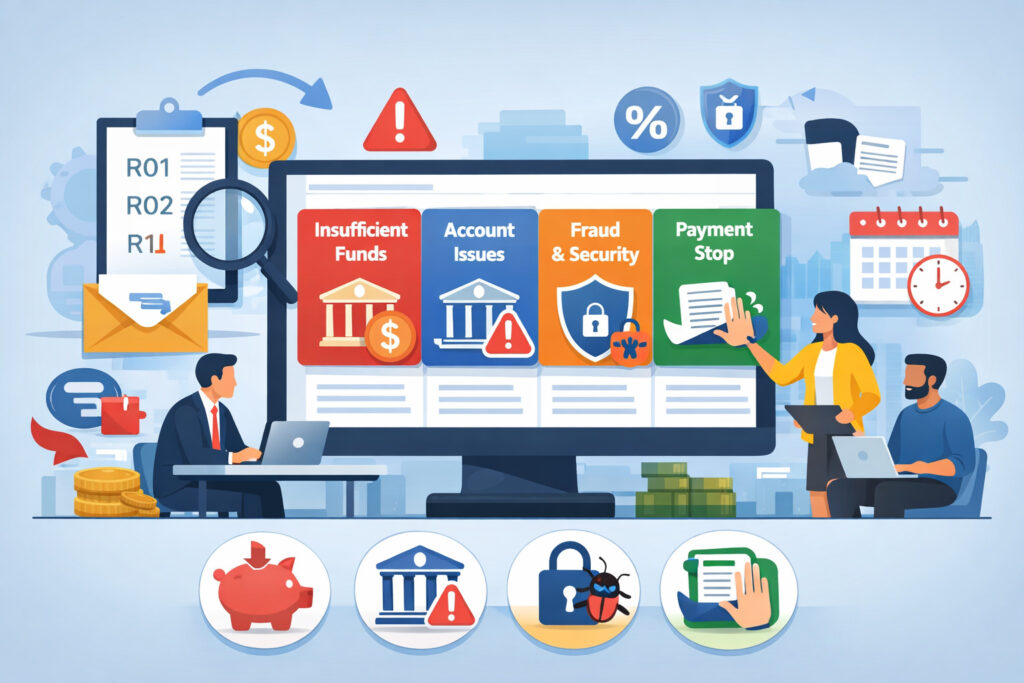
You do not need to memorize every ACH return code to manage returns well. What matters most is understanding the major categories and knowing how each category should influence your next action.
NACHA return code basics become much easier when you group codes by practical meaning instead of trying to treat every code as a separate universe.
In everyday collections work, most return codes fall into a few broad buckets:
- Temporary funding issues
- Account data or account status issues
- Authorization and customer dispute issues
- Operational or formatting problems
- Special exception situations that need human review
That framework helps simplify resolving ACH returns. Instead of asking your team to remember dozens of code definitions, you can train them to identify the category first and then follow the appropriate workflow.
Temporary funding returns
Temporary funding returns usually mean the payment might succeed later if the customer’s available balance changes. These returns often include insufficient funds or related balance timing issues. They are not always permanent failures, but that does not mean they should be retried automatically without thought.
When finance teams see these codes, they should ask whether the customer typically funds the account on a known schedule, whether previous retries have worked, and whether a reminder should go out before another debit attempt. Smart timing matters. Blind retries do not.
Account data and account status returns
These returns are usually more administrative than financial. The transaction may have failed because the account number was invalid, the account could not be located, the account was closed, or the account type was not eligible for that transaction. In most cases, these returns point to bad data or outdated customer banking information.
These are some of the most common ACH returns because account records change over time. Businesses update customers, but customers do not always update businesses. A customer may switch banks, open a new operating account, close an old one, or accidentally provide the wrong account number during onboarding.
Authorization and dispute returns
These deserve extra caution. They usually indicate the customer says the debit was unauthorized, revoked, stopped, or did not match the agreed terms. These codes should not be handled like ordinary payment failures.
They often require your team to review authorization language, debit timing, amount accuracy, and customer records before taking further action.
This category is especially important for recurring payment return handling. If your authorization practices are weak, these returns can rise quickly and create both operational and risk problems.
Operational or file-level returns
Some returns are caused by formatting or process issues rather than customer account conditions. These may involve routing problems, duplicate transactions, or file-level errors. They usually call for internal correction, not customer outreach.
If a business sees these often, it is a sign that system controls, data validation, or process design need attention. These are fixable issues, but they require operational discipline.
Resolving common ACH return codes: what the most frequent codes mean and what to do next
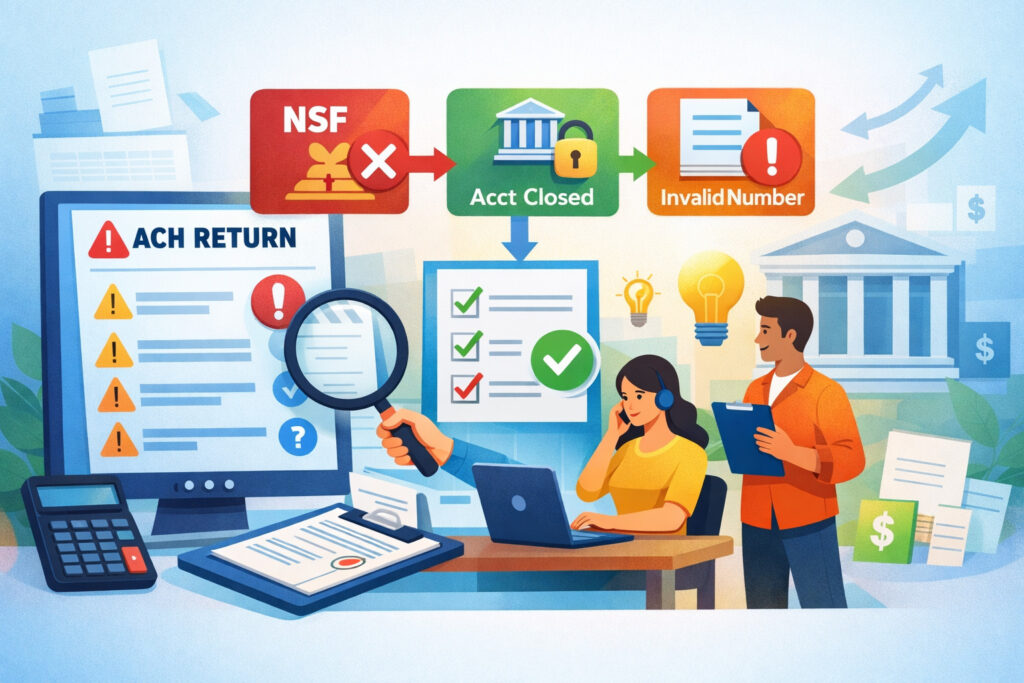
Most businesses do not encounter every ACH return code regularly. They tend to see the same core set over and over: insufficient funds, account closed, no account, invalid account number, unauthorized debit, revoked authorization, stop payment, and a handful of related operational returns.
That is good news, because it means your team can get much better results by mastering the codes that appear most often.
The table below provides a practical overview of common ACH return codes, what they usually mean, likely causes, and the next best action.
| Return Code | Meaning | Likely Cause | Best Next Step |
| R01 | Insufficient Funds | Available balance was too low at the time of debit | Consider a limited, well-timed retry after customer notice |
| R02 | Account Closed | Customer’s bank account is no longer open | Stop retries and request updated payment details |
| R03 | No Account / Unable to Locate Account | Account information does not match an open account | Verify account and routing details before resubmission |
| R04 | Invalid Account Number Structure | Account number format failed validation | Correct the data source and obtain accurate account information |
| R07 | Authorization Revoked | Customer withdrew prior debit permission | Stop future debits until new authorization is obtained |
| R08 | Payment Stopped | Customer placed a stop payment on the transaction | Review context and contact customer before any further attempt |
| R09 | Uncollected Funds | Funds may exist but are not available for withdrawal yet | Retry carefully later if appropriate |
| R10 | Not Authorized / Originator Not Known | Customer disputes authorization or does not recognize the debit | Review authorization records and escalate for internal review |
| R11 | Entry Not in Accordance With Authorization | Debit did not match agreed timing, amount, or terms | Correct the billing issue and confirm terms before retry |
| R20 | Non-Transaction Account | Account type cannot accept that debit type | Request eligible bank account details |
| R29 | Corporate Customer Advises Not Authorized | Business account holder disputes authorization | Pause activity and review authorization and payment setup |
| R24 | Duplicate Entry | Same or similar transaction appears to have been sent twice | Investigate system logic and reconcile before reprocessing |
R01 insufficient funds: when reattempting may make sense
R01 is one of the most familiar ACH debit return codes. It usually means the customer’s available balance was not enough to cover the payment at the time the debit hit the account. In many cases, this is a temporary issue rather than a permanent failure.
That does not mean every R01 should be retried the same way. A good collections team looks at account history, customer behavior, and timing. If the customer is normally reliable and tends to fund the account on a known schedule, a retry after a short notice may work well. If this is the third R01 in a row, repeating the same move may only delay resolution.
A practical workflow for R01 often includes notifying the customer, scheduling a limited reattempt window, and offering a backup payment method if needed. Messaging matters. Customers are more likely to resolve the issue quickly when the notice is specific, respectful, and actionable.
R02 account closed, R03 no account, and R04 invalid account number: fix the data before you try again
These returns point to account information problems, not short-term balance timing. That is why they should almost never be treated like NSF-style returns.
R02 means the account is closed. A retry to the same account is usually a waste of time. Your next step is to contact the customer for updated banking information or another payment method.
R03 means the bank could not locate the account. This often happens when the number entered appears structurally possible but does not match a valid open account at the receiving bank. R04 usually indicates an even more basic formatting issue, such as an invalid account number structure.
In all three cases, the right move is to fix the underlying data. That may involve checking what the customer entered, reviewing the onboarding form, confirming the routing number, and having the customer resubmit details securely. Teams that retry these codes without correcting the source data usually create repeat ACH payment failures and longer collection cycles.
A helpful process improvement here is bank account and routing number validation. Cleaner account setup reduces these preventable returns.
R07 revoked authorization, R08 payment stopped, R10 not authorized, and R11 terms mismatch: slow down and review
This group deserves extra care because it goes beyond a simple failed payment. These return reasons often indicate the customer objected to the debit, withdrew permission, or believes the debit did not match what was agreed.
R07 means the customer revoked authorization. R08 means the customer stopped payment. R10 usually signals the customer says the debit was unauthorized or the originator is not recognized. R11 generally points to a mismatch between the actual debit and the authorization terms, such as the wrong amount or timing.
For these returns, immediate reprocessing is often the wrong move. Your team should first review the authorization record, check the payment schedule, confirm the amount, verify any notice requirements, and look at recent customer communications. If the authorization is unclear or outdated, a new authorization may be needed before any future debits.
These cases also show why strong ACH authorization practices are so important. Weak records create slower collections and more preventable disputes.
How to fix ACH return codes without creating repeat failures
Businesses often focus on getting a returned payment back into the system as fast as possible. That instinct is understandable, especially when cash flow is tight. But the goal is not just speed. It is smart recovery. The best approach to fix ACH return codes is to match the response to the return reason instead of treating all failures as equal.
A practical return resolution strategy starts by separating retries from corrections from escalations. Some returns are retry candidates. Some require new customer information. Some should trigger internal review before any additional collection action. When teams skip that decision point, repeat failures become much more likely.
The first question should always be: is the reason temporary, correctable, or sensitive? Temporary reasons may support limited reattempts. Correctable reasons require updated data or a process fix. Sensitive reasons, especially authorization-related returns, call for caution and documentation.
When reattempting payment makes sense
Reattempting may make sense when the return suggests the account can still be used and the issue may resolve with timing. Insufficient funds and some uncollected funds scenarios are the most common examples. Even then, reattempting works best when it is tied to a clear customer communication and a defined retry policy.
A good retry policy typically answers these questions:
- Which return codes qualify for retry
- How many attempts are allowed
- How much time should pass before a new attempt
- Whether customer notice must go out first
- When an account should move to a manual collections queue
The purpose of a retry is not to keep debiting until something works. It is to create one thoughtful additional opportunity to collect without creating more friction.
When reattempting should stop
Reattempting is usually a poor fit for returns involving closed accounts, invalid account numbers, missing accounts, revoked authorization, stop payments, or disputes about authorization terms. In those cases, retrying the same transaction often wastes time and may create unnecessary customer conflict.
If the problem is incorrect bank data, the data must be fixed first. If the problem is customer permission, the permission issue must be resolved first. If the problem is internal billing logic, the workflow must be corrected first. Retrying without solving the cause just turns a one-time return into a recurring collection issue.
A step-by-step troubleshooting workflow for returned ACH transaction handling
When an ACH return hits your queue, speed matters, but structure matters more. The fastest teams are usually the ones with a repeatable workflow. They do not reinvent the process for every return. They follow a clear path from code review to next action.
A strong troubleshooting workflow helps finance and collections teams avoid overreacting to temporary returns and underreacting to higher-risk ones. It also makes training easier because new team members have a playbook to follow instead of relying on memory.
Step 1: Identify the exact return code and classify it by type
Start by confirming the code and assigning it to a working category: temporary funding, account data, account status, authorization, or operational error. This first step shapes everything that follows. If the classification is wrong, the next action is often wrong too.
Teams that move too quickly sometimes rely only on a short payment failure label from a dashboard. That is risky. The actual code is more informative than the label. Make sure the person handling the return can see the code itself and the associated transaction context.
Step 2: Review customer history and payment context
Before you act, look at the bigger picture. Is this a first-time return or part of a pattern? Is the payment tied to a subscription, membership, invoice, installment plan, or service retainer? Has the customer recently changed banks or disputed prior debits?
This context matters because the same code can mean different things depending on the relationship. A first-time R01 on a long-standing account may justify one more attempt. A fourth R01 in two months may suggest the account needs a different collections strategy.
Step 3: Check the authorization and account data record
For authorization-related returns, the authorization record should be reviewed right away. Confirm the payment terms, account holder identity, notice process, and any customer communications. For data-related returns, verify the routing number, account number, account type, and recent updates.
This is often where the true issue becomes clear. A code may point generally to the reason, but the record review tells you whether the root problem is customer error, outdated information, internal setup, or billing logic.
Step 4: Decide between retry, customer outreach, or internal escalation
Once the facts are clear, choose the next path. A retry may be appropriate for limited funding-related returns. Customer outreach is usually the right next step for account data changes, account closures, or payment method updates. Internal escalation is more appropriate for authorization disputes, duplicate entries, operational anomalies, or repeated return patterns.
Do not mix these paths. A well-run workflow routes each return into the right lane so the response is consistent.
Step 5: Document the action and update future billing logic
Every returned ACH transaction should leave a useful record behind. What code appeared? What was done? Was the customer contacted? Was the billing schedule changed? Was the bank account updated? Documentation turns one resolved issue into a process improvement opportunity.
This is where ACH reprocessing best practices come to life. Teams improve faster when they log what worked and what did not.
Best practices for resolving ACH returns faster and improving collections success
Fast resolution rarely happens by accident. It comes from upstream controls, clearer communication, and more disciplined exception handling. Businesses that want faster collections should think about ACH returns before they happen, not only after.
One of the simplest ways to improve performance is to connect return codes to preventive actions. If account data errors are common, strengthen validation. If unauthorized returns are rising, improve authorization records. If insufficient funds returns spike after certain billing dates, revisit payment reminders and retry timing.
Verify bank account details before submission
A surprising number of returns trace back to account detail problems that could have been caught earlier. Routing numbers entered incorrectly, account numbers copied from the wrong source, account type mismatches, and stale bank details all contribute to avoidable ACH payment failures.
Verification should happen as early as possible in the payment lifecycle. That may include form validation, account confirmation steps, internal review rules for high-value accounts, and follow-up prompts when customer-entered data looks incomplete or inconsistent.
The cleaner the data at the point of onboarding, the fewer returns your team will need to fix later.
Use clear authorization language and keep strong records
Authorization problems often begin long before a return code appears. If the customer did not fully understand what they were agreeing to, if timing or amount flexibility was not clearly described, or if documentation is difficult to retrieve later, your team is more exposed to disputes and slower resolution.
Strong authorization practices help reduce ACH returns and make disputes easier to handle when they happen. Your records should clearly support who authorized the debit, when they authorized it, what terms they agreed to, and how any changes were communicated.
For teams reviewing process quality, ACH risk mitigation guidance can help frame authorization and return management as part of a broader risk-control strategy.
Improve customer reminders and payment communication
Customer communication is often treated as a courtesy, but it is also a collections tool. Reminder timing can affect available balance, dispute rates, and how quickly a customer responds when a return occurs.
Effective payment reminders typically include the draft date, amount, and what the customer should do if bank details have changed. Return notices should explain the issue in useful terms and guide the customer toward the next step, such as updating account information or choosing another payment method.
Good communication reduces confusion and shortens the time between failed debit and successful recovery.
Segment retry strategies by return reason
Not all retries are equal. A business that uses one retry rule for every failed ACH payment usually ends up with a higher repeat-return rate. Segmenting retry strategies by return reason is one of the most practical ways to improve collections speed.
For example, R01 and R09 may qualify for a carefully timed retry. R02, R03, and R04 usually need updated data first. R07, R08, R10, and R11 often require customer contact and internal review before anything else happens.
That level of segmentation helps ensure your system behaves intelligently instead of mechanically.
Document customer permissions, account changes, and prior return behavior
The businesses that resolve ACH returns fastest are usually the ones with good records. If a customer changed bank accounts last month, that note should be easy to find. If a customer requested a billing date change, that should be visible before the next debit goes out. If prior returns suggest a pattern, that should influence the next action.
Documentation supports better judgment. It also reduces the risk of contradictory outreach from different teams.
Real-world scenarios: how different business models should handle common ACH returns
ACH return handling works best when it reflects the business model behind the payment. A returned subscription debit is not exactly the same as a returned B2B invoice payment. The code may be the same, but the customer relationship, payment cadence, and collections strategy are different.
Subscription billing scenario
A software subscription renews monthly by ACH debit. The latest charge returns R01 for insufficient funds. The customer has a strong prior payment history and no recent authorization issues.
In this case, a short, helpful notice plus one well-timed retry may be reasonable. If the retry succeeds, the account can likely continue as normal. If it fails again, the account may need to shift into an update-payment-method flow before the next cycle.
The key here is not to immediately suspend the customer after the first temporary return if their history suggests the issue is likely short-lived.
B2B invoicing scenario
A business customer is paying invoices by ACH. The payment returns R29 indicating the corporate customer advises the entry was not authorized.
This should not be treated like a routine payment failure. The accounts receivable team should review the payment instruction setup, the authorization arrangement, the account used, and whether the payer changed treasury controls or banking policies. Reattempting without that review can damage the relationship and slow resolution further.
For B2B accounts, payment authority and banking controls may involve multiple stakeholders, so outreach often needs to be more coordinated.
Installment payment scenario
A customer on a monthly installment plan returns R02 because the account is closed. The payment plan itself is still valid, but the bank account is not.
The right next step is usually to contact the customer promptly, explain that the bank account on file can no longer be used, and provide a secure path to update payment details. A retry to the same account is not helpful. Depending on internal policy, the next installment date may also need review so the account does not keep failing automatically.
Membership billing scenario
A gym or association membership debit returns R11 because the customer says the debit did not match the agreed terms. Perhaps the amount changed after a pricing update, or the billing date did not align with the original schedule.
This is a billing-logic and communication issue as much as a payment issue. The team should review what was authorized, what notice was sent, and whether the debit matched those terms. Resolution may involve correcting the billing setup, clarifying the change, and obtaining updated authorization before future debits continue.
Service-based business scenario
A service provider invoices clients monthly and collects through ACH. A client payment returns R03 because the account cannot be located.
This often points to incorrect account details or an outdated record. The collections team should reach out with a specific request to confirm or update the bank information and, if appropriate, temporarily offer another payment route to avoid further delay.
Common mistakes businesses make when resolving ACH returns
Many ACH return problems do not come from the code itself. They come from how businesses respond. The same few mistakes tend to show up repeatedly, especially when return handling is decentralized or overly automated.
One of the biggest mistakes is treating every return as a retry opportunity. That may feel efficient, but it often creates more repeat failures. Closed accounts, invalid account numbers, and authorization-related returns usually need correction or review, not another immediate debit attempt.
Another common mistake is using poor authorization records. When a customer disputes a payment and the documentation is incomplete, teams lose time trying to reconstruct what happened. In some cases, they may not be able to support the debit at all. That slows collections and increases operational risk.
Waiting too long to follow up is another avoidable problem. A temporary return can become a prolonged collections delay if the customer is not contacted quickly. On the other hand, reacting too aggressively to every return can also hurt customer relationships. The best approach is timely, code-aware, and measured.
Over-automation without decision rules
Automation is useful, but only when the rules are good. If your system automatically retries every ACH return on the next business day, it may create duplicate work, customer frustration, and unnecessary failures.
Automation should support judgment, not replace it. It should know the difference between funding-related returns, data-related returns, and authorization-sensitive returns. If it does not, your team will spend more time cleaning up after the system than benefiting from it.
Failing to update the source of truth
Another frequent mistake is solving the immediate payment issue without fixing the account record. A customer provides a new bank account, the payment is collected manually, and then the old information remains in the recurring billing profile. The next scheduled debit fails again.
That is not a payment problem anymore. It is a workflow problem. Every successful resolution should include updating the source system so the same issue does not repeat.
Using generic customer messaging
“Your payment failed” is rarely enough. It does not tell the customer what to do, what may have happened, or how urgent the issue is. Generic notices lead to slower responses and more inbound questions.
Better notices are short, specific, and useful. They explain whether the customer should update bank details, expect a retry, or contact the business to resolve an authorization issue.
How to reduce ACH returns over time through better onboarding, training, and workflow design
The most effective way to resolve ACH returns faster is to have fewer of them in the first place. That does not mean businesses can eliminate returns entirely. Some will always happen. But return volume can often be reduced through better setup, clearer customer communication, stronger internal training, and smarter collections workflows.
The first opportunity is onboarding. When customers initially provide bank information, the process should make it easy to enter accurate details and understand the authorization terms. Confusing forms, unclear consent language, and weak validation create problems that surface later as ACH collections issues.
The second opportunity is recurring billing design. Customers should know when debits will occur, what amount to expect, and how to update details if their bank account changes. The more predictable the process feels to the customer, the fewer avoidable returns you tend to see.
Build account validation and review into onboarding
Validation is not only about catching typos. It is also about confirming that the payment method being captured is actually usable for the intended debit type. Strong onboarding reduces account data returns, cuts down on manual corrections, and supports better payment success over time.
Even small improvements can help. Requiring confirmation of account details, verifying routing information, and adding review steps for unusual entries can reduce common administrative returns significantly.
Train staff to recognize return categories, not just codes
Many teams rely too heavily on one or two experienced employees to handle returns. That creates delays and inconsistency. Better training distributes that knowledge across billing, collections, customer service, and finance staff.
Staff do not need to become ACH specialists overnight. They need to know how to identify which returns may be retried, which need updated customer information, and which should trigger internal review. Category-based training is easier to scale and usually produces better results than pure code memorization.
Improve handoffs between billing, collections, and customer service
ACH return handling often breaks down when teams work in silos. Billing may know the schedule. Collections may know the customer relationship. Customer service may know about a recent complaint or account change. If those insights stay separated, resolution slows down.
Shared notes, clear ownership, and consistent case statuses help teams move faster. The goal is to prevent a return from bouncing between departments while the payment remains unresolved.
Review return patterns monthly and act on them
A return code report is not useful unless someone reviews it and makes changes. Monthly analysis can reveal whether the biggest problems are data quality, customer funding patterns, recurring payment setup, or authorization friction.
That review should lead to action. If R03 returns are rising, tighten account-entry controls. If R11 returns are showing up more often, revisit authorization terms and notice processes. If R01 returns spike after certain billing dates, reconsider debit timing or reminder cadence.
FAQ
Q.1: What is the difference between an ACH return code and a failed payment message?
Answer: A failed payment message is usually a high-level label shown in a dashboard or customer notice. An ACH return code is the specific reason tied to why the transaction was returned. The return code gives your team the detail needed to decide whether to retry, correct data, request new authorization, or escalate the issue.
Q.2: Which ACH return codes usually allow a retry?
Answer: Temporary funding-related returns are the most common retry candidates. Insufficient funds and some similar balance-related issues may support a limited, well-timed reattempt. But retries should always follow internal policy, processor rules, authorization type, and the specific return reason. Not every failed payment should be retried.
Q.3: Should we retry a returned ACH payment right away?
Answer: Not automatically. Immediate retries often create more problems when the return reason involves closed accounts, bad account data, stop payments, or authorization concerns. A retry should only happen when the code and account context suggest it is appropriate.
Q.4: What ACH return codes should trigger internal review instead of reprocessing?
Answer: Authorization-related returns, stop payments, revoked permissions, duplicate-entry issues, and repeated return patterns should often trigger internal review. These situations may point to billing errors, customer disputes, or workflow weaknesses that need correction before any future debit is attempted.
Q.5: How can we reduce ACH returns in recurring billing?
Answer: Start with stronger onboarding, accurate bank detail capture, clear authorization records, payment reminders, and segmented retry logic. Recurring payment return handling improves when customers understand the schedule and your team updates banking details quickly when changes occur.
Q.6: Why do ACH returns keep happening to the same customers?
Answer: Repeat returns often signal an unresolved root cause. The customer may be using outdated bank details, may have inconsistent account funding, may not understand the billing date, or may have concerns about the authorization setup. The issue usually will not disappear until the underlying cause is addressed.
Q.7: Are all ACH return codes handled the same way by every business?
Answer: No. Handling practices may depend on your payment processor, authorization type, internal workflow, transaction context, and applicable NACHA requirements. That is why businesses should create internal response rules that fit their operating model instead of relying on guesswork.
Conclusion
Resolving common ACH return codes is not just about knowing what R01 or R07 means. It is about building a smarter collections process around the reasons payments fail.
When your team can quickly distinguish temporary funding problems from account-data issues and authorization concerns, it stops wasting time on the wrong next steps and starts recovering revenue more efficiently.
The businesses that handle ACH returns well usually do three things consistently. They classify return codes correctly. They tailor their response to the return reason instead of treating every failure the same way.
And they use return trends to improve onboarding, authorization, customer communication, and recurring billing workflows over time.
That is what makes ACH return management practical instead of reactive. You are not just fixing isolated payment failures. You are improving how your business collects, how your teams coordinate, and how customers experience the payment process.
If you want better results, start with the returns you see most often. Build code-based decision rules. Tighten account validation. Strengthen authorization records. Improve outreach timing. And make sure every return leaves behind a better process than the one that produced it.
In the end, resolving ACH returns well is one of the clearest ways to protect cash flow without adding unnecessary friction. The goal is not just fewer returns. It is faster recovery, cleaner operations, and a collections workflow that works with more confidence from one payment cycle to the next.
Leave a Reply