By Joseph Bryson April 14, 2026
When businesses compare same day ACH vs standard ACH, they are usually trying to answer a practical question, not a technical one: How fast will the money move, how much will it cost, and will it arrive when we need it to? That question affects payroll, vendor relationships, invoice collection, subscriptions, refunds, and day-to-day cash flow decisions.
A payment that arrives a few hours earlier can prevent a late payroll correction, protect a supplier relationship, or improve customer satisfaction. A payment that is simply predictable and low-cost can be even more valuable for routine operations.
ACH timing matters because the business impact of “fast enough” depends on the situation. A recurring membership payment collected on a scheduled billing date usually does not need premium speed. A same-day supplier payment needed to release inventory might.
The problem is that ACH marketing language can make everything sound faster and simpler than it really is. Same Day ACH is faster, but it is not instant. Standard ACH is often described as slow, but many standard ACH payments settle in one business day or less depending on timing, bank handling, and provider workflows.
This guide explains the difference between same day ACH and standard ACH in practical, business-focused terms. You will learn how ACH transfers work, what same day ACH payments explained actually means in day-to-day operations, how standard ACH processing time works, why cut-off times matter, where fees come into play, and how to choose between these two ACH processing options for different business needs.
Along the way, we will also look at realistic scenarios for accounts payable, receivables, payroll, refunds, recurring billing, and B2B payments.
What ACH is and how ACH transfers work before you compare same day ACH vs standard ACH
Before you can make sense of same day ACH vs standard ACH, it helps to understand what ACH is in the first place. ACH stands for Automated Clearing House.
It is the bank-to-bank payment network used for direct deposits, bill payments, recurring debits, business-to-business transfers, and many other electronic payments. It is built for broad use, reliability, and cost efficiency rather than true instant movement.
ACH payments move in batches. That is one of the biggest reasons people get confused about speed. When someone initiates a payment, the money does not necessarily move the moment they click a button.
Instead, the payment instruction usually goes through the sender’s bank or payment provider, then through an ACH operator, and then to the receiving bank. Each step is influenced by timing, file submission windows, bank posting schedules, internal reviews, and settlement rules.
The ACH network processes payments for most of the business day and settles multiple times daily, but it still follows banking-day rules. Weekends and federal holidays can push timing out. So can provider cut-offs, internal fraud screening, and manual approvals.
That is why two ACH payments initiated on the same morning may not behave the same way if they are sent through different banks or platforms.
There are also two broad transaction types within ACH:
- ACH credits, where the sender pushes money out, such as payroll, supplier payments, and refunds
- ACH debits, where an authorized party pulls money in, such as recurring subscriptions, utility drafts, and customer invoice collections
This matters because credits and debits can have different operational risks, posting behavior, and return patterns. A payroll credit often follows a predictable schedule. A customer debit may require more attention to authorization quality, return timing, and customer communication.
The three timing layers that shape ACH payment settlement timing
When businesses ask about ACH payment settlement timing, they are usually mixing together three different timing layers.
The first is submission timing. This is when your bank, processor, or payment platform actually accepts the payment into its workflow.
You might initiate a transfer at 4:50 p.m., but if your provider’s internal cut-off was 4:00 p.m., the payment may not enter that day’s processing cycle at all. From your perspective, it feels like the payment started today. Operationally, it may start tomorrow.
The second is network settlement timing. Once the payment is submitted into the ACH flow, it gets processed according to available windows. Same Day ACH uses compressed windows during the business day.
Standard ACH usually settles on the next banking day or according to scheduled effective dates. The ACH network itself is highly structured, which is good for predictability, but it means timing is never just “send now, arrive now.”
The third is receiving bank posting and availability timing. Even after a receiving bank gets the entry, the visible result can differ. Some institutions post multiple times daily. Others rely on fewer internal posting cycles.
That is why a same-day payment may appear in one recipient’s account by early afternoon and in another account closer to evening.
This layered timing is the heart of the ACH transfer speed comparison. Businesses that understand these layers make fewer mistakes. They build better customer expectations, choose the right payment method more often, and avoid relying on generic claims like “ACH takes three days” or “Same Day ACH means instant.”
What Same Day ACH really is and what same day ACH payments explained should actually mean

Same Day ACH is the faster option within the ACH network. It allows eligible payments to settle on the same business day if they are submitted in time for the right processing window.
Nacha describes Same Day ACH as the ACH network’s faster payment method, and current rules support same-day processing for a wide range of eligible credits and debits, with transaction limits up to $1 million.
That sounds simple, but this is where many businesses get tripped up. Same day ACH payments explained in sales copy often sound like “send money today and it arrives today.” In practice, that is only true when several conditions line up.
The payment has to be eligible, your provider has to support Same Day ACH for that use case, the file has to be submitted before the relevant cut-off, and the receiving side still has to post and make funds available on time.
Nacha publishes schedules showing three same-day windows with ODFI deadlines at 10:30 a.m. ET, 2:45 p.m. ET, and 4:45 p.m. ET, along with linked settlement and availability expectations.
Those are network-level timing points, not promises from every payment platform. Many providers set earlier internal deadlines to allow for fraud checks, file creation, and approval workflows. That means your true operational cut-off might be well before the official network deadline.
Another source of confusion is the phrase “same day.” Same Day ACH is still batch processing. It is faster ACH, not real-time account-to-account movement. Businesses that treat it like an instant rail often run into avoidable problems, especially in payroll corrections, urgent vendor payments, or customer payout promises.
Where Same Day ACH works best for businesses
Same day ACH for businesses makes the most sense when speed clearly adds business value, but the transaction still fits ACH’s batch-based model.
One common example is a vendor payment needed to release goods, keep production moving, or prevent a service interruption. In these cases, paying a modest premium for faster ACH can be far cheaper than using a wire or dealing with downstream operational delays.
Payroll is another good example. Most payroll should be planned in advance, but mistakes happen. A missed bonus, underpayment correction, or onboarding issue sometimes requires urgent action. Same Day ACH can help finance and HR teams fix the issue without resorting to more expensive alternatives.
Faster disbursements also matter in insurance payouts, marketplace settlements, rebates, commission payments, and reimbursement workflows where recipients expect money quickly but not necessarily instantly.
Collections can benefit too. If a business is trying to pull a payment on a due date, close out an account before a weekend, or accelerate receivables near month-end, Same Day ACH can improve cash positioning.
This is especially useful when a customer agrees to pay but the business wants a better chance of having the transaction settle promptly within that banking day.
Still, faster is not always better. Same Day ACH costs more than standard ACH through many providers. It also demands tighter internal coordination. Approval delays, incorrect account details, or late-day initiation can wipe out the expected timing advantage. Businesses that use Same Day ACH will usually apply it selectively, not by default.
A practical supporting resource on timing and use cases is Same-Day ACH: what it is and how it works, especially for teams trying to build reasonable cut-off expectations into internal processes.
What Standard ACH really is and why standard ACH processing time is often misunderstood
Standard ACH is the regular processing path for ACH payments that are not submitted or designated for same-day settlement. It is commonly used for payroll runs scheduled in advance, recurring billing, vendor payments, account transfers, subscription collections, and many other routine payment workflows. Despite the label “standard,” it is not necessarily slow in the way many people assume.
One of the most persistent misconceptions in regular ACH payments explained discussions is that standard ACH always takes two to three business days. In reality, Nacha has emphasized that the significant majority of ACH payments settle in one business day or less.
That does not mean every payment behaves that way, but it does mean the old blanket description of ACH as a multi-day system is often outdated or too simplistic.
So what does standard ACH processing time usually look like? For many businesses, it means a payment initiated today settles on the next business day if it is submitted before the provider’s cut-off and passes validation. In other cases, it may settle later because of weekends, holidays, provider batching practices, risk review, or scheduled effective dates.
Standard ACH credits that are available to the receiving institution by 5:00 p.m. local time on the previous banking day must generally be made available by 9:00 a.m. local time on settlement day under the current rule structure.
This makes standard ACH especially useful for businesses that value predictability over speed. If your finance team knows a payroll file needs to reach employees on Friday morning, standard ACH works well when submitted on a disciplined schedule.
If recurring invoices debit customers on the first of the month, standard ACH is often the better operational choice because it is cheaper and easier to fit into routine workflows.
Why Standard ACH is often the better option for planned payments
Standard ACH shines when the business already knows when the payment needs to happen. Recurring subscriptions are a good example. If you bill members or customers on the same date each month, you usually do not need the extra cost of Same Day ACH. What matters more is consistency, successful retries where allowed, and clear billing communication.
The same goes for many accounts payable processes. A finance team that approves vendor payments every Tuesday and Thursday can use standard ACH to maintain discipline, reduce costs, and create predictable cash outflows.
Standard ACH also works well for scheduled payroll, franchise fees, rent collection, loan repayments, and invoice-based B2B settlements where the due date is known in advance.
Another overlooked strength of standard ACH is that it often fits better with internal control systems. Businesses with multiple approvers, funding checks, treasury sign-offs, or ERP workflows may find that same-day submission pressure creates more operational risk than value.
Standard ACH gives teams breathing room. It allows time for review, correction, and scheduling without paying for extra speed they do not really need.
For recurring workflows, it can also help to understand how automation changes timing behavior. A related read on setting up recurring ACH payments is useful for teams thinking about billing cadence, scheduling, and low-friction collections.
Same Day ACH vs Standard ACH at a glance: the practical difference between same day ACH and standard ACH
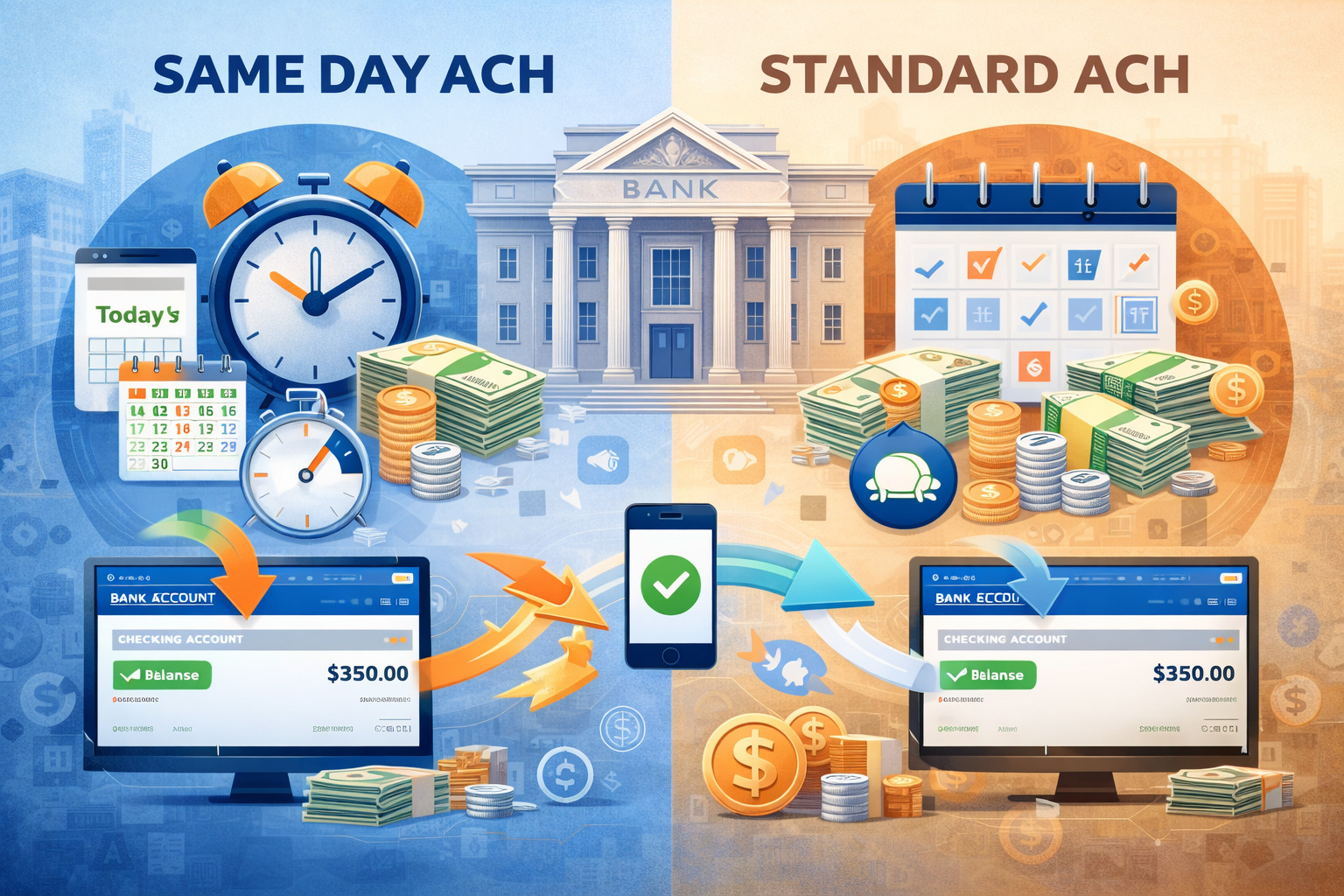
At the highest level, the difference between same day ACH and standard ACH comes down to urgency, timing windows, cost, and operational fit. Same Day ACH compresses processing so eligible payments can settle within the current business day.
Standard ACH uses regular timing, often next business day when submitted properly, but sometimes longer depending on workflow conditions.
Here is a practical comparison table that business owners and finance teams can use as a starting point:
| Factor | Same Day ACH | Standard ACH |
| Basic speed | Same business day for eligible payments submitted before cut-off | Often next business day; may take longer depending on timing and workflow |
| Processing model | Batch-based, accelerated windows | Batch-based, regular scheduling |
| Network cut-off sensitivity | Very high | Moderate |
| Provider internal cut-offs | Often earlier than network deadlines | Still important, but usually less operational pressure |
| Typical cost | Higher than standard ACH, but usually lower than a wire | Lower-cost option for routine payments |
| Best use cases | Urgent vendor payments, payroll corrections, last-minute collections, faster disbursements, time-sensitive transfers | Recurring billing, planned payroll, scheduled AP, subscriptions, routine B2B payments |
| Customer expectation risk | Higher if teams promise “today” without cutoff clarity | Lower if schedules are set properly |
| Operational flexibility | Useful for exceptions and urgent needs | Better for planned, repeatable workflows |
| Weekend and holiday impact | Still limited to banking days | Still limited to banking days |
| Instant? | No | No |
This table captures the reality behind same day vs regular ACH transfers. The speed difference is real, but the bigger difference is how the payment fits into your workflow. Same Day ACH is the premium timing option within ACH. Standard ACH is the default workhorse.
In practice, finance teams should think less about which option is “better” and more about which option matches the transaction. A one-time urgent commission payout and a scheduled monthly subscription debit are not the same problem. They should not automatically use the same payment setting.
Why cut-off times create most of the confusion in same day vs regular ACH transfers
If there is one issue that causes the most misunderstandings in same day vs regular ACH transfers, it is cut-off timing. Businesses often assume that because the network offers Same Day ACH, they can initiate a payment at any point during the day and still get same-day settlement. That is not how it works.
There are official network deadlines, but there are also provider-level deadlines. Many banks and processors stop accepting same-day files earlier than the final network deadline so they can review transactions, confirm balances, run risk checks, and build files.
Internal treasury workflows can also slow things down. If your accounts payable manager submits the payment on time but your final approver does not release it until later, the payment can miss the window.
Standard ACH has cut-off risk too, but the consequences often feel smaller because the expectation is already next-day or scheduled. Same Day ACH magnifies cut-off risk because the value of the payment depends on that compressed timeline. Missing a same-day deadline can effectively turn a premium-speed payment into an ordinary next-day payment.
That is why teams need documented internal rules. For example, your provider may technically support same-day submission until late afternoon, but your business may choose an internal same-day deadline of noon for outbound vendor payments and 11:00 a.m. for emergency payroll files. Those buffers reduce avoidable disappointment and make payment timing more dependable.
Cost, tradeoffs, and why faster ACH is not always the right choice
Speed has a cost. That does not automatically make Same Day ACH a bad deal, but it does mean businesses should use it intentionally. In many provider pricing models, standard ACH carries a lower per-transaction cost, while Same Day ACH adds a premium.
Exact fees vary widely by processor, bank relationship, volume, account risk, and product configuration. Some providers charge flat add-on fees. Others use tiered pricing or bundled service models.
The key question is not just “How much more does same-day cost?” It is “What problem are we solving by paying for speed?”
If the faster timing prevents a late fee, keeps a supplier from holding shipment, resolves an employee issue before payday ends, or improves collection timing on a large receivable, the premium may be easy to justify. If the payment was already planned and no one benefits from a faster arrival, the extra cost may add no real value.
This is where ACH decisions become operational rather than purely financial. A finance leader may prefer standard ACH because it reduces transaction costs. An operations leader may prefer Same Day ACH in specific workflows because it protects service continuity or improves the customer experience. Both views can be right, depending on the transaction.
There is also the cost of complexity. Same Day ACH may require tighter staffing coverage, earlier approvals, more active exception handling, and clearer customer communication. Those operational costs are not always visible in pricing sheets, but they matter.
Hidden tradeoffs: returns, reversals, and timing that looks faster than it feels
One reason businesses sometimes overvalue fast ACH is that settlement speed is only part of the story. Posting is not always the same as final certainty. Returns, exceptions, and internal reviews can still affect the real business outcome after the payment appears to move.
For receivables teams, this matters especially on ACH debits. A customer payment may look successful in the dashboard, but if the account was invalid, closed, unauthorized, or lacked funds, a return can still follow within applicable windows. That does not mean ACH is unreliable. It means businesses need to separate initial speed from operational confidence.
This is also why faster ACH is not always the best answer for collections. Sometimes the better move is stronger authorization, account verification, clearer billing communication, or better retry strategy rather than paying for same-day processing. Likewise, on the outbound side, a rushed same-day payment with bad account details is still a bad payment.
Businesses that want healthier ACH outcomes should pair payment speed decisions with stronger process controls. Good examples include payee verification, approval buffers, customer reminders before debits, and clear escalation rules for urgent payments.
A useful adjacent topic here is how to make an ACH payment, especially for teams building standardized procedures and trying to reduce preventable errors.
Best business use cases for Same Day ACH
The best use cases for Same Day ACH are the ones where waiting until the next business day would create a meaningful business problem. One classic example is an urgent vendor payment. Maybe a supplier is holding a shipment until funds are confirmed.
Maybe a field services company needs to pay a subcontractor today to keep work moving. In those moments, Same Day ACH can be the most cost-effective compromise between a wire and a routine ACH payment.
Payroll corrections are another high-value use case. Businesses do not want employees waiting days for an error to be fixed, especially when trust and morale are on the line. Same Day ACH can help correct underpayments, missed payroll entries, or reimbursement issues faster than standard ACH while avoiding the heavier cost of a wire.
Customer disbursements also benefit. Think claims payouts, refunds on larger purchases, marketplace seller transfers, settlement payouts, legal disbursements, or earned wage access-style scenarios where faster access matters. Same Day ACH can improve the recipient experience without requiring a true instant payment rail.
Collections and receivables teams may also use Same Day ACH near due dates or at month-end. If a customer agrees to pay and the business wants the strongest chance of getting the debit processed in the current banking day, Same Day ACH can help accelerate cash movement.
That can matter for liquidity planning, borrowing base calculations, and close-period receivables management.
Still, Same Day ACH should be used with care. It works best when the payment details are already validated, approvals are streamlined, and the business has realistic cutoff rules. Used well, it is a targeted tool. Used carelessly, it becomes an expensive way to miss deadlines with more urgency.
Practical Same Day ACH scenarios for AP, AR, payroll, and refunds
Here are some realistic ways businesses use Same Day ACH effectively:
- Accounts payable: A manufacturer needs to release an urgent materials payment before a supplier will ship. Same Day ACH avoids a wire while still improving timing enough to keep operations moving.
- Accounts receivable: A customer calls before the end of the day to settle a high-value invoice. The business initiates a same-day debit, understanding that actual availability still depends on timing and authorization quality.
- Payroll: An employee’s direct deposit amount was incorrect. Finance submits a correction using Same Day ACH so the employee does not have to wait until the next payroll cycle.
- Refunds: A company wants to issue a faster refund to preserve trust after a billing error or service disruption. Same Day ACH speeds up delivery compared with a routine next-day workflow.
- Marketplace or contractor payouts: A platform pays sellers, creators, or contractors faster to meet expectations and reduce payout complaints.
In each scenario, speed solves a real problem. That is the common thread. Same Day ACH becomes a strong business choice when the payment timing has immediate operational, reputational, or relationship consequences.
Best business use cases for Standard ACH
Standard ACH is ideal for the broad category of payments that are important, repeatable, and best handled through predictable scheduling.
For many businesses, this includes most recurring billing, regular supplier payments, subscription collections, rent payments, standard payroll runs, membership dues, installment plans, and B2B invoice payments scheduled ahead of due dates.
The reason standard ACH works so well in these situations is simple: there is no need to pay extra for speed when the payment can be planned.
A subscription business that bills customers on the first of the month benefits more from consistency, clean authorization, and retry management than from same-day acceleration. A finance team that runs weekly payables can create reliable workflows around standard ACH and keep costs lower across large volumes.
Standard ACH is also easier to align with internal controls. Many organizations require layered approvals, payment reviews, spend thresholds, and scheduled release processes.
These controls are healthy, but they do not pair naturally with last-minute urgency. Standard ACH gives businesses enough room to maintain discipline without fighting the clock on every payment.
Another major use case is cash flow management. Standard ACH allows businesses to schedule payments in line with expected receivables, funding cycles, and treasury planning. That predictability matters.
A payment method does not need to be the fastest to be the most useful. In many cases, the best ACH payment methods for businesses are the ones that support consistent forecasting and fewer surprises.
Practical Standard ACH scenarios for subscriptions, payroll, vendor payments, and B2B transfers
Here are some common scenarios where standard ACH is usually the smarter option:
- Recurring billing: A software company debits subscribers monthly on a fixed billing date. Standard ACH keeps fees down and fits automation well.
- Scheduled payroll: Payroll files are prepared and approved ahead of payday. Standard ACH supports reliable direct deposit timing when the schedule is managed properly.
- Routine vendor payments: A distributor pays approved invoices on set payment runs each week. Standard ACH reduces costs and creates structured cash outflows.
- B2B invoices: A customer agrees to pay net terms on a known due date. Standard ACH works well when the payment is initiated in advance.
- Membership or service plans: Gyms, clinics, schools, and service businesses often use standard ACH debits for predictable collections.
- Loan or installment payments: Recurring authorized drafts usually do not need same-day acceleration unless there is a special exception.
These are the kinds of payments that make up the backbone of ACH volume in many businesses. They do not need premium urgency. They need consistency, low cost, and workflow compatibility. That is exactly where standard ACH performs best.
What can change actual timing: cut-offs, weekends, holidays, approvals, and provider rules
One of the biggest mistakes businesses make when evaluating same day ACH vs standard ACH is assuming that network rules alone determine timing. In reality, actual payment timing is shaped by a long chain of operational variables.
The ACH network provides the framework, but your real experience depends on your bank, provider, file timing, transaction type, internal controls, and the receiving institution’s posting practices.
Weekends and federal holidays are obvious factors. ACH follows banking days. If you initiate a transfer late on Friday, the visible timing can stretch quickly even if your dashboard makes it look like the payment has already started. Holidays create the same effect, especially around payroll and end-of-month obligations.
Provider-specific rules are just as important. Your processor may support Same Day ACH for credits but not for certain debit use cases. It may allow same-day submission only up to a certain dollar amount below the network maximum. It may also batch transactions at specific times or flag new payees for additional review.
Internal approval processes matter more than many people realize. A payment can be “ready” in accounts payable, but if treasury approval comes too late, the cut-off is missed. The same problem appears in payroll, where an urgent correction can still fail to go out same-day if HR, finance, and banking operations are not aligned.
Customer-facing expectations should always account for these variables. That is why good finance teams talk about expected timing, cut-off windows, and provider rules rather than giving blanket same-day promises.
Why “processed” does not always mean “available” or “final”
Another source of confusion is the word “processed.” A payment platform may mark an ACH transfer as processed when it has been accepted into workflow, not when the recipient can use the funds. That distinction matters for both outbound payments and collections.
For outbound credits, the receiving bank still controls posting and availability within applicable rules. Nacha’s resources show that Same Day ACH credits in earlier windows have earlier availability expectations, while later-window credits may only need to be available by the end of the processing day.
That means “same-day” can still feel very different depending on submission time and receiving bank behavior.
For inbound debits, a processed status may only mean the payment was submitted successfully. It does not necessarily mean the business can treat the funds as risk-free. Returns and exceptions may still emerge. That is especially relevant in subscriptions, invoice collection, and any debit-heavy business model.
Operationally, this means finance teams should define internal statuses carefully. “Submitted,” “settled,” “posted,” and “available” should not be treated as interchangeable terms. When businesses blur those definitions, they make poor cash flow decisions and create confusion for customers, employees, or vendors.
Common mistakes businesses make when choosing ACH processing options
The most common mistake is assuming all ACH is either “same-day” or “two-to-three days.” Neither shortcut is reliable. ACH timing exists on a spectrum shaped by cut-offs, banking days, payment type, provider rules, and receiving bank posting.
Businesses that rely on generic assumptions often choose the wrong payment setting or communicate unrealistic timelines to customers and vendors.
A second mistake is ignoring provider cut-off windows. Teams may know Same Day ACH exists, but they do not realize their actual internal deadline is earlier than the official network timing. This leads to frantic late-day submissions, avoidable escalation, and disappointed recipients.
A third mistake is choosing speed when predictability matters more. Some businesses default to faster options because they sound better, but most payment operations benefit more from consistency than urgency. Standard ACH may be the stronger choice for recurring billing, scheduled payables, and payroll prepared in advance.
A fourth mistake is failing to align payment timing with internal workflow reality. For example, accounts payable may promise same-day vendor payments even though approvals routinely take hours. Or a billing team may promise “next-day ACH” without accounting for weekends and holidays.
Finally, many businesses overlook communication. If a customer, vendor, or employee expects funds today, “we submitted it through ACH” is not enough. They need a realistic description of when the payment is likely to be posted and available.
Operational warning signs that your ACH timing strategy needs work
Here are some warning signs that a business has not fully aligned its ACH workflow with real timing behavior:
- Team members regularly ask whether ACH is “instant”
- Vendor or customer complaints happen after late-day submissions
- Payroll corrections become emergency events too often
- Accounts receivable assumes submitted debits are the same as collected funds
- Internal approval chains routinely miss provider cut-offs
- Finance and customer support teams give different answers about payment arrival times
- Same Day ACH is used by default even for scheduled payments
- Standard ACH is blamed for delays actually caused by internal process gaps
When these patterns show up, the answer is not always a different payment rail. Often it is better education, clearer cut-off rules, smarter escalation, and more disciplined scheduling.
How to decide between same day ACH vs standard ACH for a specific payment
The best way to choose between same day ACH vs standard ACH is to look at the transaction through four lenses: urgency, value, expectations, and operational readiness.
First, ask how urgent the payment truly is. Does it need to arrive within the current business day to solve a problem, or would next-business-day timing still work? If there is no meaningful downside to waiting, standard ACH is often the more efficient choice.
Second, look at transaction value and business impact. A higher-value payment does not always need to be faster, but the cost of delay may be larger. A supplier holding a large shipment or a customer waiting on a meaningful refund may justify Same Day ACH more easily than a small routine payment.
Third, consider the recipient’s expectations. If a payment promise has already been made, timing matters more. But even then, you should verify whether Same Day ACH can realistically meet that promise under your actual provider rules and internal workflows.
Fourth, assess operational readiness. Do you have clean account information, the right authorization, timely approvers, and enough buffer before cut-off? If not, paying for same-day speed may not produce a same-day outcome.
This is where ACH payment methods for businesses become a strategic decision rather than a technical checkbox. The right answer is not always the fastest or cheapest option. It is the one that best fits the payment’s urgency and your team’s ability to execute it well.
A practical checklist for choosing the right ACH option
Use this checklist before selecting Same Day ACH or Standard ACH:
- Is the payment truly urgent, or just important?
- What happens if the funds are not available until the next business day?
- Has the payment been initiated before the provider’s same-day cut-off?
- Are all required approvals already complete?
- Are the account details verified and current?
- Is the transaction eligible for Same Day ACH under your provider’s rules?
- Does the recipient actually need funds today, or simply confirmation today?
- Would a standard ACH payment still meet the business need at a lower cost?
- Are weekends or holidays likely to affect the visible timing?
- If this is a debit, are you also considering return risk and authorization quality?
If most answers point toward urgency, readiness, and immediate business impact, Same Day ACH may be appropriate. If the payment can be scheduled, predicted, and managed without urgency, standard ACH is usually the better fit.
Frequently Asked Questions
Is Same Day ACH instant?
No. Same Day ACH is faster than standard ACH, but it is still a batch-based payment method. It can settle within the same business day if the payment is submitted before the provider’s cutoff time, but it is not the same as an instant or real-time payment.
Does standard ACH always take multiple business days?
Not always. Standard ACH often settles on the next business day when submitted on time, although actual timing can vary based on the payment provider, bank processing schedules, weekends, holidays, and internal approval workflows.
What is the biggest difference between Same Day ACH and Standard ACH?
The biggest difference is timing. Same Day ACH is designed for eligible payments that need to settle within the same business day, while Standard ACH is generally used for routine payments that can be scheduled ahead of time and processed at a lower cost.
Can Same Day ACH be used for both credits and debits?
Yes. Same Day ACH can be used for eligible ACH credits and ACH debits, depending on the payment provider’s capabilities, bank rules, transaction type, and submission timing.
Why did a Same Day ACH payment not arrive the same day?
This usually happens because the payment missed a cutoff window, the provider has earlier internal deadlines, the payment was submitted on a weekend or holiday, or the receiving bank posted the payment later in the day. Same Day ACH depends on timing and provider-specific processing rules.
Should businesses use Same Day ACH for payroll?
It can be useful for payroll corrections, missed payments, or urgent reimbursements. For regular payroll runs that are planned in advance, Standard ACH is usually the more practical and cost-effective option.
Is faster ACH always worth the extra cost?
No. Same Day ACH can be worth the added cost when payment speed solves a real business problem, such as an urgent vendor payment or payroll correction. For recurring billing, planned payables, and scheduled payroll, Standard ACH is often the better value.
Conclusion
The smartest way to understand same day ACH vs standard ACH is to stop thinking of one as “good” and the other as “slow.” Both are useful. They simply solve different timing problems.
Same Day ACH is best when urgency matters and the business benefit of faster settlement is real. It works well for payroll corrections, urgent vendor payments, faster refunds, last-minute collections, and other time-sensitive scenarios. But it depends heavily on cut-off timing, provider rules, and internal execution. It is faster ACH, not instant ACH.
Standard ACH remains the better choice for most planned payment activity. It is typically lower cost, easier to align with internal controls, and well suited to recurring billing, scheduled payroll, routine vendor payments, subscription collections, and other repeatable workflows. And despite the old stereotype, standard ACH is often faster in practice than many people assume.
The real difference between same day ACH and standard ACH is not just speed. It is the combination of speed, cost, cut-off sensitivity, and workflow fit. Businesses that choose well do not default to the fastest or cheapest option.
They match the payment method to the business need, communicate realistic expectations, and build internal processes around how ACH timing actually works.
When you evaluate same day vs regular ACH transfers through that lens, the decision becomes clearer. If the payment is urgent and your team can meet the timing window, Same Day ACH may be the right move. If the payment is planned and predictability matters more than acceleration, standard ACH is usually the smarter, steadier choice.
Leave a Reply