
Electronic bank payments can simplify invoice collection, recurring billing, payroll, vendor payments, donations, rent collection, and other financial workflows. However, the terminology surrounding these transactions can be difficult to understand when a business first begins accepting or sending ACH payments.
Common ACH payment terms cover several areas at once. Some describe the people and financial institutions involved. Others describe how a payment is authorized, submitted, settled, returned, verified, secured, and recorded.
Understanding ACH payment terminology does not require memorizing every technical definition. Most businesses only need a working knowledge of the terms that affect payment timing, customer communication, bank account information, failed transactions, recurring billing, and reconciliation.
This ACH glossary explains the essential ACH terms businesses are likely to encounter. It also shows how ACH terms and definitions connect throughout the payment lifecycle—from the moment a payment is authorized until it settles or is returned.
The information is educational and general. Businesses should consult their financial institution, payment provider, accountant, legal professional, or qualified compliance adviser when questions involve specific rules, contracts, taxes, accounting treatment, cybersecurity requirements, or regulatory obligations.
What Are Common ACH Payment Terms?
Common ACH payment terms are the words and phrases used to describe electronic payments moving through the Automated Clearing House network. The terminology identifies who initiates the payment, whose account is affected, which financial institutions handle the transaction, how the payment is classified, and what happens after it is submitted.
For example, a business collecting a monthly membership payment may be called the originator. The customer is usually the receiver, even though money is being withdrawn from the customer’s account. The business’s financial institution may act as the ODFI, while the customer’s financial institution acts as the RDFI.
Other ACH transaction terms describe the direction of the payment. An ACH debit pulls authorized funds from an account, while an ACH credit pushes funds to another account. Settlement, return codes, SEC codes, effective entry dates, prenotes, and account validation describe additional parts of the process.
The ACH network processes electronic debit and credit instructions between participating financial institutions, commonly through batches rather than individual real-time messages. An official overview of how ACH works provides additional details about common entry types and payment flows.
Why ACH Terminology Matters
Understanding business ACH payment terminology helps staff interpret payment reports and communicate accurately with customers, vendors, banks, and processors.
Without that knowledge, a team may mistakenly assume that an authorized payment has settled, that a submitted debit is guaranteed, or that a returned transaction is the same as a refund.
The terminology also affects cash-flow planning. Knowing the difference between submission, processing, settlement, posting, and funding allows a business to estimate when money may become available without treating an expected date as an unconditional promise.
Return terminology is equally important. A return code can indicate insufficient funds, an invalid account number, a closed account, a stop-payment request, or an authorization issue. Each situation may require a different response.
Clear ACH payment definitions can also improve customer service. Employees can explain what occurred without relying on vague statements such as “the bank rejected it” or “the transfer is still processing.”
Who Should Learn ACH Terms?
Business owners are not the only people who benefit from learning essential ACH terms. Anyone who creates payments, handles billing questions, updates customer accounts, reviews deposits, or records transactions should understand the basic terminology.
That may include:
- Accounts receivable and accounts payable staff
- Bookkeepers and accounting teams
- Office and practice managers
- Customer service representatives
- Payroll administrators
- Property managers
- Nonprofit administrators
- Subscription and membership billing teams
- Ecommerce operations teams
- Finance and treasury personnel
Different employees do not need the same depth of knowledge. Customer service staff may primarily need authorization, settlement, return, refund, and recurring-payment terms. Accounting teams may need deeper knowledge of batches, settlement reports, effective dates, reconciliation, and transaction identifiers.
A short internal ACH glossary can give each team a consistent set of definitions and reduce misunderstandings between departments.
ACH Payment Terms at a Glance
The following table provides a quick reference for several foundational ACH processing terms.
| ACH Term | Simple Meaning | Why It Matters | Example Use |
| ACH | Electronic bank-payment network | Moves debit and credit instructions between accounts | A customer pays an invoice from a checking account |
| ACH debit | Authorized pull from an account | Commonly used to collect customer payments | Monthly membership payment |
| ACH credit | Payment pushed to another account | Commonly used for payouts and disbursements | Vendor invoice payment |
| Originator | Party that starts the ACH entry | Identifies who is initiating the payment | Business submits a customer debit |
| Receiver | Party whose account receives the entry | Identifies the account affected by the entry | Customer authorizes a debit |
| ODFI | Originating financial institution | Introduces the entry into the network | Business bank sends the payment instruction |
| RDFI | Receiving financial institution | Receives the entry for the account holder | Customer bank receives a debit instruction |
| Authorization | Permission to initiate the payment | Helps establish valid payment terms | Customer approves recurring billing |
| SEC code | Code identifying the entry type | Classifies the transaction and authorization channel | WEB, TEL, PPD, CCD, or CTX |
| Settlement | Financial movement between institutions | Affects expected funding and cash flow | Funds settle after processing |
| Return | Entry sent back instead of completed | Requires investigation and follow-up | Payment returned for insufficient funds |
| Prenote | Non-dollar test entry | Helps check account information | Account details tested before payroll |
| Micro-deposits | Small deposits used for verification | Help confirm account access | Customer confirms two deposit amounts |
| Reconciliation | Matching payments with business records | Supports accurate accounting | Deposit matched to an invoice |
How to Use the Table
The table can be used as a first reference when reviewing payment reports or speaking with a provider. When an unfamiliar term appears, identify which part of the payment process it describes: the network, a participant, a payment direction, an authorization method, processing, verification, a return, or reporting.
For example, ODFI and RDFI describe financial-institution roles. WEB and CCD classify entries. Settlement and effective entry date relate to timing. Return code and NSF explain unsuccessful payments.
After identifying the category, review the more detailed definition before deciding what action to take. This is especially important for returns, reversals, authorization questions, and recurring-payment changes.
Businesses should avoid taking action solely because a term sounds familiar. A reversal is not simply another word for a refund, and a settled payment is not always beyond the possibility of a later return.
Why ACH Terms Connect Together
ACH payment network terms rarely operate independently. A single customer payment may involve an originator, receiver, ODFI, RDFI, ACH operator, payment processor, gateway, SEC code, authorization record, effective entry date, settlement event, and possible return.
Consider a recurring online payment. The customer authorizes a business to debit a bank account each month. The online authorization channel may affect the SEC code. The business sends the entry through a gateway or processor, and its financial institution submits it through the ACH network.
The customer’s institution receives the debit instruction and posts it to the account. If the account lacks funds or the customer challenges the authorization, the entry may be returned with a code identifying the reason.
Learning the terms as parts of one connected process makes them easier to remember than studying each definition separately.
ACH Network, Participants, and Financial-Institution Roles

ACH stands for Automated Clearing House. It refers to the electronic payment network used to exchange debit and credit instructions between financial institutions.
The word “clearing” describes the exchange, sorting, and processing of payment instructions before final settlement. The word “house” reflects the organized network structure through which participating institutions follow standardized formats, schedules, and operating rules.
An ACH operator receives batches from originating institutions, processes the entries, and distributes them to receiving institutions. Most businesses do not interact directly with an operator. They normally use a bank, payment processor, billing platform, payroll system, accounting application, or ACH payment gateway.
Businesses interested in the complete sequence can review this guide explaining how the ACH network moves money. Federal Reserve ACH services similarly describe the network as a batched system for exchanging debit and credit transactions between financial institutions.
ACH Compared With a General Bank Transfer
ACH is one form of electronic bank transfer, but not every bank transfer uses the ACH network. Wire transfers, real-time payment systems, internal account transfers, card payments, and some person-to-person services may use different payment rails.
ACH is commonly designed for scheduled, repeatable, and batch-based transactions. Wires are often used when a business needs a high-value transfer handled through a different process with faster or more final settlement characteristics.
Paper checks rely on physical or imaged check information rather than an ACH entry, although some checks may later be converted into electronic entries.
An eCheck is often a customer-facing description for a check-like electronic payment processed through ACH. The exact product and workflow can vary by provider, so businesses should confirm what the term means in their system.
Originator, Receiver, ODFI, RDFI, and ACH Operator
The originator is the party that initiates an ACH entry. A business acts as an originator when it submits an authorized customer debit or sends an ACH credit to a vendor.
The receiver is the person or organization whose account receives the ACH entry. In an ACH debit, the receiver may be the customer whose account is debited. In an ACH credit, the receiver may be an employee, vendor, contractor, or customer receiving money.
The Originating Depository Financial Institution, or ODFI, is the financial institution that introduces the ACH entry into the network for the originator. The Receiving Depository Financial Institution, or RDFI, receives the entry for the receiver’s account. An ACH operator processes and routes batches between participating institutions.
ACH Debit, ACH Credit, Direct Debit, and Direct Deposit
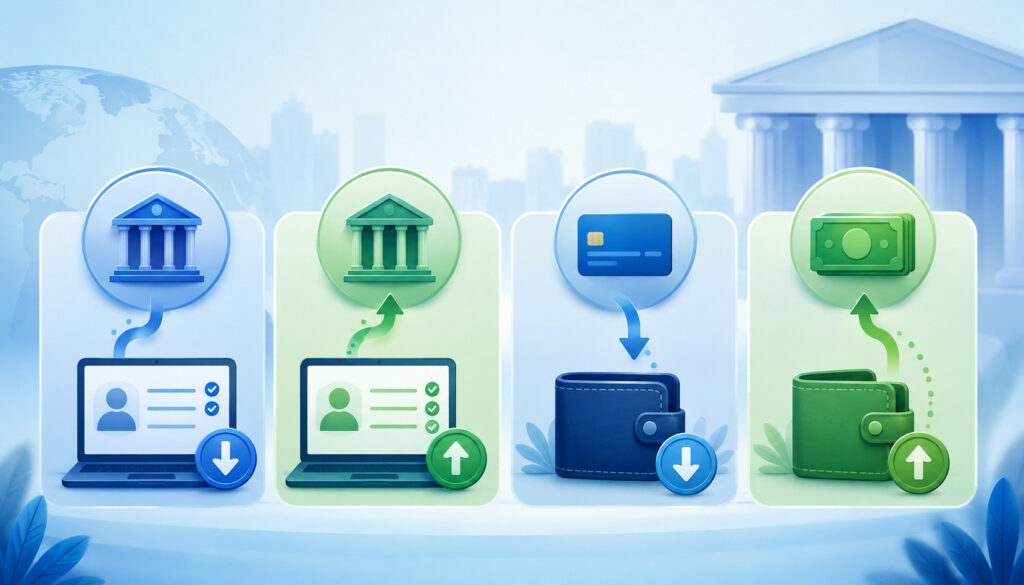
An ACH debit is an entry used to pull money from an account after authorization. Businesses commonly use ACH debits for invoices, subscriptions, rent, tuition, memberships, service plans, installment payments, and recurring donations.
An ACH credit pushes money from the sender’s account to another account. Common uses include payroll, vendor payments, contractor payouts, reimbursements, refunds, and transfers between business accounts.
The terms direct debit and ACH debit are often used in similar customer-payment contexts. Direct debit generally describes an arrangement in which a customer authorizes a business to withdraw funds. The underlying payment may be processed as an ACH debit.
Direct deposit generally describes an ACH credit delivered to an employee, contractor, vendor, or other recipient. Payroll is the best-known use, but direct deposit may also support reimbursements and other business disbursements.
ACH Debit Versus ACH Credit
The easiest way to distinguish these ACH transfer terms is to focus on who controls the movement.
With an ACH credit, the account holder sending the money generally initiates a push. For example, a business approves a vendor invoice and sends money to the vendor’s account.
With an ACH debit, the party collecting money initiates a pull based on authorization from the account holder. For example, a property manager submits a scheduled rent debit after the tenant has agreed to the payment terms.
Both entries travel through the ACH network, but they create different operational considerations. Debits require particular attention to authorization, customer communication, insufficient funds, and unauthorized-return risk. Credits require careful payee verification because sending money to incorrect or fraudulent account details can be difficult to correct.
eCheck and Check-Like Electronic Payments
An eCheck is a term commonly used for an electronic payment that uses bank routing and account information instead of a physical check. In many business systems, the payment is processed as an ACH debit.
Unlike a paper check, an eCheck does not need to be mailed, physically deposited, or manually transported. Customers may enter their banking information into a secure payment form, approve the transaction, and receive an electronic confirmation.
However, an eCheck should not be described as guaranteed money. Incorrect account data, insufficient funds, closed accounts, stop-payment instructions, or authorization disputes may still result in a return.
Businesses should confirm how their provider uses the term because “eCheck,” “bank payment,” “electronic check,” and “ACH payment” may appear as interchangeable customer-facing labels even when the underlying workflows differ.
ACH Authorization, One-Time Payments, and Recurring Payments

ACH authorization is permission to initiate an entry affecting another party’s account. The authorization establishes the relationship between the originator and receiver and should make the payment terms understandable.
A one-time ACH payment authorizes a single transaction. Examples include an individual invoice, security deposit, tuition payment, donation, registration fee, or one-off business purchase.
A recurring ACH payment authorizes payments on an ongoing schedule. It may be used for subscriptions, rent, memberships, installment plans, maintenance agreements, service contracts, and donation pledges.
Authorization methods can vary based on the account type, entry type, payment channel, transaction purpose, and applicable requirements. Businesses should follow the instructions of their financial institution or processor rather than assuming that one authorization format works for every ACH debit.
What an Authorization Agreement Should Address
An authorization agreement should help the payer understand what is being approved. Depending on the transaction and applicable requirements, relevant details may include:
- Name of the payer and payment recipient
- Amount or method for determining the amount
- One-time or recurring status
- Payment frequency and expected dates
- Bank-payment method
- Start date and duration
- Cancellation or revocation procedure
- Contact information
- Treatment of failed payments
- Method used to provide confirmation or a copy
Recurring consumer transfers may carry specific authorization and copy-delivery requirements. The federal rule covering preauthorized transfers is one relevant source, but businesses should obtain professional guidance for their exact situation.
A practical explanation of setting up an ACH authorization form may also help teams identify the operational information they need to collect.
Authorization Records and Recurring Billing Practices
Authorization records can help a business answer customer questions, investigate returns, confirm payment schedules, and document changes. Records may include the authorization, confirmation message, transaction amount, date, invoice reference, cancellation request, and communication history.
For recurring payments, the business should make the schedule easy to understand. Customers should know when debits will occur, whether amounts can vary, how to update an account, and how to cancel according to the agreed process.
Payment reminders may reduce confusion, especially when charges are infrequent or amounts change. Clear descriptions on confirmations and account statements can also help customers recognize the transaction.
ACH Settlement, Effective Entry Date, and Same-Day ACH
ACH settlement is the financial movement between participating institutions after entries have been cleared and processed. Settlement affects when institutions exchange funds, but it should not automatically be treated as the same as customer-facing posting, provider funding, or final certainty.
The effective entry date is the date associated with the intended processing or settlement of a batch. How it is handled can depend on file timing, the entry, provider settings, banking days, and whether the payment qualifies for same-day processing.
Same-Day ACH is an accelerated ACH option for eligible transactions submitted within applicable processing windows. It is still batch-based and should not be confused with a real-time payment.
The ACH file guide notes that originating institutions may have contractual rules for effective dates and for files containing invalid or outdated dates.
Submission, Settlement, Posting, and Funding
These ACH settlement terms describe different events:
- Submission means the payment instruction has entered the bank’s or provider’s workflow.
- Processing means the instruction is being reviewed, formatted, batched, or transmitted.
- Settlement means funds are exchanged between participating financial institutions.
- Posting means the transaction appears on the relevant account.
- Funding may describe when a provider makes proceeds available to the business.
A dashboard status such as “processed” may not mean the recipient can use the money or that a debit can no longer be returned. Provider terminology varies, making it important to review status definitions.
Businesses should build cash-flow forecasts around realistic availability policies rather than assuming that initiation equals collected funds.
Same-Day ACH Is Faster but Not Instant
Same-Day ACH can allow eligible transactions to settle during the current banking day. However, eligibility, provider support, internal approval deadlines, transaction limits, processing cutoffs, account reviews, and receiving-bank posting can affect the outcome.
The network supports multiple processing and settlement opportunities, but a provider may set an earlier customer deadline so it has time to review and transmit entries. Federal ACH services also exclude certain entry types and transactions above the applicable network limit from same-day eligibility.
Same-day processing may be useful for an urgent vendor payment, payroll correction, customer refund, or time-sensitive collection. Routine subscriptions and scheduled payables may be better suited to standard processing.
For further comparison, review Same-Day ACH versus standard ACH.
ACH Returns, Return Codes, NSF, and Unauthorized Returns
An ACH return occurs when an entry is sent back instead of being completed as originally submitted. The receiving institution uses a standardized return reason code to explain why the entry is being returned.
Common categories include:
- Insufficient or unavailable funds
- Closed accounts
- Invalid account numbers
- Unable-to-locate accounts
- Stop-payment requests
- Unauthorized entries
- Incorrect transaction details
- Accounts that cannot accept the entry
NSF means non-sufficient funds. It generally indicates that the account did not have enough available money to complete the payment.
An unauthorized return indicates that the receiver states the entry was not properly authorized. This may result from missing permission, misunderstood recurring terms, failure to cancel a debit, fraud, incorrect customer details, or inadequate records.
Return reason codes provide standardized information for investigating these events.
What to Do After an ACH Return
The first step is to review the exact return code and the original transaction. Confirm the customer, amount, account details, authorization record, invoice, submission date, and any previous attempts.
The appropriate response depends on the reason. Incorrect account information may require corrected details. An NSF return may require customer contact and a new payment arrangement. An authorization-related return may require stopping future debits while the matter is reviewed.
Businesses should not automatically resubmit every returned debit. Reinitiation rules, provider policies, customer instructions, and the return category may limit or affect what is appropriate.
Update accounting and customer records promptly so an unpaid invoice is not mistakenly treated as collected. Teams can also consult this guide to resolving common ACH return codes.
Return, Dispute, Refund, and Reversal
A return sends an ACH entry back through the banking process because it could not be completed or was rejected under an applicable return reason.
A dispute is a broader customer or account-holder challenge involving a transaction. The dispute may lead to a return, investigation, correction, or another resolution.
A refund is a new payment that gives money back after the original payment. It is commonly used for cancellations, overpayments, returned goods, billing adjustments, or service issues.
A reversal is a limited correction method for certain erroneous ACH entries, such as a duplicate or incorrect amount. It should not be used as a substitute for an ordinary refund. Businesses should follow processor and financial-institution guidance because reversal use is governed by specific conditions.
Prenotes, Micro-Deposits, and Bank Account Verification
Bank account verification means checking that banking information is accurate, usable, or connected to the person or organization providing it. Verification can reduce incorrect-account errors, avoidable returns, fraud exposure, and customer frustration.
A prenote, or prenotification entry, is a non-dollar ACH entry sent before a live transaction. It can help check whether the routing number and account number can be processed through the network.
Micro-deposits are small deposits sent to an account for verification. The customer may be asked to confirm the exact amounts, demonstrating access to the account.
Other verification methods may include instant account connections, account-validation services, database checks, document review, or manual confirmation. Each method has different speed, customer-experience, cost, privacy, and risk considerations.
Prenote Versus Micro-Deposit Verification
A prenote and a micro-deposit process both support account validation, but they operate differently.
A prenote is generally a zero-dollar ACH entry used to test account information through the ACH process. It does not necessarily prove that the customer actively controls the account.
Micro-deposits place small amounts into the account and require the customer to report those amounts. This provides evidence that the customer can access the account, although the process may take additional time and create extra steps.
Instant verification can be faster but may require the customer to connect through a secure interface. Businesses should evaluate which methods their provider supports and what verification is appropriate for their payment channel.
Routing Numbers and Account Numbers
A routing number identifies the financial institution involved in the transaction. An account number identifies the particular checking or savings account.
Both must be entered accurately. A routing-number error may send the entry toward the wrong institution or cause immediate rejection. An incorrect account number may lead to a return or, in some cases, a more serious wrong-account problem.
Banking details should not be kept in unsecured emails, shared documents, handwritten notes, or broadly accessible spreadsheets. Payment systems should limit access and avoid displaying complete account numbers unnecessarily.
Standard Entry Class Codes: WEB, TEL, PPD, CCD, and CTX
Standard Entry Class codes, usually called SEC codes, classify ACH entries. A code can indicate whether an entry is associated with a consumer or business account, whether it is single or recurring, how authorization was obtained, and what record format is used.
The correct code is not simply a label selected for convenience. It connects the payment to a particular use case and set of processing expectations.
An official SEC code reference explains that these codes identify the consumer or corporate nature of entries, single or recurring status, and applicable record formats.
Businesses should rely on provider guidance when determining the correct code. Selecting an entry type based only on a short definition can lead to improper classification.
WEB, TEL, and PPD Entries
A WEB entry commonly covers a consumer ACH debit authorized through an internet or mobile channel. Examples may include online invoice forms, customer portals, ecommerce checkouts, and digital donation pages.
A TEL entry generally relates to certain consumer debits authorized by telephone. Businesses using phone authorizations should confirm eligibility, recording or notice requirements, and documentation procedures with their provider.
A PPD entry, meaning Prearranged Payment and Deposit, is commonly associated with consumer credits or debits supported by an appropriate authorization. It may appear in direct deposit, recurring billing, or other consumer-payment workflows.
These categories may look similar from the customer’s perspective, but the authorization channel and transaction design can affect classification.
CCD and CTX Entries
A CCD entry, or Corporate Credit or Debit, is commonly used for business-to-business payments. Examples include supplier payments, corporate collections, intercompany transfers, and business invoice payments.
A CTX entry, or Corporate Trade Exchange, is also designed for business payments but can carry more remittance information. That additional data may help a recipient match a payment to multiple invoices, purchase orders, customer records, or other accounting references.
CTX can be valuable in invoice-heavy environments where a single transfer covers several obligations. However, the usefulness depends on whether the originating and receiving systems can transmit, receive, and interpret the remittance details.
Businesses should ask their bank or processor which corporate entry formats are supported and how payment-related information will appear in reports.
ACH Batches, Files, Gateways, and Processors
ACH batch processing means grouping multiple entries together for submission. A batch might contain payroll credits, customer debits, vendor payments, or other entries sharing relevant characteristics.
An ACH file is a structured electronic file containing payment instructions. It can include file-level, batch-level, and entry-level information used by financial institutions and ACH operators.
Payroll systems, billing platforms, accounting applications, processors, and banks may create or transmit ACH files. Incorrect dates, routing numbers, account numbers, transaction codes, amounts, or formatting can delay or reject payments.
An ACH payment gateway generally provides the interface through which a business accepts or manages payments. An ACH payment processor handles operational functions involved in submitting transactions, communicating with financial institutions, reporting results, and managing returns.
Batch Reports and ACH Files
Batch reports help businesses confirm what was submitted, when it was transmitted, how much the batch contained, and whether entries were accepted or rejected.
Useful identifiers may include:
- Batch number
- File identifier
- Company or originator identifier
- Effective entry date
- Entry count
- Total debit amount
- Total credit amount
- Individual trace numbers
- Processing status
These details are particularly valuable when a deposit total does not match the expected amount or when multiple payments must be investigated.
Businesses should retain reports according to their operational, contractual, accounting, and professional guidance. The reports should also be protected because they may contain sensitive customer or payment information.
ACH Payment Gateway Versus ACH Payment Processor
The gateway is commonly the business-facing technology layer. It may provide secure payment forms, hosted pages, recurring billing, customer notifications, user permissions, reporting, account verification, and software integrations.
The processor is commonly responsible for payment-processing functions behind that interface. It may validate transaction data, submit entries, receive status updates, report returns, calculate fees, and coordinate settlement.
A single provider may perform both roles, making the distinction less visible. Businesses should focus on what the service actually does rather than relying only on product labels.
Important features to review include account verification, authorization tools, recurring-payment controls, settlement reporting, transaction limits, return handling, user permissions, integrations, support, security measures, and export options.
ACH Reconciliation and Payment Security Terms
ACH payment reconciliation means matching payment activity with invoices, customer accounts, bank deposits, settlement reports, returns, refunds, fees, and accounting records.
A payment should not be marked complete merely because it was submitted. The business may need to confirm that it settled, identify any related fees, monitor for returns, and update the corresponding invoice or account.
Payment security terminology describes how banking information and system access are protected. Common terms include encryption, tokenization, authentication, user permissions, access control, audit logs, secure forms, masking, and data retention.
No individual control removes every risk. Effective protection generally combines secure technology, restricted access, employee procedures, verification, monitoring, and incident-response planning.
Payment Reconciliation Practices
A consistent reconciliation process helps detect missing deposits, duplicate entries, unexpected fees, returned payments, incorrect customer balances, and unapplied cash.
Helpful reference fields include invoice numbers, customer IDs, transaction IDs, trace numbers, batch numbers, settlement dates, and refund references. Using the same identifiers across billing, payment, and accounting systems reduces manual investigation.
Teams should reconcile frequently enough to identify problems before they accumulate. High-volume businesses may need daily review, while lower-volume organizations may use another consistent schedule.
Returned payments should be linked to the original transaction rather than entered as unrelated activity. Refunds and reversals should also be recorded separately so the accounting history explains what happened.
Encryption, Tokenization, and Access Control
Encryption transforms readable data into a protected form that requires an authorized key or process to interpret. It may protect information during transmission, storage, or both.
Tokenization replaces sensitive information with a substitute value. The business system can use the token for permitted functions without repeatedly exposing the complete bank-account details.
Access control determines which users can view information or perform actions. Permissions may restrict who can create a payment, change banking details, approve a batch, issue a refund, export data, or manage recurring billing.
Security guidance recognizes tokenization and fine-grained access control as useful methods for reducing exposure of sensitive payment data.
ACH Payment Terms Checklist
The following checklist summarizes the categories most businesses should understand.
| Term Category | Terms to Know | Why It Matters | Priority |
| Network basics | ACH, Automated Clearing House, ACH network | Explains the payment system | High |
| Participants | Originator, receiver, ODFI, RDFI, ACH operator | Identifies who is involved | High |
| Payment direction | ACH debit, ACH credit, direct debit, direct deposit | Explains how money moves | High |
| Authorization | One-time, recurring, authorization agreement | Supports clear payment permission | High |
| Timing | Batch, effective entry date, settlement, Same-Day ACH | Supports cash-flow planning | High |
| Returns | Return, return code, NSF, unauthorized return | Helps resolve failed payments | High |
| Verification | Prenote, micro-deposits, account validation | Reduces avoidable errors | Medium/High |
| Entry classification | WEB, TEL, PPD, CCD, CTX | Identifies transaction type | Medium/High |
| Corrections | Refund, reversal, dispute | Distinguishes resolution methods | High |
| Security | Encryption, tokenization, authentication, permissions | Protects sensitive information | High |
| Reporting | Batch reports, settlement reports, reconciliation | Supports accurate records | High |
How to Use the Checklist
The checklist can support staff training, payment-provider reviews, procedure development, and software implementation. Begin with the high-priority network, participant, payment-direction, authorization, return, timing, and security terms.
Next, identify which transaction types the business actually uses. A company sending only business vendor credits may have different training needs from a subscription service collecting consumer WEB debits.
Add provider-specific status labels to the internal version of the checklist. For example, document what “pending,” “submitted,” “processed,” “settled,” and “funded” mean in the platform.
Review the checklist when the business adds online payments, recurring billing, payroll, a new gateway, a different processor, higher transaction limits, or new account-verification methods.
Records to Keep With ACH Transactions
Organized records make ACH terms useful in practice. Depending on the workflow, businesses may need access to:
- Customer or vendor authorizations
- Payment confirmations
- Invoices and account statements
- Batch and settlement reports
- Return notices
- Refund and reversal records
- Recurring-payment schedules
- Cancellation requests
- Customer communications
- Account-verification results
- Provider statements and fee reports
- User-access and approval logs
Retention requirements can depend on transaction type, contracts, applicable rules, accounting policies, and other obligations. Businesses should follow professional and provider guidance rather than choosing a universal retention period.
Common Mistakes With ACH Payment Terminology
A frequent mistake is confusing ACH debit with ACH credit. Staff may assume that “credit” means money received by the business and “debit” means money sent out. In ACH terminology, the description is tied to the receiver’s account entry and the direction in which the transaction is initiated.
Another mistake is treating settlement as instant or irreversible. Settlement, posting, availability, provider funding, and return exposure are separate concepts.
Businesses may also ignore return codes and record every failed transaction as generic nonpayment. That removes useful information and can cause inappropriate follow-up.
Other mistakes include using the wrong SEC code, keeping weak authorization records, calling a refund a reversal, storing bank information insecurely, and assuming all providers define payment statuses in the same way.
Confusing Similar ACH Terms
Several terms sound similar but describe different events.
Authorization is permission to initiate the payment. Submission means the payment instruction entered a workflow. Settlement relates to the exchange of funds between institutions. Funding often describes when a provider makes proceeds available.
A return sends an entry back. A refund sends money back through a new transaction. A reversal corrects certain erroneous entries under limited conditions. A dispute is a challenge that may lead to investigation or another action.
Documenting these distinctions in internal procedures helps prevent customer-service errors and inaccurate accounting entries.
Failing to Train Billing and Customer Service Staff
Employees who interact with customers should be able to explain common ACH payment terms without making promises that the system or rules cannot support.
Training should cover authorization, payment timing, recurring schedules, return messages, account updates, cancellations, refunds, and escalation procedures. Staff should know when they can answer a question and when it must be referred to finance, management, the processor, or a professional adviser.
Role-specific examples make training more useful. A customer service representative may practice responding to an NSF return, while an accounting employee may practice matching a settlement report to invoices.
Refresher training is valuable when payment software, provider rules, approval procedures, or recurring-billing workflows change.
Best Practices for Understanding and Using ACH Terms
Begin with the payment lifecycle rather than trying to memorize an alphabetical list. Learn who starts the entry, whose account is affected, how authorization is obtained, how the payment is classified, when it is submitted, how it settles, and what happens if it is returned.
Businesses should also:
- Distinguish ACH debit from ACH credit
- Learn the most common return categories
- Define internal payment-status labels
- Verify bank details using appropriate methods
- Protect routing and account information
- Keep authorization and payment records organized
- Reconcile deposits and returns consistently
- Train billing, finance, and customer service teams
- Review processor reports regularly
- Ask for clarification instead of guessing
- Obtain professional guidance for compliance-sensitive questions
These practices turn ACH payment definitions into useful operating knowledge rather than isolated technical vocabulary.
Build a Simple Internal ACH Glossary
An internal glossary can include the term, a short definition, a business-specific example, the department responsible, and the related procedure.
For example:
- ACH debit: Customer payment pulled under authorization; billing team initiates it.
- Return: Payment sent back by the receiving institution; accounts receivable reviews it.
- Settlement report: Report used to match payment activity to accounting records.
- Reversal: Limited correction process; management approval required before use.
Keep the glossary in a location accessible to authorized employees. Update it whenever terminology in the payment platform changes.
The glossary should supplement formal procedures rather than replace provider documentation, contracts, operating rules, or professional advice.
Questions to Ask an ACH Payment Processor
Understanding ACH payment processing terms helps a business ask more precise questions during provider selection.
Useful questions include:
- Do you support both ACH debits and ACH credits?
- Which SEC codes are available?
- What authorization tools are provided?
- How does bank account verification work?
- What are the standard and same-day cutoff times?
- What do your payment-status labels mean?
- When are funds normally made available?
- How are return codes reported?
- What return or NSF fees may apply?
- What transaction and daily limits apply?
- How are recurring payments changed or cancelled?
- What security and user-permission controls are available?
- Can reports include invoice and customer identifiers?
- How are refunds and reversals handled?
- What support is available when a payment is returned?
A suitable provider should be able to explain these points clearly and show how they apply to the proposed workflow.
Frequently Asked Questions
What are the most common ACH payment terms businesses should know?
Businesses should begin with ACH, Automated Clearing House, originator, receiver, ODFI, RDFI, ACH operator, ACH debit, ACH credit, authorization, SEC code, settlement, effective entry date, return, return code, NSF, prenote, account verification, refund, reversal, and reconciliation.
These terms describe the core parties, payment directions, processing stages, and possible outcomes.
What does ACH mean?
ACH stands for Automated Clearing House. It is an electronic payment network through which participating financial institutions exchange debit and credit entries.
Common uses include direct deposit, invoice payments, recurring debits, vendor payments, rent collection, donations, and other bank-to-bank payments.
What is the difference between ACH debit and ACH credit?
An ACH debit pulls funds from an account under authorization. An ACH credit pushes funds from the sender’s account to a recipient. A recurring customer payment is commonly an ACH debit. A payroll deposit or vendor payout is commonly an ACH credit.
What are ODFI and RDFI in ACH payments?
The ODFI is the Originating Depository Financial Institution. It submits the ACH entry into the network for the originator. The RDFI is the Receiving Depository Financial Institution. It receives the entry for the receiver’s account.
What is an ACH return code?
An ACH return code is a standardized code explaining why an entry was returned. It may indicate insufficient funds, a closed account, invalid account information, a stop-payment request, or an authorization-related issue. The code helps the business determine the appropriate follow-up.
What does NSF mean in ACH payments?
NSF means non-sufficient funds. It generally indicates that the account did not contain enough available money to complete the debit. The business may need to update the invoice, contact the customer, and follow its provider-approved procedure for collecting payment.
What are SEC codes in ACH processing?
SEC codes classify ACH entries according to factors such as account type, authorization channel, payment purpose, and record format. Common examples include WEB, TEL, PPD, CCD, and CTX. Businesses should use the code directed by their provider for the specific transaction.
Why is ACH authorization important?
Authorization establishes the payer’s permission and the agreed payment terms. Clear authorization can reduce misunderstandings about amounts, dates, recurring schedules, and cancellations. It also gives the business a record to review when a customer asks a question or challenges a transaction.
Conclusion
Understanding common ACH payment terms helps businesses manage electronic bank payments with greater accuracy and confidence.
The most important concepts include ACH debit, ACH credit, originator, receiver, ODFI, RDFI, ACH operator, authorization, settlement, returns, SEC codes, account verification, refunds, reversals, reconciliation, and payment security.
Businesses do not need to memorize every ACH payment definition or return code. They should understand the essential ACH terms that influence authorization, timing, customer communication, transaction classification, failed payments, recordkeeping, and access to sensitive information.
A practical internal glossary, regular staff training, organized payment records, clear customer communication, and consistent reconciliation can prevent many avoidable errors.
When a term affects legal requirements, accounting treatment, security obligations, or payment compliance, the safest approach is to consult the appropriate provider or qualified professional rather than guessing.
Leave a Reply